A Tongue of Greek Fire

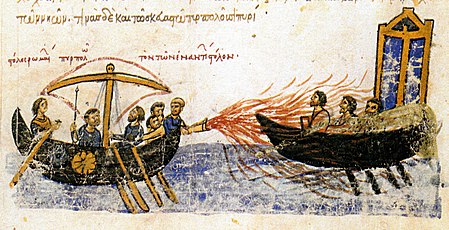
A Byzantine ship using Greek fire against a ship belonging to the rebel Thomas the Slav, 821. 12th century illustration from the Madrid Skylitzes. The tiny rudder of the ship controls its movement and “Greek fire” was a terrifying weapon that we still don’t completely understand; it seems to have been similar to napalm.

When we put bits into the mouths of horses to make them obey us, we can turn the whole animal. Or take ships as an example. Although they are so large and are driven by strong winds, they are steered by a very small rudder wherever the pilot wants to go. Likewise, the tongue is a small part of the body, but it makes great boasts. Consider what a great forest is set on fire by a small spark. The tongue also is a fire, a world of evil among the parts of the body. It corrupts the whole body, sets the whole course of one’s life on fire, and is itself set on fire by hell. (James 3:3-6)

The tongue was viewed throughout Church history as the key to a person’s inner life. Justin Martyr, Church Father and Apologist, wrote, “By examining the tongue of a patient, physicians find out the diseases of the body; philosophers find out the diseases of the mind; Christians find out the diseases of the soul.” Gossip and idle talk in 2nd Thessalonians mark the followers of the Antichrist, the sower of division and discord. Gossip and idle talk are among the deadliest of the “deadly sins;” if I can eliminate these from my life, I have become nearly perfect.

We can each see ourselves as a ship, directed by the rudder, spewing the medieval weapon of Greek fire at people we consider our enemies–or even our friends, if we are bored and want to hear the sound of our own voices. Greek fire was deadly and inextinguishable; the substance known as “wildfire” in Game of Thrones was based on Greek fire.

Too often we would rather say anything than endure a moment of silence. Or we are hungry for the attention that comes our way when we begin, “Did you hear about ….” We fast from noise, we fast from attention-seeking when we exercise control of our tongue. If there was a 12-step program for Gossipers Anonymous or Idle Talkers Anonymous, we could all sign up and attend the meetings.

St. Gregory of Nyssa thought that hate, envy, and hypocrisy–the three roots of most gossip–are the attitudes most opposed to real humanity. Inasmuch as we have surrendered to these attitudes, we have become subhuman and cannot hope to become the true human beings we were created to be so long as we harbor these attitudes.

We are given the fasting days of the Church to practice control of what comes out of our mouths (gossip) as well as what goes in (food). In the 1979 BCP of the United States, we are called to fast on most Fridays and the weekdays of Lent; in earlier editions of the BCP, there are also Ember Days, Rogation Days, and the eves of 16 major feasts that are considered fasting days.

Fire goes out without wood, and quarrels disappear when gossip stops. Proverbs 26:20     
Rahab the Prostitute

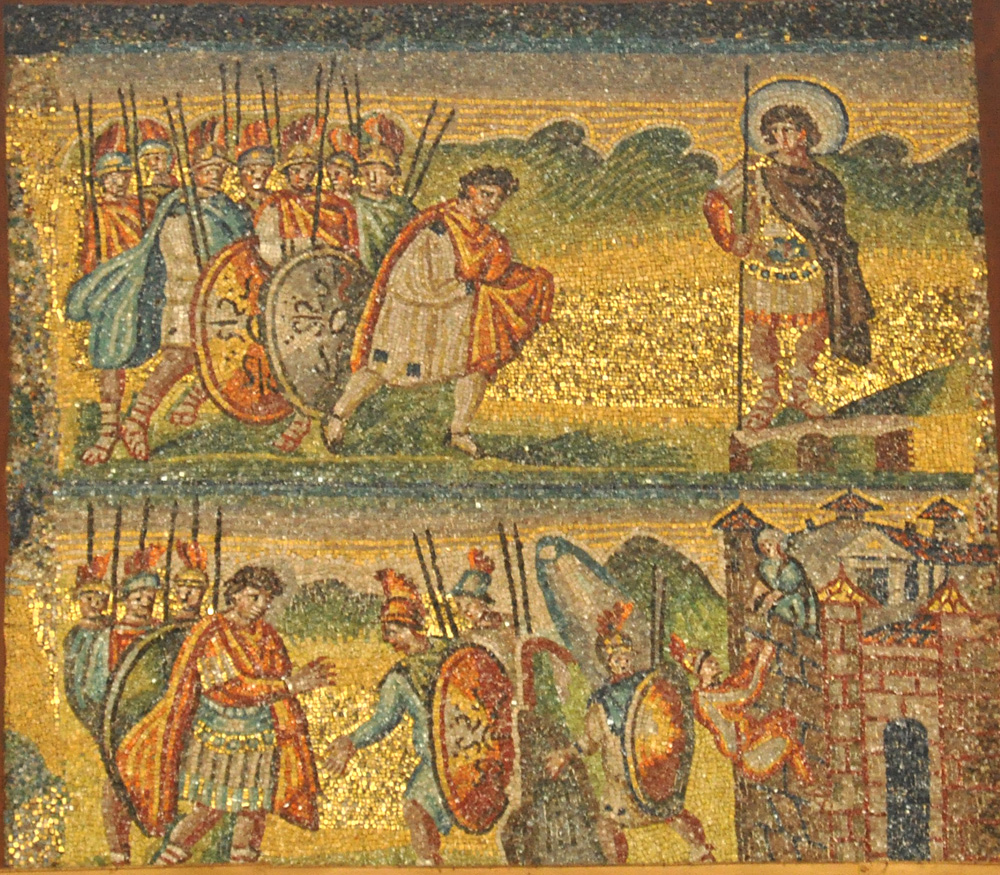
Rahab Helps the Spies; The Lord Appears as Captain of the Israelite Host in this 5th century Mosaic in the Nave, Basilica of Santa Maria Maggiore, Rome.

Likewise, was not Rahab the prostitute also justified by works when she welcomed the messengers and sent them out by another road? For just as the body without the spirit is dead, so faith without works is also dead. (James 2:25-26)

So, just who was this “Rahab, the prostitute” that the Apostle James is talking about in the same paragraph as the patriarch Abraham? These two figures from the Old Testament–Abraham and Rahab–are the two most important people that St. James can cite as examples of his point about the necessity of faith-works going together. Rahab must have been quite someone to rank up there with Abraham.

In the book of Joshua, chapters 2 and 6, we are told the story of the spies Joshua sends into the city of Jericho before the Hebrews attacked it. Rahab, a prostitute, hid the spies and made a deal: the Israelite army would spare her and her family when they attacked and massacred the city. Joshua agreed to this. After the city of Jericho was attacked and Rahab’s family spared, she is said to have become the great-great-grandmother of King David; thus, Rahab is an ancestor of Christ.

Although her status as a sex worker might make us think Rahab a person outside the Kingdom of God, it is her action based on her faith in the God of Israel which saves her–and the people of Israel and eventually the world as her bravery and foresight make the Incarnation possible. Her response to God is just as important as Abraham’s — both of them were necessary to save the world.

Early Christian teachers and preachers frequently mentioned Rahab as a woman who demonstrated many virtues (faith, hospitality, repentance) as well as a model for Christians living “in the world” and as a harbinger of salvation. Read more about these sermons here.

In the mosaic above, we see the visit of the “prince of the host of the Lord” to Joshua before the conquest of Jericho (Joshua 5:13-15). That he is an angel is indicated by a halo rather than wings, and his military garb expresses his role as leader of a host. In the text he has a “drawn sword,” but here it is a labarum such as the archangel Michael carries in Byzantine icons.

Seeing this person, Joshua “fell on his face to the ground.” In the mosaic we see only the beginning of this movement.

The lower register illustrated Joshua 2:1-21. Joshua on the left tells his two spies to reconnoiter in Jericho. On the right, the prostitute Rahab (wearing green and standing on the battlements of the city) helps them escape by climbing down the wall.

Religion Pure and Undefiled

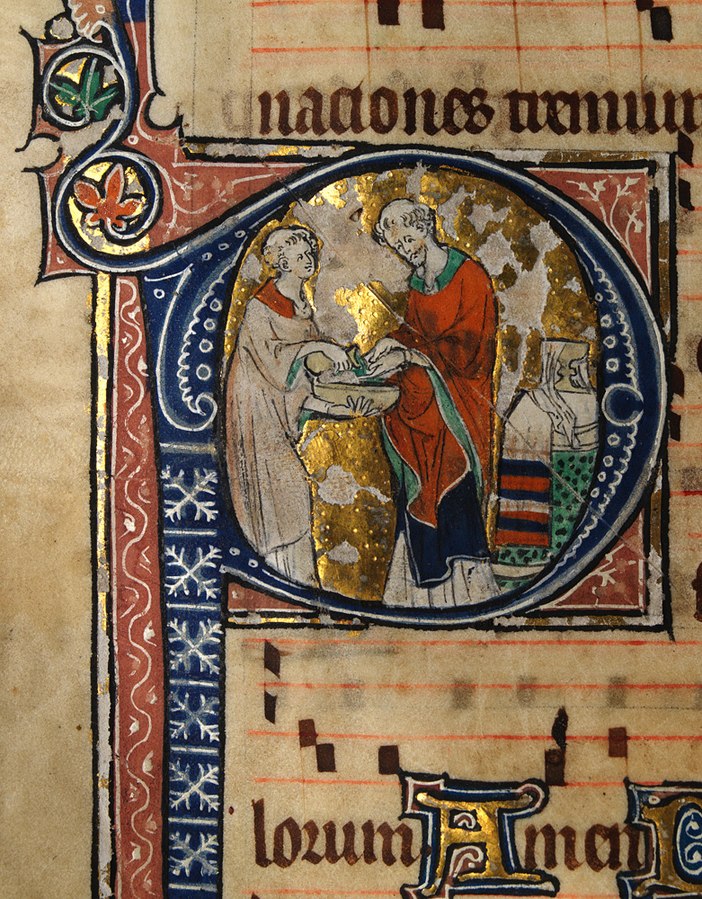
Priest washes his hands in English manuscript illumination AD 1310-1320

Pure and undefiled religion before God and the Father is this: to visit orphans and widows in their trouble and to keep oneself unspotted from the world. (James 1:27)

Widows were not just women whose husbands had died. A true widow was a woman whose husband had died and who had no other family—no brothers or sisters, no sons or daughters, no cousins or extended family—to whom she might turn for support. A real widow was a woman might reasonably have been expected to have someone who would be obligated to care for her but who, in fact, had no one in the world. She was totally alone. Bereft of resources. An elderly—or at least older—woman who had nothing. Among the non-Christians, these women were discarded and ignored by society.

Orphans were likewise those destitute children who had no one who could be expected by society to be obligated to care for them. Although an orphan’s mother might be deceased, the primary definition of “orphan” was a child—or children—whose father was deceased and who had no uncles or aunts or grandparents or cousins who would typically be expected to take in the fatherless. Anyone who showed any interest in such a child was probably mostly interested in taking in someone who could serve as free labor in the household.

Such destitute people—true orphans, true widows—were in dire circumstances because there was absolutely no expectation or encouragement of charity in Greek or Roman society.

Widows and orphans were referred to as “the altar of God” because they were supported by the offerings of the people and because the widows made intercession for the Church and the larger society. In these first few generations and early centuries of the Church, it was unthinkable that someone could attend the Eucharist and NOT make some small offering if they expected to receive Holy Communion. Receiving Communion went hand-in-hand with making an offering; one was impossible without the other. So what could the baptized orphans do? We know that in some places, the orphans—homeless children completely dependent on the parish for their survival—were responsible for bringing the clean water to be mixed with the wine in the chalice.

This clean water would not only be used to mix with the wine in the chalice. It would be used to wash the hands of the celebrating priest or bishop at the altar (at the conclusion of the offertory) as well as any assisting deacons or concelebrating priests (before receiving Holy Communion themselves). No one thought the priests came to church with dirty hands; the handwashing was an outward portrayal of an inner disposition of spiritual cleanliness and purity.

(For centuries, before all the changes of the 1960s-1970s, the priest would quietly recite verses from Psalm 26 during the handwashing: “I will wash my hands in innocence, O Lord, that I may go in procession ‘round your altar, singing aloud a song of thanksgiving and recounting all your wonderful deeds,” clearly a reference to the upcoming Eucharistic Prayer.)

Such iconographic handwashing was not limited to the clergy. All Christians would wash their hands—some would splash their faces as well—with water before they prayed at home or entered a church building. The house churches of the first generations of Christians had a fountain in the courtyard which would be used by people coming to church there; many Christians still perform a stylized version of this washing when they enter a church by crossing themselves with blessed water, the small basins beside the church doors tiny versions of the fountains that used to be in the courtyards of the Roman villas used as churches.

No one thought—or thinks—that people are coming to church with dirty hands. The washing always was—and still is—an iconographic act, an outward portrayal of that inward disposition of being clean from spiritual defilement, being free of worthless—fake—religion.

When we come to the Eucharist, we have to bring something to offer—whether it is as elaborate as our fulltime professional prayers or as simple as a flagon of clean water. As one aspect of our offering, we need to be caring for the destitute in their distress—doing something, enacting true religion that is pure and undefiled.