Law of Liberty

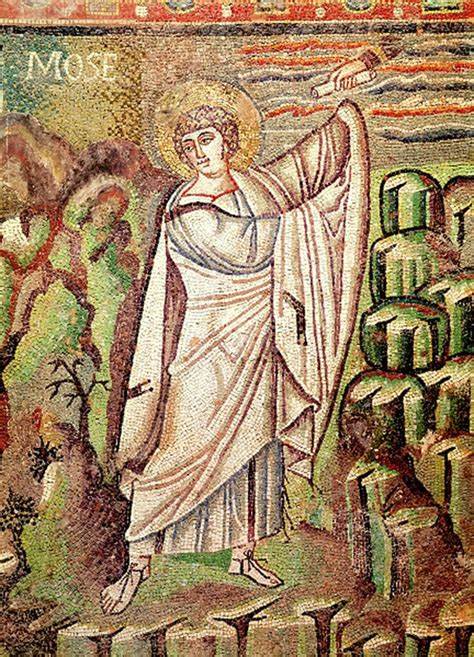
A Byzantine mosaic depicts Moses receiving the Law on Mt. Sinai. Unlike the two tablets of stone usually depicted–as when Charlton Heston played Moses in the “Ten Commandments”–the Torah is depicted as a scroll here which the Lord is handing to Moses. Moses covers his hands with his cloak to protect them as he receives the scroll; directly touching such a holy object that is given directly by God could incinerate his hands if he does not protect them.

Anyone who listens to the word but does not do what it says is like someone who looks at his face in a mirror and, after looking at himself, goes away and immediately forgets what he looks like. But whoever looks intently into the perfect law that gives freedom, and continues in it—not forgetting what they have heard, but doing it—they will be blessed in what they do. (James 1:23-25)

The “law of liberty,” the perfect law that gives freedom, sounds like a contradiction in terms, right? What law gives liberty and freedom? This law seems to be like a mirror: look into it, see yourself, and then go away and act on what you have seen-realized by gazing. Is this how normal life works?

Although Moses led the people to freedom through the Red Sea, that freedom was not meant for wild parties and living high-on-the-hog, without responsibilities or duties. The freedom of Passover is fulfilled in obedience to the Law given on Mt. Sinai at Pentecost; likewise, the Resurrection of Christ is consummated by the giving of the Spirit on Pentecost–the freedom of new life is sealed by obedience. Freedom is given to the human race so that we can choose to heed the Word of God.

That’s what the “law that gives freedom” is for: by embracing it, we give ourselves to the one who liberates us from Death and are free to love; love is the summary of all the rules and all the laws ever given. Slaves cannot and do not love. Only the free can choose to love. By loving, we commit ourselves to caring. By caring, we commit ourselves to putting someone else’s needs before our own. By putting someone else’s needs before our own, we curtail our options but are able to find fulfillment in what we do, seeing the face of God in those we are committed to.

James, a Servant of God

An icon of the 17th century depicts James as a young boy travelling to Egypt with his father Joseph and his stepbrother Jesus together with the Blessed Virgin, Jesus’ mother. The icon of James as an adult shows him vested as the 1st bishop of Jerusalem. The scroll he holds reads, “O Lord, who blesses those who bless thee….” which is one of the last prayers of the Divine Liturgy of the Orthodox Church.

James, a servant of God and of the Lord Jesus Christ, To the twelve tribes in the Dispersion: Greeting! Count it all joy, my brethren, when you meet various trials,  for you know that the testing of your faith produces steadfastness. And let steadfastness have its full effect, that you may be perfect and complete, lacking in nothing. (James 1:1-4)

The epistle of James is probably the first of the New Testament texts to be written. If 1 & 2 Thessalonians were the first epistles written by the Apostle Paul (AD 51-52), the epistle of James (written AD 45) predates the Apostle Paul by 5+ years. Traditionally attributed to “James the Just,” the son of Joseph by his first wife and the stepbrother of Jesus, the epistle that bears his name is more an extended sermon-homily than it is a letter. (This makes it similar to the Epistle to the Hebrews, which is also an extended sermon-commentary rather than a letter per se.)

James, the “brother of the Lord” as he is commonly referred to because they were stepbrothers, was not a believer (John 7:3-5) until after the resurrection (Acts 1:141 Corinthians 15:7Galatians 1:19). (He was the youngest of Joseph’s children and was a pre-teen when Joseph wed the Virgin Mary. Because James was still living at home with his father and the Virgin, he went down to Egypt with the Holy Family when they fled from Herod after the visit of the Magi described in Matthew 2.) He became the head of the Jerusalem church and is mentioned first as a pillar of the church (Galatians 2:9). He presided at the first council of the Church, held at Jerusalem in AD 50. James was martyred in approximately AD 62, according to the historian Josephus. (Apart from a handful of references in the synoptic Gospels, the main sources for the life of James the Just are the Pauline epistles, the Acts of theApostlesJosephusEusebius and Jerome, who also quote the early Christian chronicler Hegesippus and Epiphanius.)

Some think that this epistle was written in response to an overzealous interpretation of Paul’s teaching regarding faith. This extreme view, called “antinomianism,” held that anyone who has faith in Christ is completely free from all rules, whether religious law or secular law, and all the usual moral rules of a society.

As the earliest written description of Christian beliefs and practices, the epistle of James deserves more attention than it generally receives. It shows us not only what the early Church taught but continues to illuminate our path today.

Apocalypse Epilogue: The Tree of Life

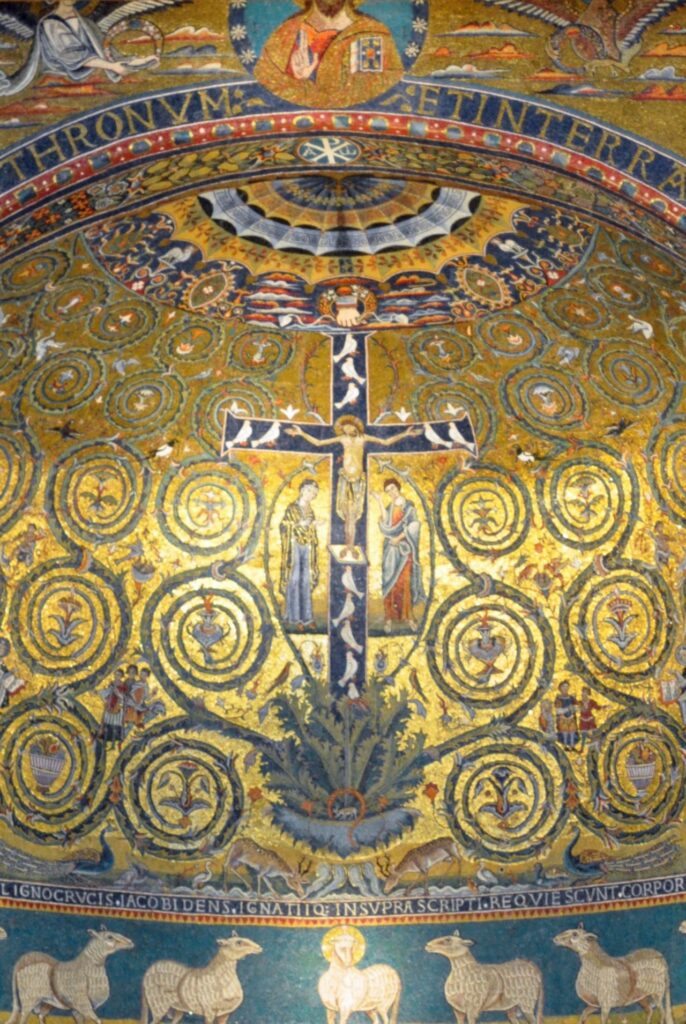
One of the best-known representations of the Cross as the ‘Tree of Life’ is the 12th century mosaic in the Basilica of San Clemente, Rome
The cross is decorated with white doves, taken to represent the Apostles who will soon fly to all corners of the world carrying the message of Christ’s victory (Psalm 19:4; Acts 1:8).
At the foot of the Cross four rivers flow out  (Genesis 2:10) and two deer drink deeply of the river of the water of life (Ezekiel 47:1-12; Revelation 22:1-2); the deer that yearns for running streams (Psalm 42:1-3) quenches its thirst  at the fountain of living water that is Christ (Zechariah 12:10; 13:1; John 4:10; 7:37-39; 19:33-37).

Blessed are those who wash their robes, so as to have the right of the tree of life, and may enter the city by the gates. Outside are the dogs, sorcerers, and fornicators, the murderers and idolators, and all who love and practice deceit. (Apocalypse 22:14-15)

This epilogue of the Apocalypse summarizes the message of the book: Christ is coming soon to judge the world and vindicate his saints. The text concludes with the usual threats against anyone who would tamper with the book as the seer has written or dictated it.

Those who wash their robes (in the blood of the lamb) and have access to the tree of life are the faithful members of the Church. They remain faithful despite the persecution described throughout the Apocalypse. The “tree of life” is both a reference to the Cross and Christ himself who transformed the Cross into the antidote for the Tree of Knowledge by which Adam and Eve sinned in Eden. Blood, which typically stains clothing, here washes clothing clean; in the Old Testament, blood both purifies (the sacrifices in the Temple, especially the Day of Atonement) and makes those who touch it unclean.

The list of those “outside the gates” of the New Jerusalem are an interesting summary of all those who personify opposition to God. “Dogs” were a common nickname for the priests of the Cybele, the “great mother” goddess; these “dogs” would castrate themselves in a fit of ecstasy and then wander the streets in groups, singing and praying and asking for alms. In many ways, they sound like the first century equivalent of the Hare Krishna groups that were so common in the 1970s (except the self-castration, of course).

Sorcerers practiced “magic,” which was the usual way to describe illicit religious practices. “Fornicators” practiced porneia (lit. “dirty living”), which included fornication but also could mean a wide variety of other behavior or activities, not all of which we would consider sexual. But it was a quick and easy way to refer to those who misbehaved sexually. Murderers and idolators clearly misapprehended the image of God inherent in each human person. All those who love or practice deceit? That sums up all evil-doing nicely, doesn’t it?

The world is neatly divided into those who have washed their robes vs. those who love and practice deceit. If only life situations and predicaments pre-apocalypse could be so clearly and easily identified!