
Mother’s Day in Mid-Lent

red  roses

Remember the smudges on the foreheads of so many people on the streets of Manhattan back on Ash Wednesday? I don’t think I’ve ever seen so many “Ashes-to-Go” stations out on the streets and corners of the city before. (One woman stopped me on a street in front of a church in the West Village which hadn’t opened yet and asked if I knew where she could get ashes. Luckily, I had just passed one such “ashes-to-go” station close by and was able to direct her to the corner of West 13th Street and Seventh Avenue to receive her annual reminder “that [we] are dust and unto dust shall [we] return.”)

How many promises to foster better habits and resolutions to give up something detrimental have fallen by the wayside now that we are approaching the mid-point of Lent? One custom associated with mid-Lent that will surprise most North Americans is that the Sunday which marks mid-Lent (this year it’s March 15) was traditionally treated like “Mother’s Day” in medieval Europe — and still is in the UK! On this mid-Lent Sunday, grown children would be expected to visit with and give roses to their mothers. (In connection with this, the Pope would often send a golden rose to a monarch who had been especially supportive of the Church during the past year. Henry VIII received such a golden rose, shortly before his break with the papacy over his divorce of Catherine of Aragon.)

The liturgical texts for this Sunday spoke of the heavenly Jerusalem as the mother of all believers. Fasting and ascetic disciplines were relaxed on this day and rose-colored vestments were worn instead of the purple vestments worn on the other days of Lent. Following this brief “vacation” from Lent, the festivity of this “Mothering Sunday,” fasting and discipline could be taken up again. It was an opportunity to try again at keeping lenten resolutions that had perhaps already fallen by the wayside.

It’s still a good day to get back to whatever good intentions we may have started Lent with — giving up a bad habit, exercising more self-control over a problematic area of our lives — as well follow J.K. Simmons’ advice at this year’s Oscars ceremony: “Call your mom, call your dad. If you’re lucky enough to have a parent or two alive on this planet, call ‘em. Don’t text. Don’t email. Call them on the phone. Tell ‘em you love ‘em, and thank them, and listen to them for as long as they want to talk to you.”
Nimrod

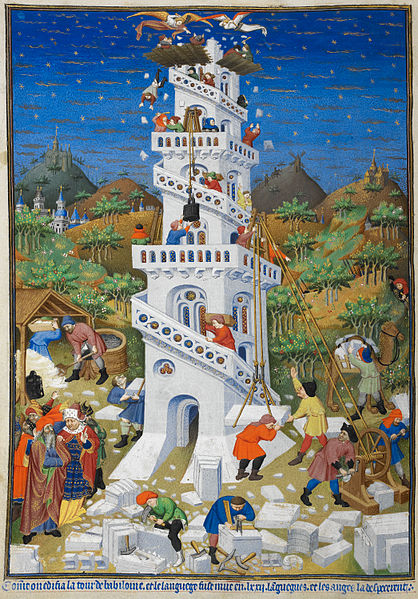
Building of the Tower of Babel, manuscript illumination from approx. 1410 (British Library Add MS 18850 f17v)

Building of the Tower of Babel, manuscript illumination from approx. 1410 (British Library Add MS 18850 f17v)

The constellation Orion, also identified in some folkloric traditions as Nimrod, is seen most clearly in the night skies of the northern hemisphere from January-March each year. Also, with the approach of Ash Wednesday and the beginning of Lent, Nimrod appears in classical Christian hymnography and sermons as one of the archetypal images of opposition and rebellion against God.

In Hebrew and Christian tradition, Nimrod is considered the leader of those who built the Tower of Babel in the land of Shinar, though the Bible never actually states this. (The illumination above shows Nimrod supervising the construction of the Tower of Babel in the lower left corner.) Nimrod’s kingdom included the cities of Babel, Erech, Accad, and Calneh, all in Shinar. (Genesis 10:10) Therefore it was likely under his direction that the building of Babel and its tower began; in addition to Flavius Josephus, this is also the view found in the Talmud and later midrash such as Genesis Rabba. Several of these early Judaic sources also assert that the king Amraphel, who wars with Abraham later in Genesis, is none other than Nimrod himself.

Judaic interpreters as early as Philo and Yochanan ben Zakai (1st century AD) interpreted “a mighty hunter before the Lord” (Heb. : לפני יהוה, lit. “in the face of the Lord”) as signifying “in opposition to the Lord.” Some rabbinic commentators have also connected the name Nimrod with a Hebrew word meaning ‘rebel’.

The historian Josephus wrote:

Now it was Nimrod who excited them to such an affront and contempt of God. He was the grandson of Ham, the son of Noah, a bold man, and of great strength of hand. He persuaded them not to ascribe it to God, as if it were through his means they were happy, but to believe that it was their own courage which procured that happiness. He also gradually changed the government into tyranny, seeing no other way of turning men from the fear of God, but to bring them into a constant dependence on his power. He also said he would be revenged on God, if he should have a mind to drown the world again; for that he would build a tower too high for the waters to reach. And that he would avenge himself on God for destroying their forefathers.

Now the multitude were very ready to follow the determination of Nimrod, and to esteem it a piece of cowardice to submit to God; and they built a tower, neither sparing any pains, nor being in any degree negligent about the work: and, by reason of the multitude of hands employed in it, it grew very high, sooner than any one could expect; but the thickness of it was so great, and it was so strongly built, that thereby its great height seemed, upon the view, to be less than it really was. It was built of burnt brick, cemented together with mortar, made of bitumen, that it might not be liable to admit water. When God saw that they acted so madly, he did not resolve to destroy them utterly, since they were not grown wiser by the destruction of the former sinners; but he caused a tumult among them, by producing in them diverse languages, and causing that, through the multitude of those languages, they should not be able to understand one another. The place wherein they built the tower is now called Babylon, because of the confusion of that language which they readily understood before; for the Hebrews mean by the word Babel, confusion …

Nimrod, the great hunter, is also said to hunt the newborn Abraham and attempt to slay him, much as Herod slew the infant boys of Bethlehem in an attempt to slay the infant Christ. Nimrod has thus remained in both Jewish and Islamic tradition an emblematic evil person, an archetype of an idolater and a tyrannical king, and often called “Nimrod the Evil.”

“Love is a Many Splendored Thing!”

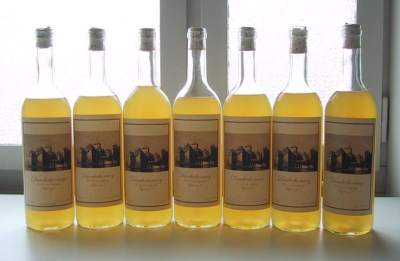
It was a Norse custom to give a newlywed couple enough mead (i.e. honey wine) to last for a month. Hence, our term "honeymoon" ti describe the first weeks of marriage.

It was a Norse custom to give a newlywed couple enough mead (i.e. honey wine) to last for a month. Hence, our term “honeymoon” ti describe the first weeks of marriage.


Collecting the honey to make mead or use to preserve/sweeten food.

With the modern celebration of Valentine’s Day nearly upon us, can thoughts of love magic be far behind? A number of traditional ways to win another’s heart have been used over the years. One way a woman could win a man’s heart was by feeding him food into which she had mixed some of her own blood (menstrual blood was especially effective). Catching the reflection of mating birds in a mirror on Thursday was the first step in a more complicated love spell. After catching the reflection, a person would give the mirror to his or her chosen and once the receiver looked into the mirror, they would be irresistibly infatuated with the mirror-giver. Or a woman might resort to the much more simple use of caraway seeds, cloves, or coriander to win the affection of the man she had chosen. One English love potion included the kidney of a rabbit, the womb of a swallow, and the heart of a dove while an ancient Greek love potion used a stallion’s semen or a mare’s vaginal discharge.

Garlic, saffron, ginger, or even vanilla(!) were more likely to be used in erotic magic, which was less concerned with affection, and more likely to be aimed by men at women. Wax images could be pierced by pins to incite lust. Striking the intended with hazel or willow branches was also thought to inspire lust. Or you could obtain a few hairs from your intended’s head, tie them in a knot with twine, and then keep the amulet on your thigh or around your genitals to draw your intended’s attentions.

Of course, there were ways to deflect this sort of magic as well. Lily or lettuce could break love spells or decrease lust and thwart unwanted attentions. Just be sure not to confuse which herbs you feed to which guest at your table!