A great podcast with fascinating episodes–especially the episode about the acoustics of Hagia Sophia and the experience of singing the Divine Liturgy there. Anthony, the host, recently interviewed me about When Brothers Dwell in Unity: Byzantine Christianity and Homosexuality (McFarland, 2016). Listen to the interview here.
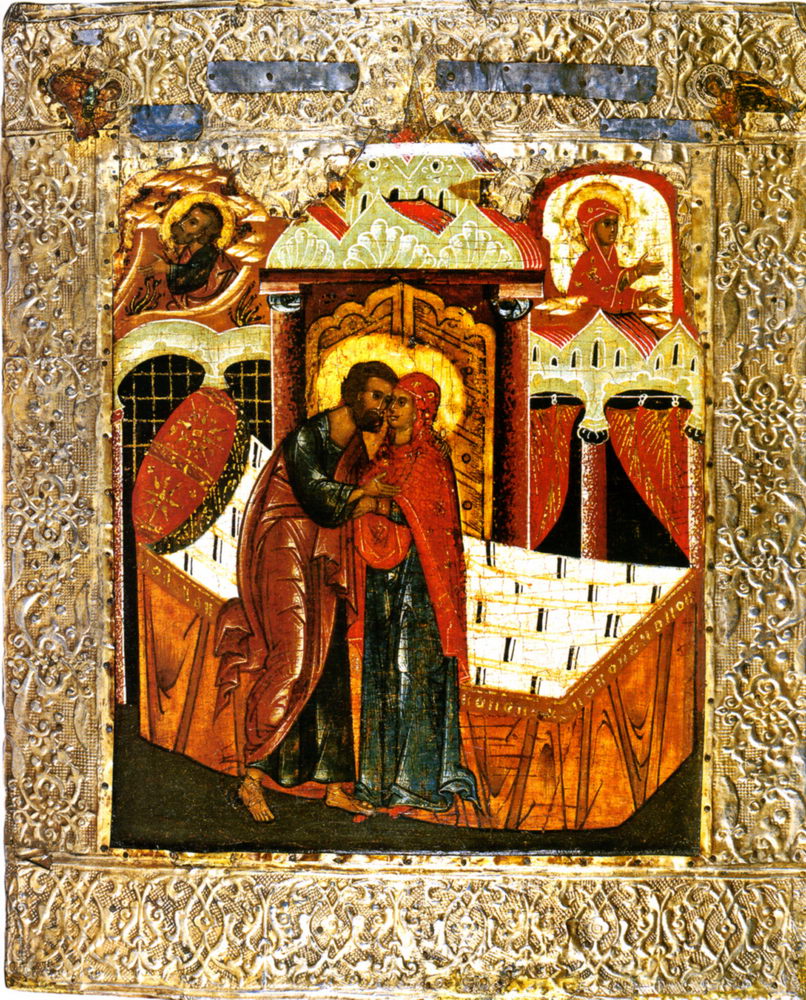
In this 16th century icon of the Conception of the Mother of God, SS. Joachim and Anna tenderly embrace, standing before a bed. Without being explicit, it tells us that the conception of St. Mary happened through natural means. (In the corners of the icon, Joachim and Anna are shown separately. According to the Protoevangelium, in his grief Joachim retired to the desert in fasting and prayer for forty days, while Anna remained lamenting at home. An angel was sent to each of them to announce that their entreaties had been heard by God and that they should return to each other to conceive; the main scene shows the happy meeting.)
The Conception of the Mother of God by Saint Anna is commemorated by the Orthodox Church on December 9 while the Western Church celebrates on December 8. St. Anna, the mother of the Virgin Mary, was the youngest daughter of the priest Nathan from Bethlehem, descended from the tribe of Levi. She married St. Joachim, who was a native of Galilee. For many years, St. Anna was childless and the couple suffered much reproach for her barrenness. When they were in Jerusalem to offer sacrifice to God, the High Priest, Issachar, upbraided Joachim, “You are not worthy to offer sacrifice with those childless hands.” Both spouses gave themselves to fervent prayer, and the Archangel Gabriel announced to them separately that they would be the parents of a daughter who would bring blessings to the whole human race.
The Orthodox Church does not
accept the teaching of the Immaculate Conception,
but has also always believed that the Virgin Mary was, from her conception,
filled with every Grace of the Holy Spirit in view of her calling as the Mother
of Christ our God. The Immaculate Conception is a Western
Christian teaching which asserts
that Mary, the mother of Jesus, was preserved by God from the transmission of original sin at the
time of her own conception. Specifically the doctrine says she was not
afflicted by the privation of sanctifying grace which afflicts mankind, but was instead
filled with grace by God, and furthermore lived a life completely free from
sin. It is commonly confused with
the doctrine of the virginal conception of Christ, though the two doctrines
deal with separate subjects.
The feast is not exactly nine
months before the feast of the Nativity
of the Theotokos (September 8) as it is in the West, but one day
later. Many have taught this is to show that God alone is perfect.
An icon of St. Nicholas with scenes from his life around the edge. Christ and the Mother of God are shown returning his vestments to him, based on a dream-vision he had while he was in prison, deprived of serving his flock because the emperor disagreed with his theology.
St. Nicholas was a bishop in 4th-century
Turkey but is commonly known as “Santa Claus” in much of the Western World. He
brings gifts to good children on his feast day (December 6) or on Christmas
Day; in some places, he is said to take away bad children in his empty gift
bag. He is sometimes accompanied by a servant or devil who takes away the bad
children or leaves switches for their parents to beat them.
His tomb is in Myra (a small town
in modern Turkey) but many of the remains were stolen by Italian sailors and
taken to Bari in 1087. The sailors
from Bari only took the main bones of Nicholas’s skeleton, leaving all the
minor fragments in the grave. The city of Venice had interest in
obtaining the remaining fragments of his skeleton and, in 1100, a fleet
of Venetian ships sailed past Myra on their way to Palestine for the First Crusade. The Venetians took the remaining bones of
Saint Nicholas, and brought them to Venice. This story was lent credence in two scientific
investigations of the relics in Bari and Venice, which confirmed that the
relics in the two cities are anatomically compatible and may belong to the same
person.
In
the late 1950s, while the crypt was undergoing much-needed restoration, the bones were
removed from it for the first time since their interment in 1089. A
special Pontifical Commission permitted Luigi Martino, a professor of human
anatomy at the University of Bari, to examine the bones under the Commission’s supervision.
Martino took thousands of measurements, detailed scientific drawings,
photographs, and x-rays. These examinations revealed the saint to have
died at over seventy years of age and to have been of average height and
slender-to-average build. He also suffered from severe chronic arthritis
in his spine and pelvis.
Another
test in 2017 in Oxford involved radiocarbon dating, which confirmed that the bones
date to the fourth century AD, around the same time that Saint Nicholas would
have died, and are not a medieval forgery.