New Jerusalem

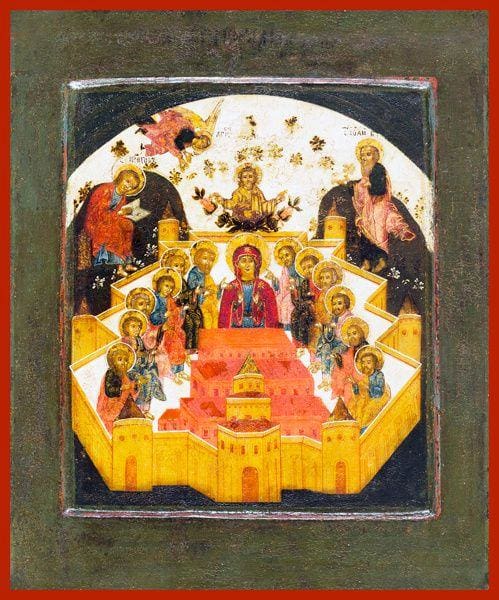
A Russian icon of the New Jerusalem, showing the apostles–the Twelve–surrounding the Mother of God in the midst of the city. She is the personification of Zion-Jerusalem-the Temple. Christ is immediately above the Holy Virgin, blessing the world. St. John the Divine is dictating to his disciple-secretary, who is writing down what St. John sees and the words of the angel speaking with him.

So [the angel] carried me away in the spirit … and showed me the holy city Jerusalem coming down out of heaven from God, possessing the glory of God. It had the radiance of a precious jewel…. (Apoc. 21:10-11)

The new heaven and the new earth are complete when the new Jerusalem descends from God. The city is described as being in a constant state of descending; it is always “coming down.” It is not static. It is always arriving. This movement indicates the city itself is alive. It is itself the Temple of the new heaven and new earth and therefore encapsulates the new creation which is intensely alive, just as the Temple built by Solomon was thought to encapsulate the world–the old world which, although it was currently alive, was always in the process of dying. The new Jerusalem is always coming down, always new, always becoming.

The new city has twelve foundation stones. Each is a precious jewel. These twelve stones are associated with the apostles, the Twelve; in Ephesians we read about the Church “built on the foundation of the apostles and prophets, Christ Jesus being himself the chief cornerstone.” (Eph. 2:20) If Peter is the rock (Matt. 16:17-19), the Twelve are the foundation.

The new city has twelve gates. Each gate is fashioned from pearl. Pearls in the ancient world were thought to be the result of lightning striking an oyster; the translucent pearl was born of fire and water, uniting these two opposite elements.

In Genesis 2, we are told that gold and jewels were found near the river Pishon. Often translated as “aromatic resin” or “pearls,” as well as “carbuncle” (a generic term meaning “a small, precious stone”), this is generally understood to refer to frankincense. (Frankincense was a particular resin/incense whose import and sale was a monopoly of the Franks in early medieval Europe, hence “the Frank’s incense.”) The resin was obtained by scoring—making slices in—the bark of certain trees. Sap would ooze from these wounds in the bark and congeal into the resin which would be scraped away and then these chunks of resin would be broken up to be used as incense. When the resin is sprinkled on hot charcoal, it melts and releases the fragrant smoke. The resins from various sorts of trees would produce a variety of fragrances which could be combined in different mixtures; myrrh, an especially bitter scent, was obtained in the same manner as frankincense but from another species of tree.

The particles of frankincense are customarily referred to as “pearls,” so that identifying Havilah–the land watered by the river Pishon–as the source of both frankincense and pearls is not necessarily a contradiction. There is also the later medieval Christian association of the round, white host at the Mass as a “pearl” as well as the eastern Christian practice of referring to the communion-particle as a “coal” (similar to the coal used by the seraphim to touch Isaiah’s lips to purify the prophet).

The jewels, pearls, and incense associated with the new city underscore its role as the temple of the new creation, the house of God in which the sacrificial worship of the Lamb is consummated.

There is a “New Jerusalem” monastery in Russia, built directly north of Jerusalem and an exact imitation of the church of the Holy Sepulchre for pilgrims who could not travel to the Middle East. It was closed by the communists and heavily damaged by the Nazis. I saw it in the early 1990s when it was still in ruins before the current restoration began.
New Heaven and New Earth

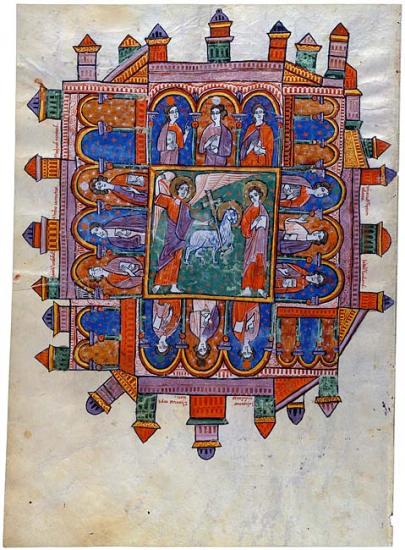
Beatus of Liébana
Las Huelgas Apocalypse
Spain
1220

Then I saw a new heaven and a new earth, for the first heaven and the first earth had passed away, and the sea was no more. I saw the holy city, new Jerusalem, coming down out of heaven from God, made ready like a bride adorned for her husband. (Apocalypse 20:1-2)

St. John has seen Hell and Satan bound with Death. Now he sees a new world emerge, clean and free of all stain. It is all that Isaiah hoped for: “Behold, I create new heavens and new earth” (Is. 65:17 and 66:2). It is everything that Enoch described: “The first heaven shall depart and pass away; a new heaven shall appear” (1 Enoch 91:16).

Some say that “there was no more sea” because the sea is the primaeval abyss, the chaos out of which matter emerged and there is no more chaos when judgement is complete. Some readers point out that seven markers of the fallen world are “no more” in the concluding chapters of the Apocalypse: the sea, death, mourning, crying, pain, every accursed thing, night. In the City of God, St. Augustine favors the idea that “the sea” is a euphemism for Death–cold, dark, deep, where a crowd can still be a vast collection of individuals in isolation. It is this Death that is no more in the new world adorned like a bride for her bridegroom and so the sea is “no more.”

In the Old Testament, the city Jerusalem is both a mourning virgin and a glorious bride. Now the time of her mourning has passed and her final victory and beauty are revealed. The bride of the Song of Songs takes her place alongside her heavenly bridegroom; during the Middle Ages, most sermons about the Song were also sermons about the Apocalypse and most sermons about the APocalypse were also sermons about the Song. The two texts go hand-in-hand. The Old Testament dreams of her glory and her dazzling garments are commonly read in church at Epiphany and Holy Saturday: the two days that most clearly anticipate the coming End and ultimate triumph of God.

Epiphany (the revelation of God’s glory in the darkness, the baptism of Christ when he descends into the water to slay the dragons hidden there as a dress rehearsal of his Passion) and Holy Saturday (Christ’s descent into the dark land of the dead–the sea mentioned earlier–to shatter the darkness with light and break the chains of those in prison there) are reflections in time of the eternal reality that is now revealed at the conclusion of the Apocalypse.

Epiphany. Holy Saturday. The conclusion of the Apocalypse. Jerusalem is adorned like a bride for her groom, the old context and environment of death and sin being swept away as the new context and environment of God’s glory is hidden no longer but emerges clearly for all to see.

Satan Bound for 1,000 Years

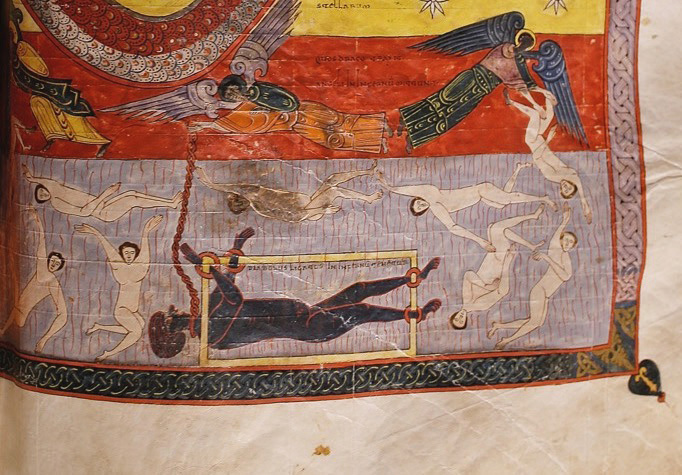
Satan chained and bound by the angel (Beatus Apocalypse illumination). Medieval illuminations often depict Satan as an African Muslim, similar to the Moors who invaded Spain; the Moors personify the Enemy, the Other.

Then I saw an angel coming down from heaven with the key of the abyss and a great chain in his hand. He seized the dragon, that ancient serpent who is Devil and the Satan, and bound him for a thousand years…. When the thousand years are ended, Satan will be let loose from his prison. (Apocalypse 20:1-2, 7)

Satan is bound in prison for 1,000 years. This period of 1,000 years is taken by most early interpreters to mean the entire period of human history from the Crucifixion to the Last Days. Satan is bound in chains by Christ but not totally incapacitated–his minions still tempt and harass the human race. St. John describes each Christian’s victory over Satan, usually by martyrdom, as the “first resurrection;” the “second resurrection” is the General Resurrection of all the dead on Judgement Day.

Satan is loosed at the end of human history not so that he can unleash his anger any more against the human race; he is loosed so that he can be finally and definitively be cast down. Many early preachers used the image of a chicken or a snake beheaded to describe Satan: slain by Christ on the Cross, yet still able to make a mess and scare humans by spewing blood from the fatal wound but seeming to still be alive, running around–“like a chicken with its head cut off!”–or wriggling about.

Satan is often described or painted as having dark or black skin; often, a devil is described as looking like “an Ethiopian” by early Christian monks. Having black skin is not necessarily a dishonor in the Old Testament; the bride in the Song of Songs is “dark and beautiful.” Neither is appearing dark always associated with evil by other cultures: Clare Rothschild points out that “the Nile received its name from the Greek word νεῖλος (‘valley’). Since the river deposits black sediment after it floods, the Egyptians called the river ‘Ar’ (‘black’)…. Black is used of Egyptian gods and goddesses as an honorific: kmwr = ‘Great Black One’ for Osiris and km as epithet used with the name of the god (e.g. Hathor, Apis, Min, Thoth, etc.) or kmt, goddess (e.g. Isis)….” But the “counter-divine” is described as black by Sophocles.

Rothschild suggests that the devils and Satan were associated with Ethiopia because Ethiopia was outside Roman-Byzantine imperial control and was therefore associated with lawlessness. Several church fathers use the illustration that all humans were once Ethiopians (lawless) but have now been brought from lawlessness to righteousness by Christ. Pamela Patton suggests that medieval Spanish interpretations of the Apocalypse–such as the Beatus Apocalypse illumination above–align Satan and Ethiopians as a way to equate Satan with the Moors who invaded the Iberian peninsula and personified the Other, the Enemy.

Rothschild points out many fascinating associations with the color black that might also have influenced the depiction of Satan.