A Rider Faithful and True

The rider Faithful and True on his white horse in the Tolkovy Apocalypse (Moscow, early 17th century).

And I saw Heaven wide open, and behold, a white horse; its rider’s name was Faithful and True and in righteousness he judges and makes war…. he was clothed in a cloak dipped in blood , and he was called the Word of God. (Apoc. 19:11, 13)

Christ, the Word of God, rides into battle and emerges victorious. The Word of God, the Logos, is the divine blueprint for the universe while the Wisdom of God is the practical application of that blueprint.

The New Testament tells us that the Word was made flesh (John 1:14) and the Old Testament tells us that Wisdom leaped down from the heavenly throne in the middle of the night to save the Hebrews in Egypt. This image of Wisdom coming to earth at midnight (Wisdom 18) to slay the enemies of Israel was first used by the Church to describe Christ’s descent into Hell and his Resurrection during the night between Holy Saturday and Easter morning but then the image of Wisdom’s descent to earth at midnight also suggested the birth of Christ at Bethlehem and eventually resulted in our celebrations of “Midnight Mass” on Christmas Eve.

The Word was made flesh. Wisdom came to earth. To say that “Wisdom built herself a house” on earth is the poetic equivalent of saying “The Word was made flesh and dwelt among us.” (Pope St. Leo the Great, Tome 2) The victory of the Word over the enemies of God is the victory of Wisdom over the enemies of God.

Christ is the Wisdom of God made flesh but because Wisdom—“Sophia” as she is identified in the oldest manuscripts of Proverbs—is a woman’s name, Wisdom has also been considered an allusion to Christ’s most pure Mother, the ever-blessed Virgin Mary. The victory of the Word-Wisdom is also the victory of the Mother of God, the Second Eve, treading on the head of the serpent that overcame the first Eve. Our Lady of Victory, although a feast to commemorate a victory over the Turks, is also an allusion to the victorious Mother of God who shares in the victory of her Son. She makes her Son’s victory possible by giving him flesh in her womb.
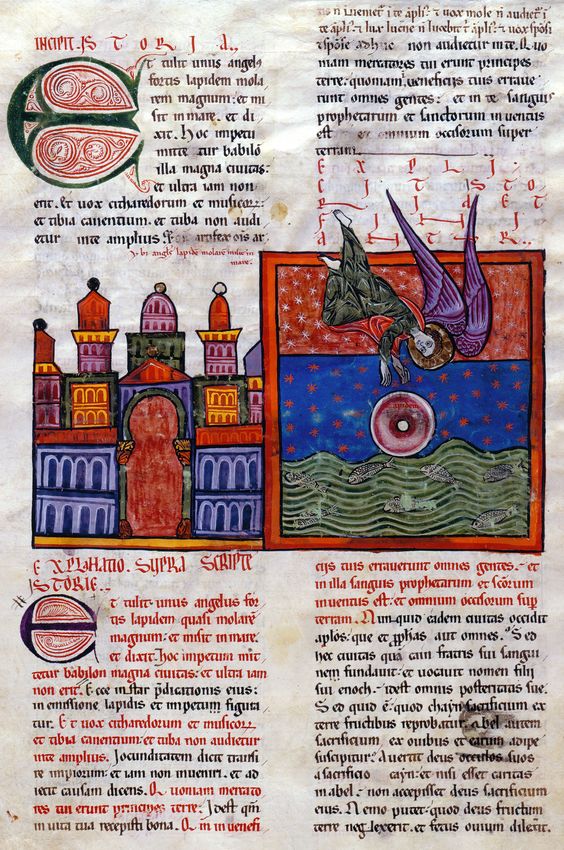
Fallen is Babylon the Great

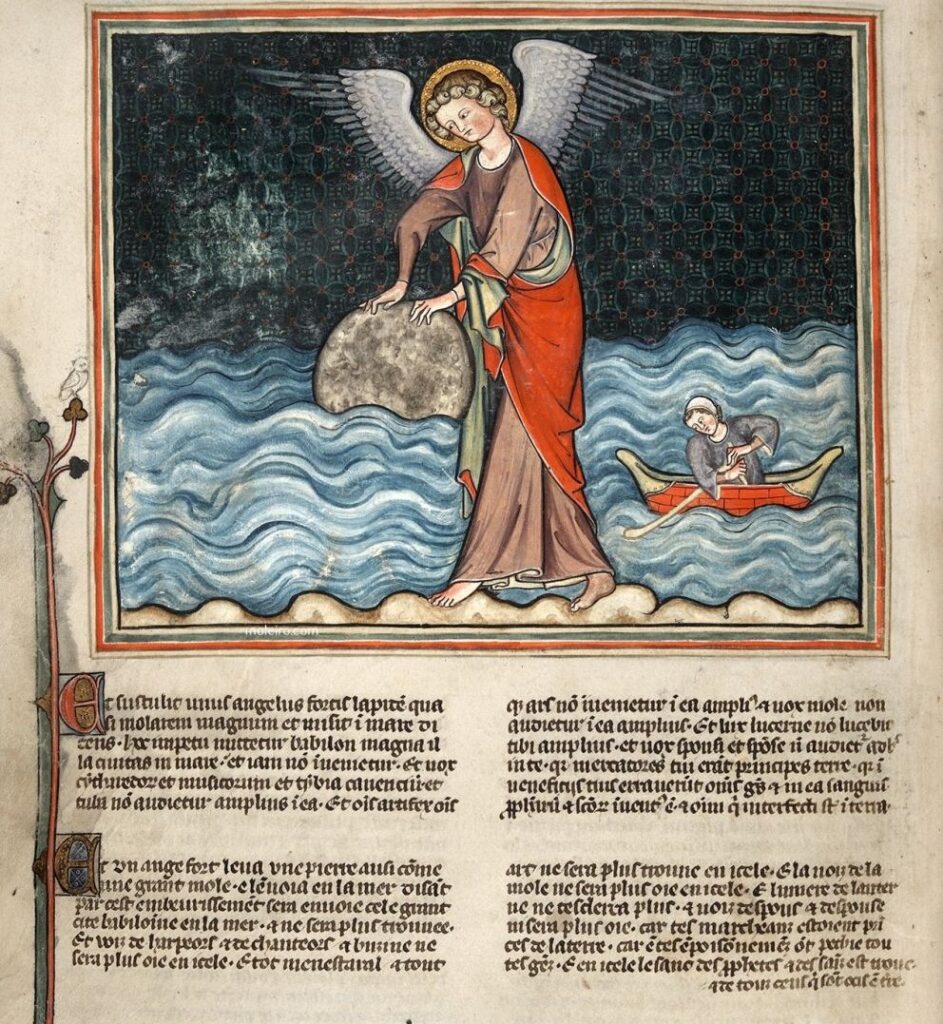
“Fallen, fallen is Babylon the great! She has become a dwelling for demons, a haunt for every unclean spirit, a haunt for every unclean and loathsome bird. For all the nations of the world have drunk the wine of her fornication…. ” (Apoc. 18:2)

The whore of Babylon is overthrown and the seer of the Apocalypse sings a series of dirges over the fallen city–both Babylon and Rome, capitals of the fallen world’s opposition to the Kingdom of God. The ruins have become the home of vile and loathsome monsters–some natural, some unnatural–as kings and sailors and merchants and those who grew wealthy from the imperial exploitation of the world mourn their losses.

It is easy–perhaps, too easy–to see the fall of Babylon-Rome as the condemnation of all economic systems that depend on the exploitation of the natural world or the labor of others. Certainly the “mark of the beast” and the refusal to let those who will not worship the Beast to participate in the economic life of society reinforces this interpretation. The Apocalypse seer insists–in many ways throughout the text–that Christians must segregate themselves from the larger society; he does not see how the Church and the fallen world can co-exist or cooperate in any way. He only sees persecution and conflict between the two, much as Augustine describes the “two cities” struggling against each other throughout human history in his classic City of God.

Another way to read the fall of Babylon is to see the city’s destruction as the overthrow of all false teaching, which is at the root of all exploitative systems. It is the misunderstanding of God’s relationship with the world, the human race and our misunderstanding of our relationship with each other that gives rise to all subsequent exploitation.

The fall of Babylon the great is the overthrow of Arius, Nestorius, and all the heresies that the Church has struggled against in the past and will continue to struggle against until the End of Days.

The Whore of Babylon

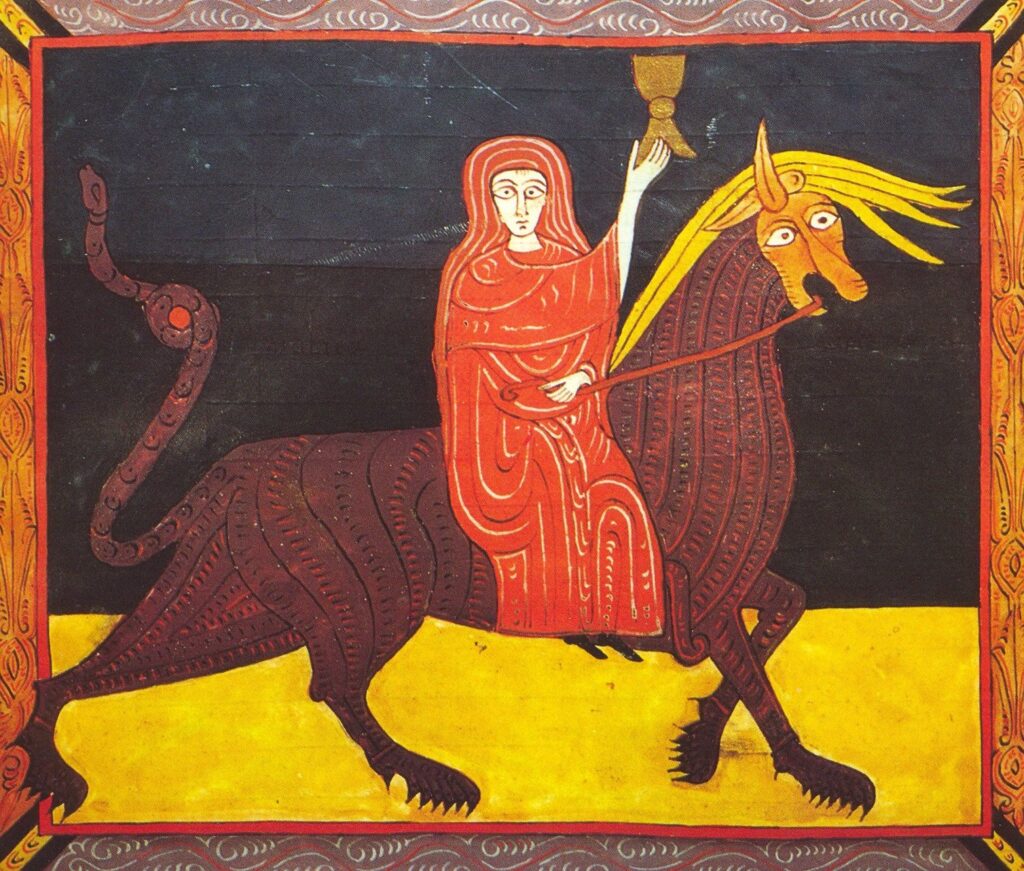
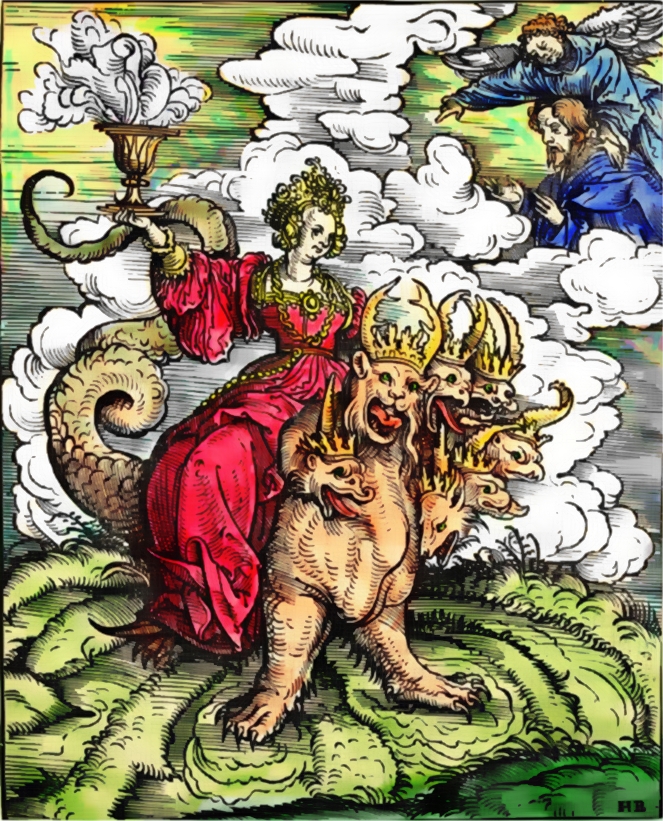
I saw a woman mounted on a scarlet beast…. the woman was clothed in purple and scarlet and bedecked with gold and precious stones and pearls. In her hand she held a gold cup full of all obscenities and the filth of her fornication…. I saw the woman was drunk with the blood of God’s people and with the blood of the martyrs of Jesus. (Apoc. 17:3-4, 6)

This woman, the famous “Scarlet Woman” and the “Whore of Babylon,” is the antithesis of the woman clothed with the sun in Apocalypse 12. The woman clothed with the sun gives birth to Christ in her children; the Scarlet Woman is drunk with the blood of those children, now martyred. The woman clothed with the sun is attacked by the dragon, the Antichrist; now the dragon, the Antichrist, escorts the Scarlet Woman in her apparent hour of triumph. The woman clothed with the sun is a mother who remains forever a virgin; the Scarlet Woman is the mother of all abominations and prostitutions imaginable. If the woman clothed with the sun is Sophia, the Divine Wisdom (Proverbs 8-9, Baruch 3-4, Wisdom 6-8), then the Scarlet Woman is the “loose woman” whose house is the gateway to Hell (Proverbs 7, 9).

The icons of Novgorod used scarlet as the background of divine light, out of which the saints stepped to greet the faithful. It is also the color of the Hellmouth, the great beast who devours the damned in icons of the Last Judgement. Scarlet is the presence of God who can be accepted or rejected but never escaped.

The Scarlet Woman is at the moment of decision, capable of giving herself over completely to the destruction of beauty and light or of turning aside from that path of destruction. She can remain the Whore of Babylon or become the Virgin Mother of the faithful, the “holy city, the new Jerusalem, coming down out of heaven from God, prepared as a bride for her husband” (Apoc. 21:2).

(For a fuller discussion of the woman clothed with the sun and the whore of Babylon, see my chapter “Clothed in Scarlet, Clothed with the Sun: Thoughts on the Women of Apocalypse 12 and 17” in Earth’s Abominations: Philosophical Studies of Evil available here.)