
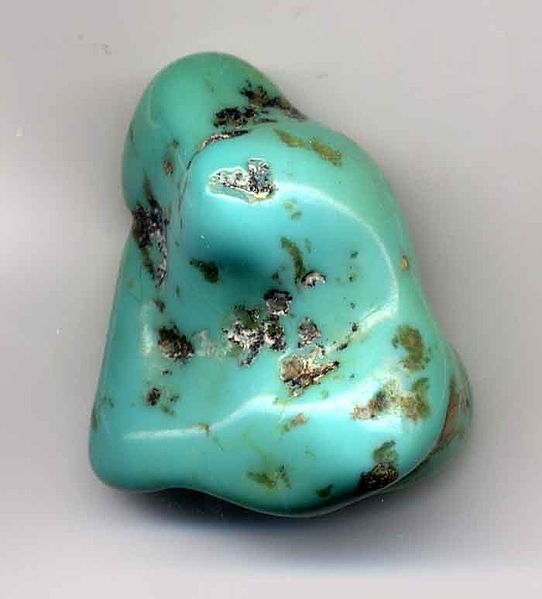
Turquiose, birthstone of December

Turquoise_

In ancient Persia it was once believed that the wearing of turquoise talismans would protect the wearer from death. It was also believed – not only among Persians but also among a number of other cultures – that a change in the color of the turquoise was a sign of danger or illness. Turquoise was carried by physicians of the fifteenth century. They claimed that the stone would counter the harmful effects of poison. They prepared a potion containing finely powdered turquoise, which, as well as proving to be a powerful antidote to scorpion stings, was also considered effective in banishing the pains arising from possession by demons.

Turks often attached Turquoise to the bridles of their horses believing that it rendered the horse more sure-footed. As the horse was often regarded as a symbol of the sun in its rapid course through the heavens, the sky-blue color of Turquoise may have caused it to be associated in some way with the horse.

The name turquoise is apparently related to the fact that is was brought to Europe from the Eastern Mediterranean by Levantine traders, more commonly known as Turks.  Its been used as a valuable ornament for ages and was used by the Egyptians thousands of years ago. The color is, of course, turquoise, but its range of color varies from green and greenish blue to sky blue shades.

For centuries, the most valuable turquoise came from Iran (Persia) but today some specimens mined in the southwestern United States compete with it.  The name “Persian Turquoise” is now generally used to refer to any turquoise stone that does not have the black or brown veining commonly found in turquoise mined in the United States.
Felix Castor

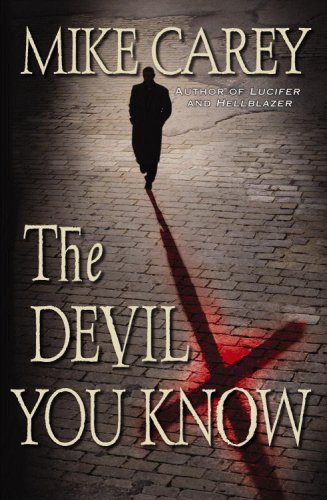
Felix Castor

This wonderful series of 5 novels follows the escapades of Felix Castor, an exorcist in contemporary London, who uses the tunes of his flute to bind the ghosts which possess the living and force them back into the shadow-world where they belong. In the London where Felix lives, the dead have made themselves known and are openly moving among the living in a variety of ways and Felix’s skills are in frequent demand. Each of the five books is a wonderful stand-alone novel in which Felix struggles to save both his clients and himself from the ghosts and demons which hide in plain sight all around us, though the overarching arc of the five books describes his attempt to free his friend from the demon Asmodeus (the demon which Felix himself inadvertently linked to his friend’s soul).

This first book in the series, The Devil You Know, introduces us to Felix’s world and characters–both living and departed– that populate it. The author includes fascinating descriptions of how magic and exorcism work and how the dead are able to cross over into the realm of the living.

The author makes one choice at the end of the first book which I would not have made, but it is the only way that makes that character able to have not only a recurring role in the series but a vital one in one of the later books of the quintet. I am happy to suggest that you add the Felix Castor books to your reading list!

Sagittarius

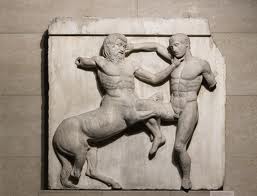
This carving from the Parthenon depicts hand-to-hand (Hand-to-hoof?) combat between a centaur and a human.

This carving from the Parthenon depicts hand-to-hand (Hand-to-hoof?) combat between a centaur and a human.

Sagittarius (the astrological sign of those born November 23–December 22) is one of the 48 constellations listed by the 2nd-century astronomer Ptolemy and remains one of the 88 modern constellations. Its name is Latin for “the archer,” and its symbol is Sagittarius.svg, a stylized arrow.

The Babylonians identified Sagittarius as the god Nerigal or Nergal, a strange centaur-like creature firing an arrow from a bow. It is generally depicted with wings, with two heads, one panther head and one human head, as well as a scorpion’s stinger raised above its more conventional horse’s tail. The Sumerian name Pabilsag is composed of two elements – Pabil, meaning ‘elder paternal kinsman’ and Sag, meaning ‘chief, head’. The name may thus be translated as the ‘Forefather’ or ‘Chief Ancestor’. The figure is reminiscent of modern depictions of Sagittarius.

In Greek mythology, Sagittarius is identified as a centaur: half human, half horse. In some legends, the Centaur Chiron was the son of Philyra and Saturn, who was said to have changed himself into a horse to escape his jealous wife, Rhea. Chiron was eventually immortalised in the constellation of Centaurus or in some version, Sagittarius.

The arrow of this constellation points towards the star Antares, the “heart of the scorpion.”

Sagittarius is undoubtedly one of the most positive of the star signs. If you were born under this sign, you are extremely confident in whatever you do. Being one of the luckiest signs, fortune seems to favor you, whether you plan things or not. That’s also the reason you don’t mind taking the odd risk or two. You feel as if you can’t possibly lose. This almost cocky attitude is something that attracts people to you.

You’re also very enthusiastic, and this is contagious — people can’t help but feel the same way in your presence.

Because people like you so much, they want to help you achieve your goals. But sometimes your life objectives are colossal — those arrows seem to shoot much further than the eye can see. Your philosophy is to bite off more than you can chew and then chew as fast as you can.

People around you will sometimes feel that you’re overly ambitious, and that your aims are pie in the sky. This is not likely to change you: you’d always rather aim high and take on the adventure of life than get to the end of the road regretting that you didn’t have a good go at making your dreams come true.