
“Good Yule!”

Yule Holiday SceneYule or Yuletide (“Yule time”) is a religious festival observed by the historical Germanic peoples, later being absorbed into and equated with the Christian festival of Christmas. The earliest references to Yule are by way of indigenous Germanic month names (Ærra Jéola (Before Yule) or Jiuli and Æftera Jéola (After Yule). Scholars have connected the celebration to the Wild Hunt, the god Odin and the pagan Anglo-Saxon Modranicht.

Terms with an etymological equivalent to Yule are used in the Nordic countries for Christmas with its religious rites, but also for the holidays of this season. Yule is also used to a lesser extent in English-speaking countries to refer to Christmas. Customs such as the Yule log, Yule goat, Yule boar, Yule singing, and others stem from Yule.

Yule is the modern English representative of the Old English words ġéol or ġéohol and ġéola or ġéoli, with the former indicating the 12-day festival of “Yule” (later: “Christmastime”) and the latter indicating the month of “Yule”, whereby ǽrra ġéola referred to the period before the Yule festival (December) and æftera ġéola referred to the period after Yule (January). Both words are thought to be derived from Common Germanic, and are cognate to Gothic (fruma) jiuleis and Old Norse (Icelandic and Faroese) jól (Danish and Swedish jul and Norwegian jul or jol) as well as ýlir, Estonian jõulud and Finnish joulu. The etymological pedigree of the word, however, remains uncertain, though numerous speculative attempts have been made to find Indo-European cognates outside the Germanic group, too.

The noun Yuletide is first attested from around 1475.

The word is attested in an explicitly pre-Christian context primarily in Old Norse. Among many others, the long-bearded god Odin bears the names jólfaðr (Old Norse ‘Yule father’) and jólnir (Old Norse ‘the Yule one’). In plural (Old Norse jólnar; ‘the Yule ones’) may refer to the Norse gods in general. In Old Norse poetry, the word is often employed as a synonym for ‘feast’, such as in the kenning hugins jól (Old Norse ‘Huginn’s Yule’ > ‘a raven’s feast’).

Yule was an indigenous midwinter festival celebrated by the Germanic peoples, absorbed into celebrations surrounding Christmas over time with Christianization. The earliest references to it are in the form of month names, where the Yule-tide period lasts somewhere around two months in length, falling along the end of the modern calendar year between what is now mid-November and early January.
Good King Wenceslas!

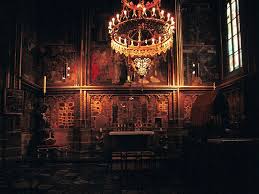
The shrine-chapel of St. Duke Vaclav (Wenceslaus) in St. Vitus' Cathedral (Prague).

The shrine-chapel of St. Duke Vaclav (Wenceslaus) in St. Vitus’ Cathedral (Prague).

Good King Wenceslas is a popular Christmas carol that tells a story of Good King Wenceslas braving harsh winter weather to give alms to a poor peasant on the Feast of Stephen (the second day of Christmas, December 26). During the journey, his page is about to give up the struggle against the cold weather, but is enabled to continue by following the king’s footprints, step for step, through the deep snow. The legend is based on the life of the historical Saint Wenceslaus I, Duke of Bohemia or Svatý Václav in Czech (907–935).

In 1853, English hymnwriter John Mason Neale wrote the “Wenceslas” lyrics, in collaboration with his music editor Thomas Helmore, and the carol first appeared in Carols for Christmas-Tide, 1853. Neale’s lyrics were set to a tune based on a 13th-century spring carol “Tempus adest floridum” (“The time is near for flowering”) first published in the 1582 Finnish song collection Piae Cantiones.

Wenceslas was considered a martyr and a saint immediately after his death in the 10th century, when a cult of Wenceslas grew up in Bohemia and in England. Within a few decades of Wenceslas’s death, four biographies of him were in circulation. These hagiographies had a powerful influence on the High Middle Ages conceptualization of the rex justus, or “righteous king”—that is, a monarch whose power stems mainly from his great piety, as well as from his princely vigor.

Although Wenceslas was, during his lifetime, only a duke, Holy Roman Emperor Otto I posthumously “conferred on [Wenceslas] the regal dignity and title” and that is why, in the legend and song, he is referred to as a “king”. The usual English spelling of Duke Wenceslas’s name, Wenceslaus, is occasionally encountered in later textual variants of the carol, although it was not used by Neale in his version. (Wenceslas is not to be confused with King Wenceslaus I of Bohemia [Wenceslaus I Premyslid], who lived more than three centuries later).

“O Christmas Tree, How Lovely Are Thy Branches!”


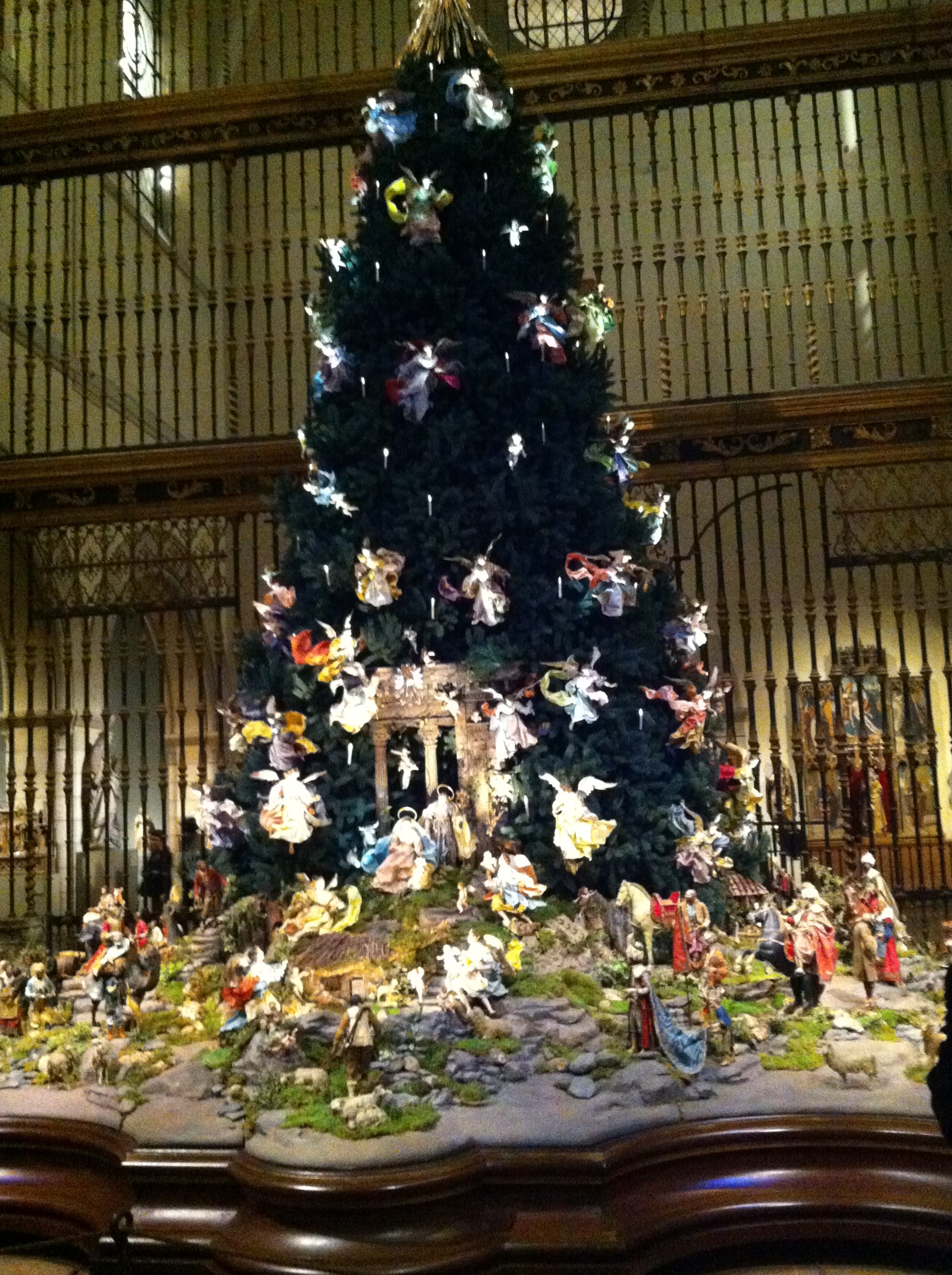
Christmas Tree at the Metropolitan Museum of Art in NYC with decorations from Naples (mid-late 1700s).

Christmas Tree at the Metropolitan Museum of Art in NYC with decorations from Naples (mid-late 1700s).

Christmas trees are among the most popular holiday customs of the modern world. Of all sizes and of many shapes, trees are set up in homes and shopping malls and store aisles to be decked with lights, tinsel, and ornaments. Children look forward to the arrival of the tree and share in its decoration. The decorated tree is the surest sign that the “holiday season” has arrived.But some disparage Christmas trees and call them little more than pagan intrusions into the Christian celebration. They cite the sacred trees of the Germanic tribes and assert that the decorated trees in modern houses are an ongoing homage to Thor, Odin, and the other gods of Valhalla. Although certain trees were considered sacred and might be decorated to celebrate certain days, no Germanic pagan would ever dream of cutting down the sacred trees or bringing them indoors. Cutting down the trees was the work of the Christian missionaries, especially St. Boniface of Mainz.

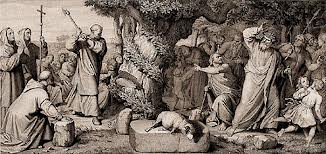
Depiction of St. Boniface cutting down Thor's Oak.

Depiction of St. Boniface cutting down Thor’s Oak.

Cutting down the holy trees was an act of desecration against the gods of Valhalla and an assertion that they were powerless to stop such a violation of their memory. When St. Boniface began to cut down Thor’s Oak, it is said that  “suddenly a great wind, as if by miracle, blew the ancient oak over. When the god did not strike him down, the people were amazed and converted to Christianity. He built a chapel dedicated to Saint Peter from its wood…”

Although the pagan Germanic celebration of the midwinter feast of Yule describes great feasting, there are no mentions of decorated trees. The “Yule logs” were ordinary trees that were cut down and brought in to be burnt, not the sacred trees. To cut down and bring the tree indoors, decorate it, and then burn it is an act specific to the newly-converted Germanic peoples to celebrate the end of the old gods and the birthday of the new.