
April Fool’s Day!

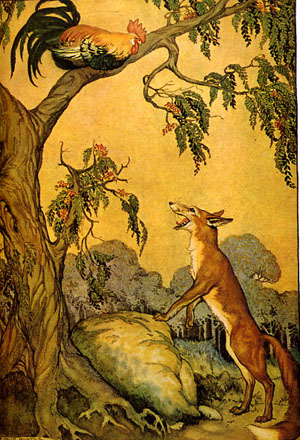
Chanticleer the rooster and Reynard the fox from Chaucer's "Canterbury Tales."

Chanticleer the rooster and Reynard the fox from Chaucer’s “Canterbury Tales.”

Precursors of April Fools’ Day include the Roman festival of Hilaria, held March 25, and the medieval Feast of Fools, held December 28, still a day on which pranks are played in Spanish-speaking countries.

In Chaucer’s Canterbury Tales (1392), the “Nun’s Priest’s Tale” is set Syn March bigan thritty dayes and two. Modern scholars believe that there is a copying error in the extant manuscripts and that Chaucer actually wrote, Syn March was gon. Thus, the passage originally meant 32 days after April, i.e. May 2, the anniversary of the engagement of King Richard II of England to Anne of Bohemia, which took place in 1381. Readers apparently misunderstood this line to mean “March 32”, i.e. April 1. In Chaucer’s tale, the vain rooster Chaunticleer is tricked by a fox.

The Roman celebration of  Hilaria on the eighth day before the Kalends of April—March 25—in honour of Cybele, the mother of the gods; the day of its celebration was the first after the vernal equinox, or the first day of the year which was longer than the night. The winter with its gloom had died, and the first day of a better season was spent in rejoicings. All kinds of games and amusements were allowed on this day; masquerades were the most prominent among them, and everyone might, in his disguise, imitate whomsoever he liked, and even magistrates.

Part 3 Available NOW!

CHOHWDeluge_FrCVR


1356: A witch burns! Prague is cursed!
2002: The curse threatens to destroy Prague with a mammoth flood–can the professors find a way to defend and save the city?


It is the winter of 1356-7 and Nadezda, with the assistance of an elderly rabbi, confronts Lilith to discover the secret of the witch’s curse. Meanwhile, in August 2002, George and Magdalena help carry out the witch’s curse by conjuring the historic flood to wash away the Charles Bridge and its magical protection of the city, allowing them to unleash the devil Svetovit. Using the magic of tarot cards, the Evil Conference professors struggle to release the defensive magic buried deep beneath the streets of Prague. Finally confronting George, Magdalena, and Svetovit face-to-face, can the professors avert the doom that is engulfing the city?

Kindle eBook available here.

Paperback soon-to-be-released! Available for advance orders here on PubSlush..


Easter and Eostre

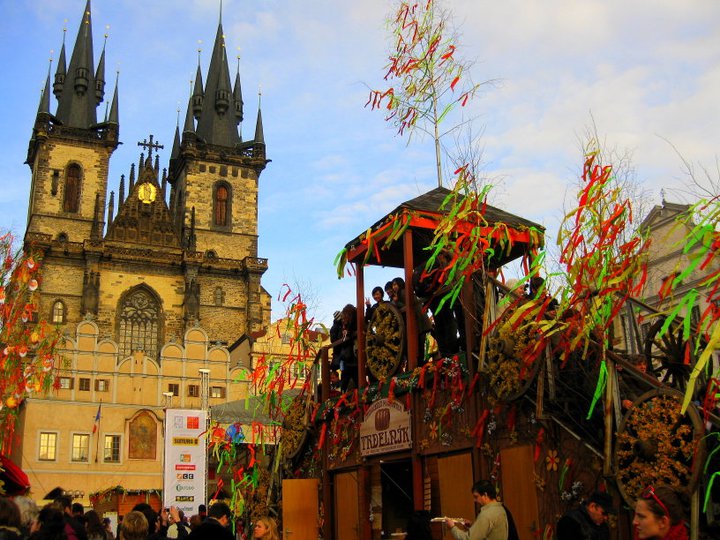
Willow switches are available in the Easter Market in the Old Town Square of Prague. Boys and young men use the switches to swat young ladies in a modern, stylized version of an ancient springtime fertility rite.

Willow switches are available in the Easter Market in the Old Town Square of Prague. Boys and young men use the switches to swat young ladies in a modern, stylized version of an ancient springtime fertility rite.

In most languages, the Christian festival of Christ’s Resurrection is known as “Pascha” or some other version of the name for “Pesach” (Passover), the Jewish feast Jesus celebrated at the Last Supper and during which he was crucified and risen. Only in English is the Christian festival called “Easter,” derived from the Anglo-Saxon goddess Eostre whose springtime feast was supplanted by that of Christ. (Estrogen and estrus and other related words are also derived from the name of the goddess as well.)

Eostre was the goddess of bounty and new life, the regeneration of nature post-winter and fertility. She was attended by rabbits (known for their prolific reproductive abilities) and decorated eggs were exchanged in her honor. (In some places, these decorated eggs were then buried in the earth as gifts to Eostre so that she could know the hopes and dreams of her children, which were depicted in the paintings on the eggs, and then fulfil them.)

A variety of practices were indulged in that were said to promote the fertility of humans and of crops, including switching young women with braided willow branches. Bonfires were a common fertility rite in the non-Christian world and St. Patrick had a major confrontation with the pagan High King of Ireland because he lit the Christian fire for Easter before the king lit the fertility bonfire nearby.

Stories of descent into the netherworld (i.e. winter) and ascent from the netherworld (i.e. spring) were told in connection with Eostre’s celebration, such as that of Persephone and Hades. The well-known “spring cleaning” of homes was part of preparing to welcome Eostre’s arrival back in the world.