
Aachen and the Figs

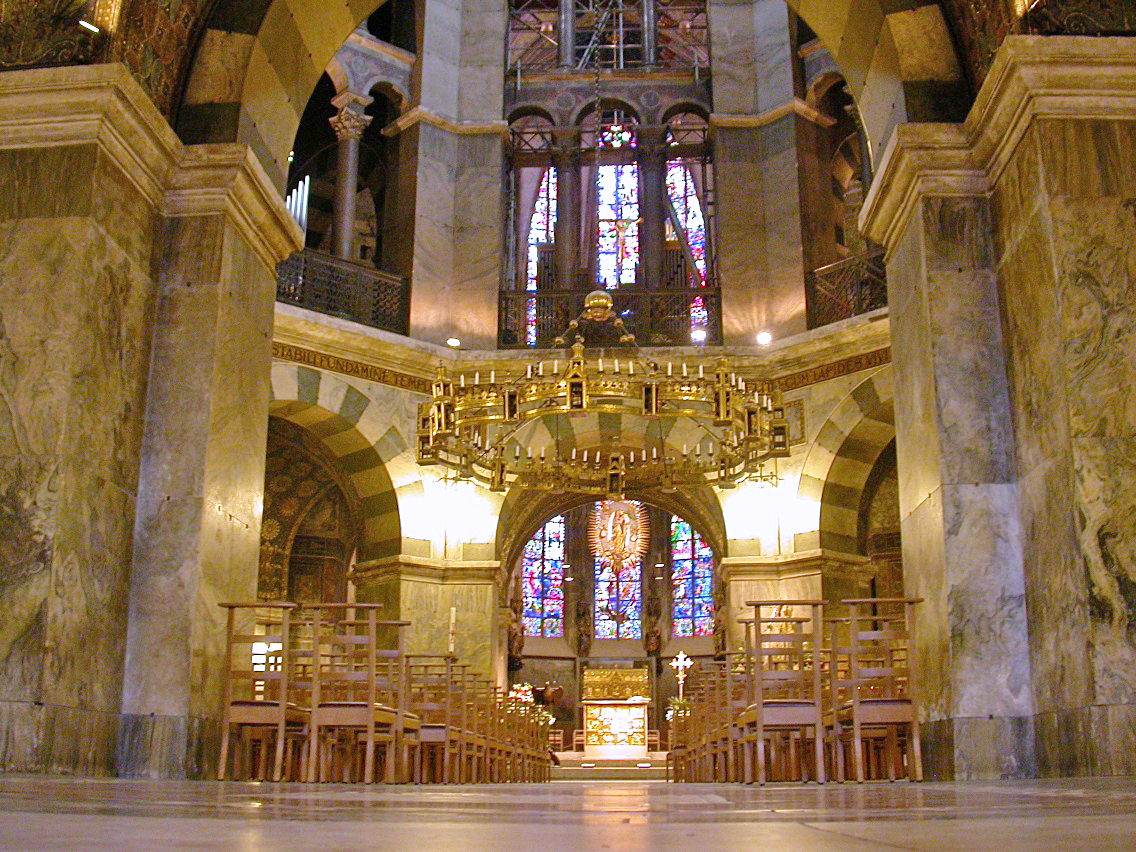
The royal chapel of Charlemagne at Aachen is an octagon as many early chapels designed to be used for baptisms were.

October 21, 1944 — During World War II in Europe, American troops captured Aachen in western Germany after a week of hard fighting. It was the first large German city taken by the allies.

Aachen first developed from a Roman settlement and spa. It became the preferred medieval Imperial residence of Charlemagne and served as his capital. It was also the place where 31 Holy Roman Emperors were crowned Kings of the Germans from AD 936-1531. Charlemagne ordered the construction of the cathedral there in 796 AD and when it was completed in AD 798, it was the largest cathedral north of the Alps. On his death, Charlemagne’s remains were interred in the cathedral and can be seen there to this day. After Frederick Barbarossa canonized Charlemagne in AD 1165, the chapel became a destination for pilgrims. For 600 years Aachen Cathedral was the church of coronation for 30 German kings and 12 queens.

Legends developed that either Charlemagne or Frederic Barbarossa would eventually rise from their tombs just before the End of the World to combat the Antichrist. Both Charlemagne and Frederick were thought to be the personification of the “Good King” who cared for and protected his people, bringing law and order to areas torn apart by chaos and violence. They are very similar to King Arthur in this regard, who was also expected to return to save Britain in its time of greatest need.

Another legend states that when Frederick was in the process of seizing Milan in AD 1158, his wife, the Empress Beatrice, was taken captive by the enraged Milanese and forced to ride through the city on a donkey in a humiliating manner. Frederick took his revenge for this insult by forcing the magistrates of the city to remove a fig from the anus of a donkey using only their teeth. To add to this debasement, they were made to announce, “Ecco la fica!” (meaning, “Behold the fig!”), with the fig still in their mouths. It used to be said that the insulting gesture called fico), of holding one’s fist with the thumb in between the middle and forefinger (which was also a way to curse one’s enemies),came by its origin from this event.

Figs and fig leaves were important in folklore and magic. Adam and Eve used fig leaves to clothe themselves when they realized that they were naked. Fig leaves also protected Romulus and Remus as infants so that they could grow up to found the city of Rome. The Pharaohs took dried figs to their graves in order to sustain their souls on their journey into the afterlife. They thought the goddess Hathor would emerge from a fig tree to welcome them into heaven.
Battle of Hastings

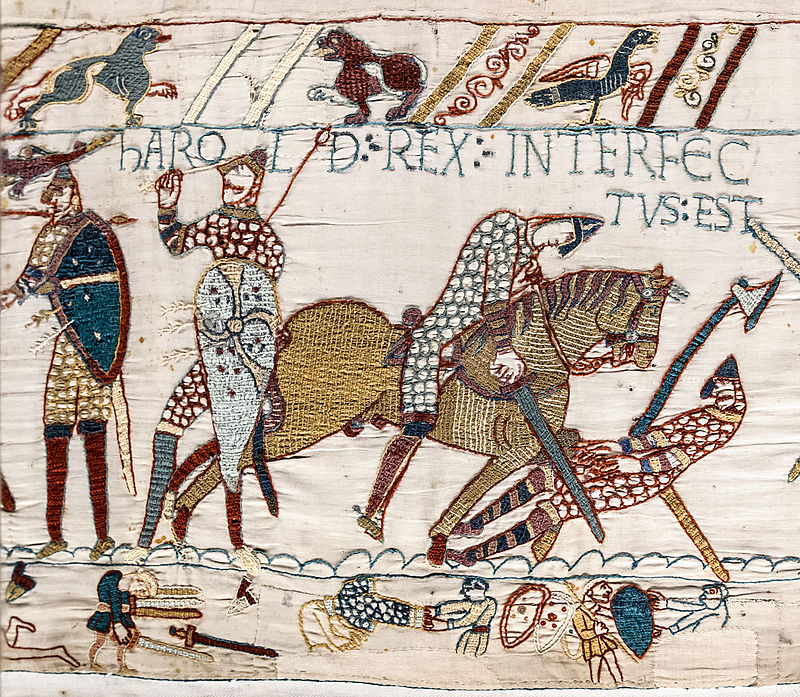
Scene from the Bayeux Tapestry depicting the Battle of Hastings and the death of King Harold. Harold was king for less than a year and died when an arrow was shot through his eye.

The Battle of Hastings was fought on 14 October 1066 between the Norman-French army of William “the Conqueror,” and an English army under the Anglo-Saxon King Harold Godwinson; when William won the battle, it was the beginning of the Norman conquest of England.

The context of the battle was that the childless King Edward the Confessor died in January 1066, which set up a succession struggle between several claimants to his throne.

King Edward ruled England for 24 years. His nickname reflects the traditional image of him as unworldly and pious. “Confessor” reflects his reputation as a saint who did not suffer martyrdom, as opposed to King Edward the Martyr. Edward built Westminster Abbey in order to have a grand church to bury royal family members. Edward and his wife had no children; it was said that they had no children because Edward kept a vow of celibacy to demonstrate his devotion to Christ. He is

For some time the Abbey had claimed that it possessed a set of coronation regalia that Edward had left for use in all future coronations. Following Edward’s canonization, these were regarded as holy relics, and thereafter they were used at all English coronations from the 13th century until the destruction of the regalia by Oliver Cromwell in 1649.

Harold was crowned king shortly after Edward’s death, but faced invasions by William as well as two other contenders for the throne. King Harold was able to defeat the other two contenders and while Harold and his forces were recovering, William landed his invasion forces in the south of England in late September 1066. Harold was forced to march south swiftly, gathering forces as he went. But he and his army lost, a “very Bad Thing” as the famous 1066 And All That describes it.

Hot Off the Press!

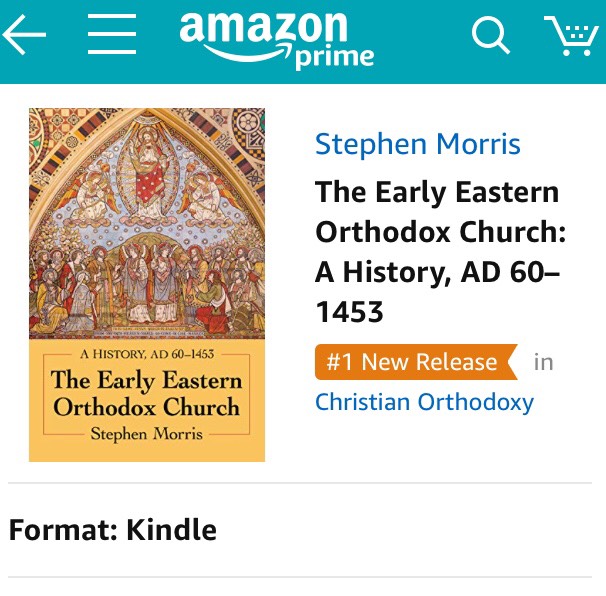
The book was a #1 New Release in one category and a Top 10 in another on Amazon.

My newest book, The Early Eastern Orthodox Church: A History, AD 60-1553, has just been released by McFarland. It was #1 and #4 in two different categories on Amazon. Order yours now–Kindle version or paperback!

One reader has already written that the book “is a delightful romp through Church history!” Another reader reports: “Super informative and easy to follow. Really interesting stuff. The pages practically turn themselves.” 👍

Although the book focuses on Church life in the Eastern Mediterranean region, much of the book is about the common heritage of both east and west (formation of the New Testament, development of church order and hierarchy, as well as the role of the ecumenical councils, etc). Many issues—the interaction of science and faith, divinity and humanity, Church and State—continue to be pertinent today.

Add your review to the book’s Amazon page as well.

There will be a Book Launch on Monday, November 12 at St. John’s-in-the-Village Church (West 11 Street @7 Avenue) with Evensong at 6:15 p.m. and Book Reading and Signing at 6:45 p.m. Discussion with Q & A will follow. Drinks will be served. Come celebrate even if you already have your copy. Books will be available for purchase—at a special discount!