St. Barbara’s Branches

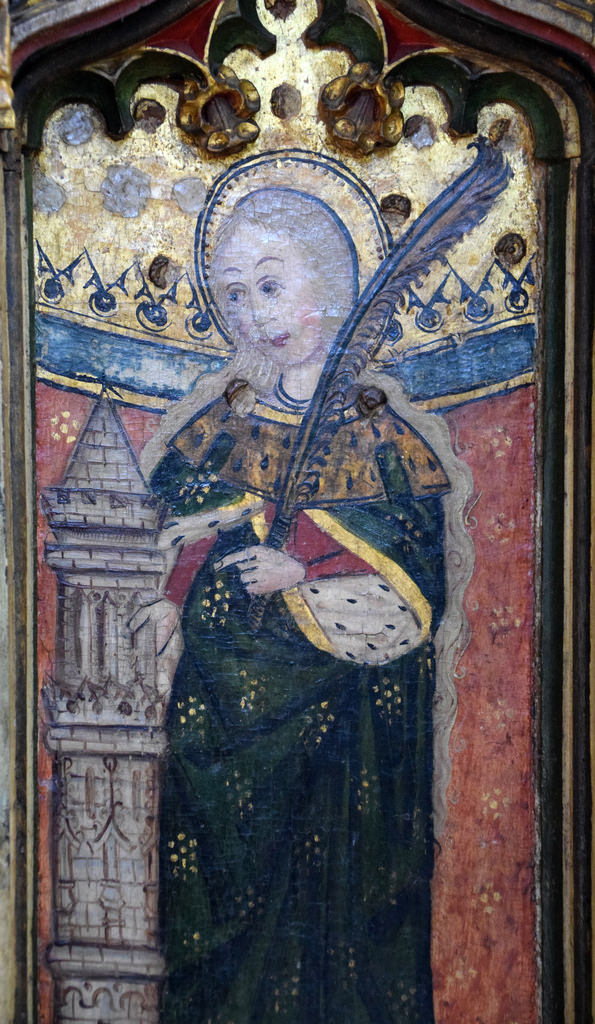
St. Barbara with her tower and palm branch–indicating that she was a martyr–on a 15th century rood screen.

Barbara, the daughter of a rich pagan named Dioscorus, was carefully guarded by her father who kept her locked up in a tower in order to preserve her from the outside world. Before going on a journey, her father commanded that a private bath-house be erected for her use near her dwelling, and during his absence, Barbara had three windows put in it, as a symbol of the Holy Trinity, instead of the two originally intended. When her father returned, she acknowledged herself to be a Christian; upon this he drew his sword to kill her, but her prayers created an opening in the tower wall and she was miraculously transported to a mountain gorge, where two shepherds watched their flocks. Dioscorus, in pursuit of his daughter, was rebuffed by the first shepherd, but the second betrayed her. For doing this, he was turned to stone and his flock was changed to locusts.

Dragged before the prefect of the province, Martinianus, who had her cruelly tortured, Barbara held true to her Christian faith. During the night, the dark prison was bathed in light and new miracles occurred. Every morning, her wounds were healed. Torches that were to be used to burn her went out as soon as they came near her. Finally, she was condemned to death by beheading. Her father himself carried out the death-sentence. However, as punishment for this, he was struck by lightning on the way home and his body was consumed by flame. Barbara was buried by the Christians and her tomb became the site of miracles.

German-speaking countries celebrate the tradition of Barbarazweig, or the “St. Barbara’s branch.” The original folklore was that unmarried girls cut twigs from cherry trees on December 4–the anniversary of St. Barbara’s martyrdom–and forced them into bloom. There is an old belief that if the twig blossoms on Christmas Eve, the girl will be married the following year.

The practice of forcing the blooms on the cherry tree twigs comes from a legend that while St. Barbara was locked in her tower, she felt lonely. She found a dried up cherry tree branch which she watered daily with a few drops from her drinking water. She was greatly consoled by the beautiful cherry blossoms that appeared just days before her impending execution.

St. Barbara’s feast day also has traditional breads and other wheat foods symbolizing the harvest, with overtones of death and rebirth, tying her feast day to Christmas. In France and the Ukraine, two or more grains of wheat are planted and forced to grow. Folklore states that if they flourish by Christmas Eve, the wheat crop will prosper that year.

According to the Golden Legend, her martyrdom took place on December 4.
St. Andrew in Scotland & Romania

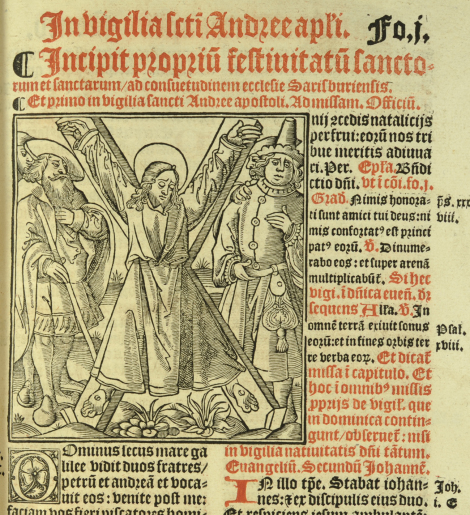
Woodcut of the martyrdom of St Andrew from a Sarum Missal printed in Paris in 1534.

Every year on November 30, Scotland celebrates the feast day of its patron saint, St. Andrew. The day is celebrated and commemorated with festivities, parades, traditional Scottish music and dancing. By law, all buildings in Scotland are required to display the Scottish National Flag that bears the image of the Saltire, or St Andrew’s Cross.

But… St. Andrew was not Scottish. In fact, the saint was born in Bethsaida, Israel. Moreover, St. Andrew never stepped foot in Scotland. Although St. Andrew was strongly associated with Scotland from around AD 1000, he only became the official patron saint of Scotland in AD 1320. (St. Andrew is also the patron saint of Greece, Russia, the Amalfi region of Italy, and Barbados.)

According to folklore, St. Andrew requested to be tied to an X-shaped cross, as he believed he was ”not worthy of dying in the same shape of a cross as Jesus”. Since the year 1385, this X-shape represents the white cross displayed on the Scottish flag. A notable feature of the small town in Scotland named for St. Andrew is the University of St Andrew. Founded in 1413, this is the oldest university in Scotland, as well as being the third oldest university in the English-speaking world. The university is known worldwide for teaching and research. The University was the first Scottish university to allow women to enroll as undergraduates (1892).

Regarded as ”one of the world’s greatest small universities”, the university is heavily interlinked with the town as students of the university making up roughly 1/3 of the population (under 20,000).

In Romania, where St. Andrew is also the patron saint, a number of traditions and rituals surround the apostle. On the morning of St Andrew’s day, mothers gather up tree branches and make a bunch for each family member; the person whose bunch blooms by New Year’s Day will have good luck and health that year. It is also said girls should put a branch of sweet basil – or 41 grains of wheat – under their pillow on the night of St Andrew’s Day. If they dream someone takes them, it means they will marry soon.

St Andrew is also linked to superstition and custom surrounding matrimony in several other countries. Reports suggest that in parts of Czech Republic, Hungary and Slovakia, names of potential husbands are written on pieces of paper and stuffed in pieces of dough. After baking, the first one to rise to the top when put in a bowl of water would reveal the name of their future husband.

You can find more legends of St. Andrew here.

Musicians and St. Cecilia

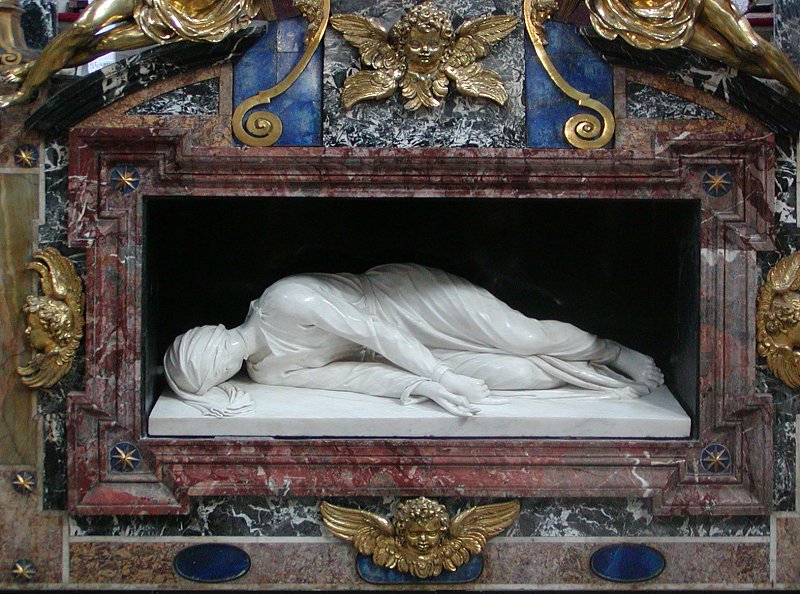
the sculptor Carlo Maderno attended the opening of St. Cecilia’s tomb in 1599 and then based his sculpture of the body on what he saw: the saint lying on her side with her arms extended and her throat cut, as if she had been dropped to the ground. The statue is now displayed beneath the high altar of the church in the Trastevere neighborhood of Rome.

Saint Cecilia is the patroness of musicians. Her feast day is celebrated on November 22. She is said to have been beheaded with a sword. An early Roman Christian church, Santa Cecilia, was founded in the 4th-century AD in the Trastevere section of Rome, reputedly on the site of the house in which she lived. The legend about Cecilia’s death says that after being struck three times on the neck with a sword, she lived for three days, and asked the pope to convert her home into a church. Cecilia was buried in the Catacomb of Callixtus, and later transferred to the Church of Santa Cecilia in Trastevere. In 1599, her body was found still incorrupt, seeming to be asleep.

She is associated with music and musicians because she “sang in her heart” during the wedding that her parents forced her to make with a pagan man whom she was able to convert on their wedding night or shortly thereafter. She and her husband were both quickly martyred.

Her feast day became an occasion for musical concerts and festivals that occasioned well-known poems by John Dryden and Alexander Pope and music by Henry Purcell (Ode to St. Cecilia); several oratorios by Marc-Antoine Charpentier (In honorem Caeciliae, Valeriani et Tiburtij canticum; and several versions of Caecilia virgo et martyr to libretti probably written by Philippe Goibaut); George Frideric Handel (Ode for St. Cecilia’s Day); Charles Gounod (St. Cecilia Mass); as well as Benjamin Britten, who was born on her feast day (Hymn to St Cecilia, based on a poem by W. H. Auden). Herbert Howells’ A Hymn to Saint Cecilia has words by Ursula Vaughan Williams; as well as many, many others.