Summer Lightning

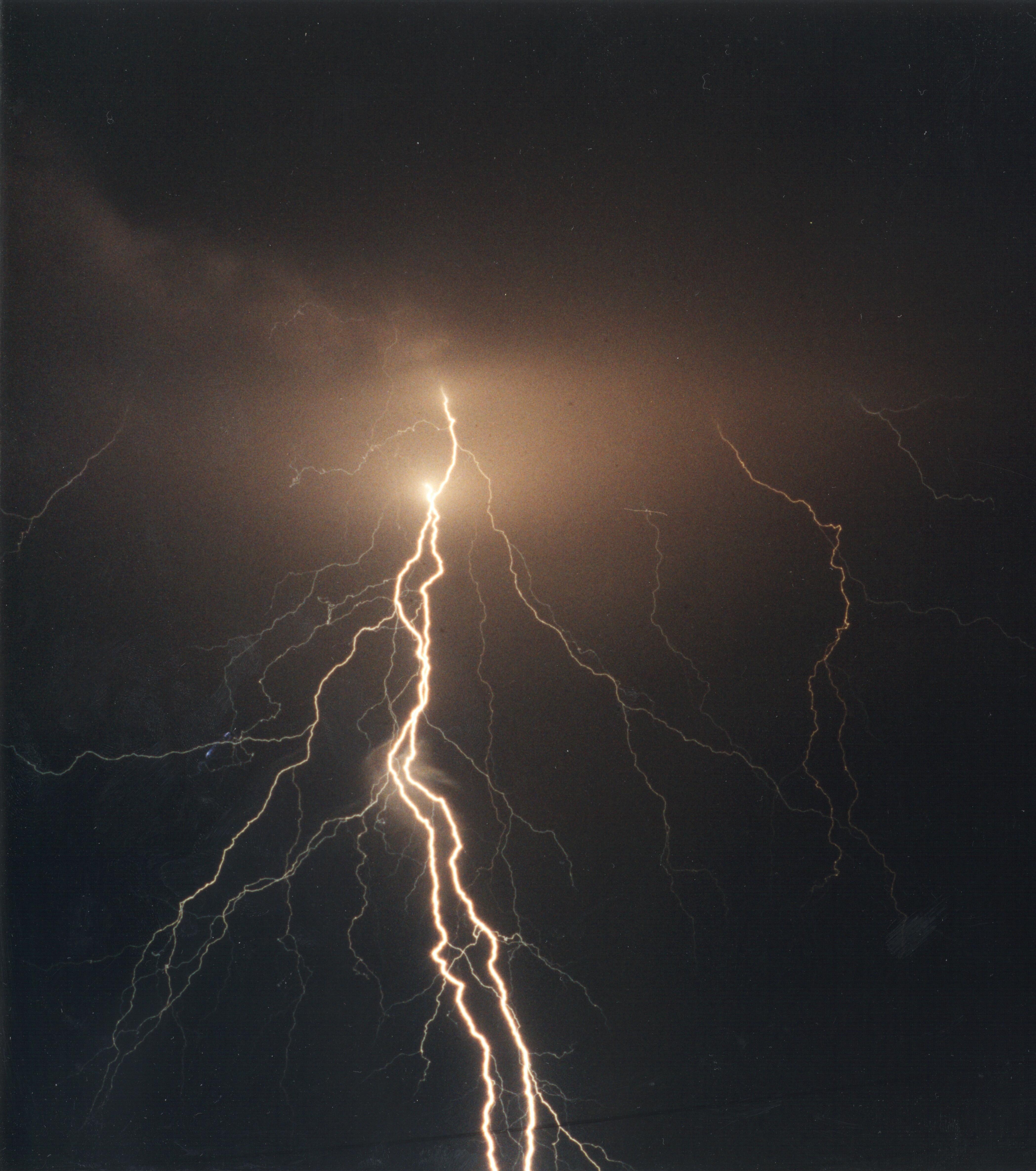
Thunderstorms and lightning strikes are most likely in spring and summer storms.

Thunderstorms and lightning strikes are most likely in spring and summer storms.

The only law against magic made by Constantine in 321 AD exempts magical “steps taken in country districts, that there may be no apprehension of (heavy) rain when the grapes are ripe, or that they may not be dashed to pieces by the force of hailstorms.” (You can read more in  Witchcraft and Magic in Europe: Ancient Greece and Rome.)

There are references to weather magic as early as ancient Greece, as in this quote by Empedocles:

And you’ll stop the force of the tireless winds that chase over the earth
And destroy the fields with their gusts and blasts;
But then again, if you so wish, you’ll stir up winds as requital.
Out of a black rainstorm you’ll create a timely drought
For men, and out of a summer drought you’ll create
Tree-nurturing floods that will stream through the ether
And you will fetch back from Hades the life-force of a man who has died.

(see more in Ancient Philosophy, Mystery, and Magic: Empedocles and Pythagorean Tradition, with thanks to http://www.otherworld-apothecary.com)

In the Jewish practice, a blessing “…He who does acts of creation” is to be recited, upon sighting lightning. The Talmud refers to the Hebrew word for the sky, (“Shamaim“) – as built from fire and water (“Esh Umaim“), since the sky is the source of the inexplicable mixture of “fire” and water that come together, during rainstorms. This is mentioned in various prayers and discussed in writings of Kabbalah.

 Rune Thorn

The Norse rune known as “Thorn” is also associated with lightning for a variety of reasons. It is the rune of cutting, sharpness, and pain, as well as brute strength, the destructive power of chaos and ruin. It also stands in for death and regeneration, transformation and the breaking down barriers.  It can be used to bring on the energies of the berserker and energies this wild should only be used in war or attack. It can be used in magic to raise and guide thunderstorms and direct lightning. In many German fairy tales such as “Sleeping Beauty” the prick of a thorn, pin or spindle casts a spell upon the victim. The bloodstone has been used with this rune in the raising of thunderstorms.
Cancer, the Crab

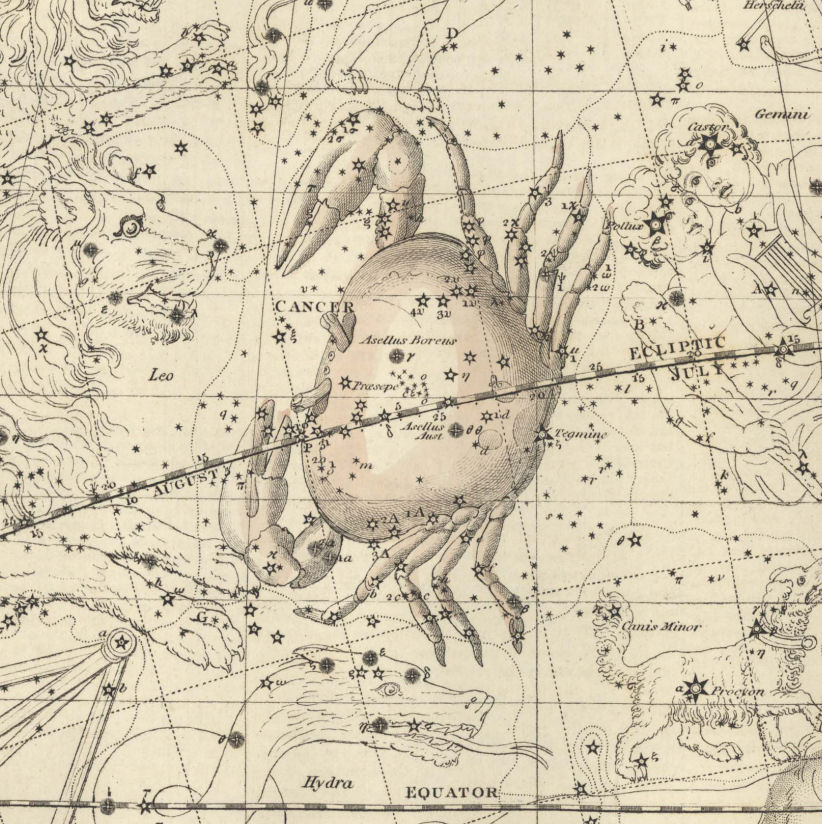
This depiction of the constellation Cancer (the Crab) is taken from the Celestial Atlas by Alexander Jamieson - 1822.

This depiction of the constellation Cancer (the Crab) is taken from the Celestial Atlas by Alexander Jamieson – 1822.

Although modern astrologers identify the sign of Cancer as a crab, it has been represented as various types of creatures, usually those living in the water, and always those with an exoskeleton.

The identification of Cancer as a crab is rooted in the Twelve Labors of Hercules tale. Hercules battled the multi-headed Lernaean Hydra and Hera had sent a large crab to distract Hercules and put him at a disadvantage during the battle. But Hercules quickly dispatched the creature by kicking it with such force that it was propelled into the sky. Other accounts say the crab grabbed onto Hercules’ toe with its claws, but Hercules simply crushed the crab underfoot. Hera, grateful for the creature’s heroic effort, gave it a place in the sky. (Some scholars have suggested that the crab was a late addition to the myth of Hercules in order to make the Twelve Labors correspond to the twelve signs of the Zodiac.)

In the Egyptian records of about 2000 BC, the Cancer sign was described as Scarabaeus (Scarab), the sacred emblem of immortality. In Babylonia the constellation was known by a name which can refer to both a crab and a snapping turtle. There also appears to be a strong connection between the Babylonian constellation and ideas of death and a passage to the underworld, which may be the origin of these ideas in much later Greek myths associated with Hercules and the Hydra. In the 12th century, an illustrated astronomical manuscript shows it as a water beetle. Albumasar writes of this sign in the work published in 1489 as a large crayfish. Jakob Bartsch and Stanislaus Lubienitzki, in the 17th century, described it as a lobster.

Those born during the Cancer period (June 22–July 22) are said to be emotional and intuitive but shrewd.

IF YOU LIKED THIS POST ABOUT THE FOLKLORE & OCCULT QUALITIES ASSOCIATED WITH CANCER THE CRAB, CLICK HERE TO SEE MY FANTASY NOVELS IN WHICH ALL THE MAGIC AND SUPERNATURAL EVENTS ARE BASED ON AUTHENTIC MEDIEVAL-RENAISSANCE OCCULT BELIEFS AND PRACTICES.

Midsummer


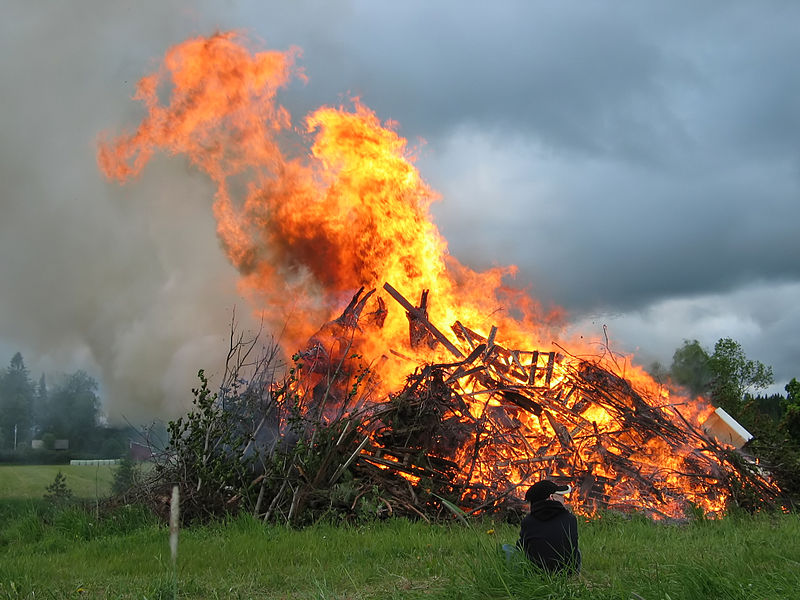
A bonfire for Midsummer in Mäntsälä, Finland.

A bonfire for Midsummer in Mäntsälä, Finland.

The summer solstice, more commonly known as Midsummer, marked the longest day of the year and the zenith of magical power often called “white magic.” Magic worked on Midsummer was most often concerned with life and fertility. Jumping through the Midsummer bonfire was a way to attract fertility, good luck, and prosperity to both the jumper and the surrounding fields. The bonfires of Midsummer are traditionally kindled from the friction of two sacred woods, fir and oak. Nine different types of herbs are thrown upon the Midsummer fire: mistletoe, vervain, St. John’s Wort, heartsease, lavender, and a choice of four others chosen from herbs typical of this season such as yarrow. Folks would feast, dance and jump the fire for luck and fertility. The herds were driven through the embers in days long ago to purge disease and illness from them. When the fires had burned down, folks would carry ashes back to their homes to sprinkle on fields, the four corners, and lay embers on the hearth. The ashes bring powers of protection, health and luck.

Water is the other important aspect of Midsummer. In times past folks swam in waters that flowed towards the rising sun as it climbed in Midsummer morning sky. Bathing in springs and rivers on Midsummer brings healing, cleansing and protection. The dew of Midsummer is said to bestow health to whomever drinks of it. Especially powerful is fetching running water of Midsummer morn and mixing it with ashes from the bonfire, sprinkling it around the house, yard and on oneself bestows protection and luck. Iceland combined the beliefs about bathing and dew into one practice: Icelandic folklore says that if you bathe naked in the morning dew on the morning of June 24, you will keep aging at bay for longer.) Midsummer Eve, the night before the solstice, is the evening of herbs. The herbs and flowers gathered this night are considered exceptionally potent. St John’s Wort, burdock, thorn, and nettle , should be harvested on Midsummer Eve and hung on doors or windows and placed around the home for protection. Royal Fern seeds which are gathered at midsummer are said to make the possessor invisible. They who find Royal Fern blossoms on Midsummer’s eve become wise, lucky, and wealthy. Women wear braided circlets of clover and flowers, while men wear chaplets of oak leaves and flowers around their heads. In times past, livestock were also decorated with garlands made of flowers, foliage, and oak leaves.