12th Night, Part 2

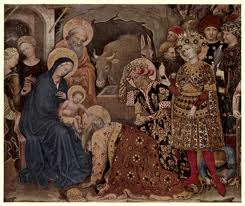
The arrival of the 3 kings to worship the newborn Christ-child is celebrated on Twelfth Night.

The arrival of the 3 kings to worship the newborn Christ-child is celebrated on Twelfth Night.

Twelfth Night is a festival  marking the coming of the Epiphany and concluding the Twelve Days of Christmas.

In medieval and Tudor England, the Twelfth Night marked the end of a winter festival that started on All Hallows Eve — now more commonly known as Hallowe’en. The Lord of Misrule symbolizes the world turning upside down. On this day the King and all those who were high would become the peasants and vice versa. At the beginning of the Twelfth Night festival, a cake that contained a bean was eaten. The person who found the bean would rule the feast. Midnight signaled the end of his rule and the world would return to normal. The common theme was that the normal order of things was reversed. This Lord of Misrule tradition dates back to pre-Christian European festivals such the Ancient Roman festival of Saturnalia.

(Shakespeare’s play Twelfth Night, or What You Will was written to be performed as a Twelfth Night entertainment. The play has many elements of the Lord of Misrule theme, in the tradition of Twelfth Night, such as a woman Viola dressing as a man, and a servant Malvolio imagining that he can become a nobleman.)

Food and drink are the center of the celebrations in modern times, and all of the most traditional ones go back many centuries. The punch called wassail is consumed especially on Twelfth Night, but throughout Christmas time, especially in the UK. Around the world, special pastries, such as the tortell and king cake are baked on Twelfth Night, and eaten the following day for the Feast of the Epiphany celebrations. In English and French custom, the Twelfth-cake was baked to contain a bean and a pea, so that those who received the slices containing them should be designated king and queen of the night’s festivities.

In colonial America, a Christmas wreath was always left up on the front door of each home, and when taken down at the end of the Twelve Days of Christmas, any edible portions would be consumed with the other foods of the feast. The same held true in the 19th-20th centuries with fruits adorning Christmas trees. Fresh fruits were hard to come by, and were therefore considered fine and proper gifts and decorations for the tree, wreaths, and home. Again, the tree would be taken down on Twelfth Night, and such fruits, along with nuts and other local produce used, would then be consumed.

In the eastern Alps, a tradition called Perchtenlaufen exists. Two to three hundred masked young men rush about the streets with whips and bells driving out evil spirits. In Nuremberg until 1616, children frightened spirits away by running through the streets and knocking loudly at doors. In some countries the Twelfth Night and Epiphany marks the start of the Carnival season, which lasts through Mardi Gras Day. Modern American Carnival traditions shine most brightly in New Orleans, where friends gather for weekly King Cake parties. Whoever gets the slice with the “king”, usually in the form of a miniature baby doll (symbolic of the Christ Child, “Christ the King”), hosts next week’s party.

(The Shorter Oxford English Dictionary reads “the evening of the fifth of January, preceding Twelfth Day, the eve of the Epiphany, formerly the last day of the Christmas festivities and observed as a time of merrymaking”. There is some confusion these days, however, as to which night is Twelfth Night: modern practice is often to regard the night of Epiphany itself (sixth of January) to be Twelfth Night. The older tradition of Twelfth Night being the 5 January stems from the medieval practice of the day beginning at sunset, rather than at midnight as it does now. Thus Twelfth Night falls on 5 January, ahead of Twelfth Day on the 6th.)
12th Night, Part I


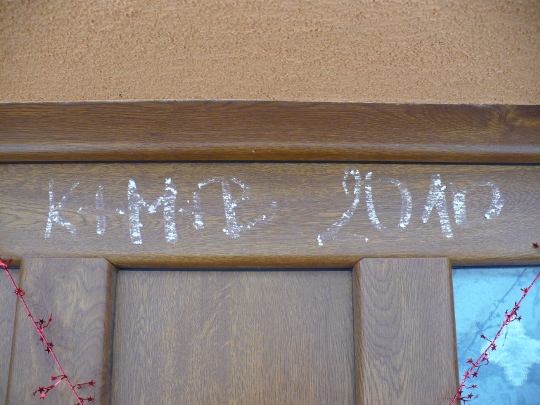
Czech doors inscribed with Epiphany blessing

Czech doors inscribed with Epiphany blessing

Western Christians observe a twelve-day festival, starting on December 25, and ending on January 5, known as Christmastide or the Twelve Days of Christmas. Christmas ends with the celebration of Epiphany (January 6), the end of the Twelve Days.

On the Feast of the Epiphany, the priest, wearing white vestments, will bless the Epiphany water, frankincense, gold, and chalk. Chalk is used to write the initials of the three magi over the doors of churches and homes. The letters stand for the initials of the Magi (traditionally named Caspar, Melchior, and Balthasar), and also the phrase Christus mansionem benedicat, which translates as “may Christ bless the house”.

According to ancient custom, the priest announced the date of Easter on the feast of Epiphany. This tradition dated from a time when calendars were not readily available, and the church needed to publicize the date of Easter, since many celebrations of the liturgical year depend on it. The proclamation may be sung or proclaimed at the ambo by a deacon, cantor, or reader either after the reading of the Gospel or after the post-communion prayer. (In New York City, the only church I know to do this according to the proper chant is the Church of St. Mary the Virgin in Times Square.)

The Roman Missal thus provides a formula with appropriate chant (in the tone of the Exsultet) for proclaiming on Epiphany, wherever it is customary to do so, the dates in the calendar for the celebration of Ash Wednesday, Easter, and other holy days that will mark the following liturgical year.

“Good Yule!”

Yule Holiday SceneYule or Yuletide (“Yule time”) is a religious festival observed by the historical Germanic peoples, later being absorbed into and equated with the Christian festival of Christmas. The earliest references to Yule are by way of indigenous Germanic month names (Ærra Jéola (Before Yule) or Jiuli and Æftera Jéola (After Yule). Scholars have connected the celebration to the Wild Hunt, the god Odin and the pagan Anglo-Saxon Modranicht.

Terms with an etymological equivalent to Yule are used in the Nordic countries for Christmas with its religious rites, but also for the holidays of this season. Yule is also used to a lesser extent in English-speaking countries to refer to Christmas. Customs such as the Yule log, Yule goat, Yule boar, Yule singing, and others stem from Yule.

Yule is the modern English representative of the Old English words ġéol or ġéohol and ġéola or ġéoli, with the former indicating the 12-day festival of “Yule” (later: “Christmastime”) and the latter indicating the month of “Yule”, whereby ǽrra ġéola referred to the period before the Yule festival (December) and æftera ġéola referred to the period after Yule (January). Both words are thought to be derived from Common Germanic, and are cognate to Gothic (fruma) jiuleis and Old Norse (Icelandic and Faroese) jól (Danish and Swedish jul and Norwegian jul or jol) as well as ýlir, Estonian jõulud and Finnish joulu. The etymological pedigree of the word, however, remains uncertain, though numerous speculative attempts have been made to find Indo-European cognates outside the Germanic group, too.

The noun Yuletide is first attested from around 1475.

The word is attested in an explicitly pre-Christian context primarily in Old Norse. Among many others, the long-bearded god Odin bears the names jólfaðr (Old Norse ‘Yule father’) and jólnir (Old Norse ‘the Yule one’). In plural (Old Norse jólnar; ‘the Yule ones’) may refer to the Norse gods in general. In Old Norse poetry, the word is often employed as a synonym for ‘feast’, such as in the kenning hugins jól (Old Norse ‘Huginn’s Yule’ > ‘a raven’s feast’).

Yule was an indigenous midwinter festival celebrated by the Germanic peoples, absorbed into celebrations surrounding Christmas over time with Christianization. The earliest references to it are in the form of month names, where the Yule-tide period lasts somewhere around two months in length, falling along the end of the modern calendar year between what is now mid-November and early January.