Jonathan Strange and Mr. Norrell

Jonathan-Strange-Mr-Norrell

This first novel by Susanna Clarke, Jonathan Strange and Mr. Norrell, is an intriguing exploration of the alternate history of magic’s restoration to England during the war against Napoleon. Mr.. Norrell, an unlikeable old man who dares to make the jump from theoretical magic to practical magic(!), struggles to keep magic in England completely under his control but is forced by circumstance to take on Jonathan Strange as a student. Strange’s attitude toward magic is much more open and welcoming, eager to make magic available to the English public. Lurking in the background is a malignant fairy king, to whom Norrell owes a terrible debt. There a several storylines going on in the novel that weave together and overlap while each maintaining its own integrity as a subsidiary tale. When Clarke brings them all together at the novel’s climax, the effect is stunning.

A lengthy but delightful romp through the possible alternative history of the United Kingdom, I urge everyone interested in bringing magic back into the modern world to read the record of Strange and Norrell.

Carnation, the birth flower of January

Carnations were given to the gods by the Romans and later used to provoke love in the hearts of those who received them.

Carnations were given to the gods by the Romans and later used to provoke love in the hearts of those who received them.

Composed of tightly packed, fringed petals of white, yellow, pink, or red, carnations have many different meanings. To the Indians of Mexico, they are the “flowers of the dead,” and their fragrant blooms are piled around corpses being prepared for burial. (Perhaps because carnations are poisonous and should never be eaten!) For the Koreans, three carnations placed on top of the head are a form of divination. The flower that withers first indicates which phase of the person’s life will contain suffering and hardship. To the Flemish people of Europe, red carnations symbolized love, and a kind of carnation called a pink was traditionally associated with weddings. Red carnations were also used to provoke love and admiration in the recipient for the giver and to overcome heartache.

Also known as Jove’s flower, white carnations were used by the ancient Romans to pay tribute to the gods they love.  Wreaths of white carnations mixed in with other colors of carnations are laid in front of the statues of Roman gods.

Associated with the element of fire and the sun, carnations were also used in England during the reign of Queen Elizabeth I to prevent death (execution) on a scaffold and can still be used in protective magic.

Capricorn (21 December-20 January)

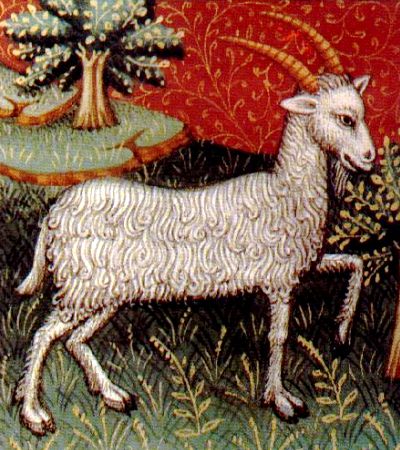
This illustration of Capricorn is from a 15th century astrological handbook.

This illustration of Capricorn is from a 15th century astrological handbook.

Despite its faintness, Capricornus has one of the oldest mythological associations, having been consistently represented as a hybrid of a goat and a fish since the Middle Bronze Age. First attested in depictions on a cylinder-seal from around the 21st century BC, it was explicitly recorded in the Babylonian star catalogues as “The Goat-Fish” before 1000 BC. The constellation was a symbol of the god Ea and in the Early Bronze Age marked the winter solstice.

In Greek mythology, the constellation is sometimes identified as Amalthea, the goat that suckled the infant Zeus after his mother Rhea saved him from being devoured by his father Cronos (in Greek mythology). The goat’s broken horn was transformed into the cornucopia or horn of plenty.Capricornus is also sometimes identified as Pan, the god with a goat’s head, who saved himself from the monster Typhon by giving himself a fish’s tail and diving into a river.

 People born under this Sign are sensitive, sensible and secure in their own space. They not take mindless decisions but at the same time they will take well-calculated risks to get what they want. However, there are some minuses as well. Let’s have a look at some of the usual positive and negative traits of the Capricorn-born.

Known for their pragmatic approach, the Capricorn apply their minds and take into account all the facts before going forward. These confident individuals aim high and do their best to reach their goals. Their ambitious nature can be attributed to their need to build a secure future for themselves and their families. They are wise, sensible and rarely over-the-top. People trust their sound judgment and often come to them seeking their valuable advice. Once they set their eyes on something, they will start their journey to get it. They have all the patience and discipline in the world to get where they want to but they will not take pointless risks.

However, the Capricorn-born can also be pessimistic as they lack the confidence to go against the odds. No matter where they reach in life, on the back of their minds they will see themselves as under-achievers, although they are stubborn will stick to their opinions. Good at communicating but basically shy, they will take their own sweet time to open up. The Capricorn are very concerned about how turn of events will affect them, and therefore, they tend to be quite self-centered. The Capricorn also often come across at detached individuals who will not get close to people beyond a certain point. Emotional involvement doesn’t come easily to them. Mood swings sometimes make them behave irresponsibly and ruin things.