“I want a… Goldfinch?!…for Christmas”

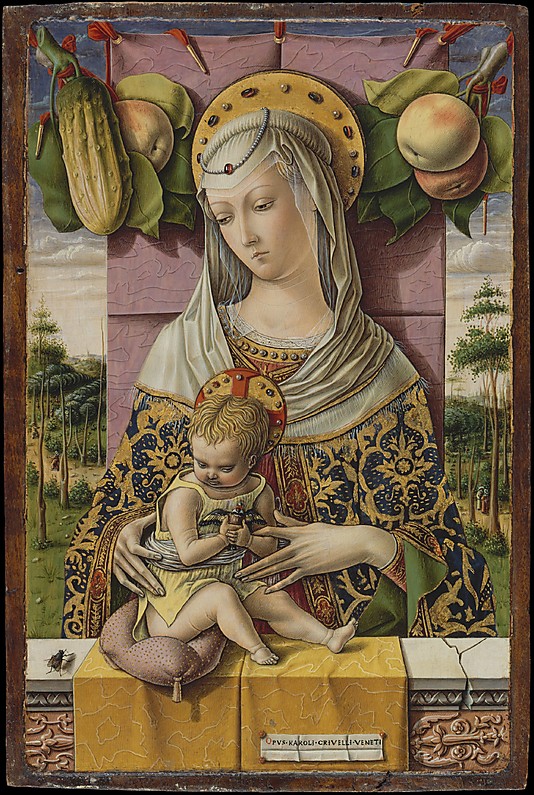
Madonna and Child, by Carlo Crivelli (1480); note the goldfinch in the Christ Child's grasp

Madonna and Child, by Carlo Crivelli (1480); note the goldfinch in the Christ Child’s grasp

Very often in traditional depictions of the Virgin and Christ Child, there is a goldfinch in the baby’s grasp. Why?

The most simple reason might be that in the 14th century it was common for young children to keep tame birds as pets. Christ’s holding a bird allows a parent or a child to recognize his human nature, to identify with him. Despite the angels and the celestial gold background, the viewer is reminded that God lived and died as a man upon the earth.

But when is traditional Christian art ever simple? Or easy?

The goldfinch appears in depictions of Christ’s birth or during his childhood because it was said that when Christ was carrying the cross to Calvary a small bird – sometimes a goldfinch, sometimes a robin – flew down and plucked one of the thorns from the crown around his head. Some of Christ’s blood splashed onto the bird as it drew the thorn out, and to this day goldfinches and robins have spots of red on their plumage. Since goldfinches are also known to eat and nest among thorns, the goldfinch is often read as a prefiguration of Christ’s Passion.

The bird could also be seen as a symbol of the Resurrection of Christ. A non-Biblical legend popular in the Middle Ages related how the child Jesus, when playing with some clay birds that his friends had given to him, bought them to life. Medieval theologians saw this as an allegory of his own coming back from the dead.

Medieval Europeans also saw the goldfinch as a protector against the plague. Since classical times superstition had credited a mythical bird – the charadrius – with the ability to take on the disease of any man who looked it in the eye. The charadrius was sometimes represented as a goldfinch. Perhaps Christ’s finch offers the worshiper protection against the seemingly unstoppable contagion.

Also, since Ancient Egypt, the human soul had been represented in religious art by a small bird. We see the “Ba” (the soul-bird) on a detail of an Egyptian coffins. A very general reading of the goldfinch might, therefore, remind the viewer that his soul is ‘in the hands’ of God.

Curious about that big cucumber hanging from the apple tree? Hmmm… Read a VERY interesting interpretation of it AND other details of this painting here.

Remember the classic “I Want a Hippopotamus for Christmas“?

P.S. After I published this post I got the news that Shelf Media Group announced their selection of the 100 Notable Books of 2016 and Storm Wolf was one of them!

“Coming:” St. Martin’s Fast and Advent

Popular among Western Christians, the advent wreath has 3 purple/red candles and 1 pink that are lit during the 4 weeks before Christmas.

Popular among Western Christians, the advent wreath has 3 purple/red candles and 1 pink that are lit during the 4 weeks before Christmas.

During the 4 weeks before Christmas, most Western Christians (Roman Catholics and Protestants) drape their churches with purple and light candles in a wreath. Children open doors on “advent calendars” to count down the days. They are keeping Advent (the season of “Coming”). Purple is associated with penitential and ascetic exercises; it is also the color of royalty. What “coming” are they preparing for?

Originally, the weeks of Advent were mostly about Christ’s coming as Judge at the End of Days but they also came to be seen as time to prepare for the birth of Christ at Christmas.

In England, especially in the northern counties, there was a custom (now extinct) for poor women to carry around the “Advent images”, two dolls dressed to represent Jesus and the Blessed Virgin Mary. A halfpenny coin was expected from every one to whom these were exhibited and bad luck was thought to menace the household not visited by the doll-bearers before Christmas Eve at the latest.

In Normandy, farmers employed children under twelve to run through the fields and orchards armed with torches, setting fire to bundles of straw, and thus it was believed driving out such vermin as were likely to damage the crops.

In Italy, among other Advent celebrations is the entry into Rome in the last days of Advent of the Calabrian pifferari, or bagpipe players, who play before the shrines of Mary, the mother of Jesus: in Italian tradition, the shepherds played these pipes when they came to the manger at Bethlehem to pay homage to the infant Jesus.

How did all this get organized? In AD 490, Bishop Perpetuus of Tours officially declared Advent a penitential season in the Frankish Church of Western Europe, ordering a fast on three days of every week from November 11 (the feast of St. Martin of Tours) till Christmas. This forty days’ fast, similar to Lent, was originally called Quadragesima Sancti Martini (Forty Days’ Fast of Saint Martin’s) and was primarily about the Last Judgement and the End of Days. In much of Europe, St. Martin’s Day on November 11 is still the beginning of the pre-Christmas season; people eat big dinners of goose, which are very much like dinner on Christmas Day (just as dinner on American Thanksgiving is so very similar to Christmas dinner).

By contrast, the Advent season of the Roman liturgy, developing a century after that of the Frankish Church, was a non-penitential, festive and joyful time of preparation for Christmas. When the Western Church unified the liturgical season, the non-penitential nature of the Roman Advent conflicted with the longer and penitential Gallic Advent. (St. Francis of Assisi expected his followers to keep the St. Martin’s Fast.) By the thirteenth century a compromise was reached, which combined the fasting and penitential character of the Gallic observance with the Mass texts and shorter four-week cycle of the Roman Advent liturgy.

Until recently, it was still common practice for clergy to recall the association of Advent and the Second Coming by preaching about one of the “four last things” on each of the four Sundays of Advent: heaven, hell, death, and judgement.

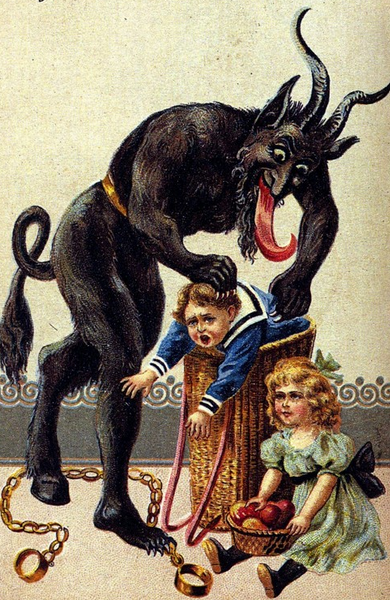
Will you be Meeting the Krampus or Čert?

krampus-stuffing-children-into-basket

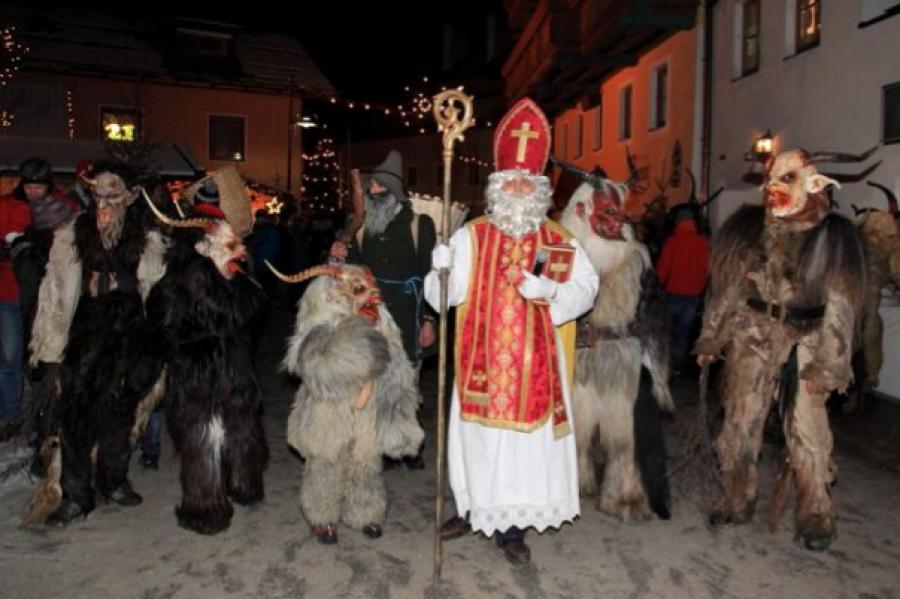
Traditionally on December 5th and 6th, St. Nicholas walks from house to house in the cities and villages of Alpine and Central Europe to admonish and laud young and old. In the Alpine regions, he is accompanied by a Krampus (an evil creature, a devil of sorts), who is going to punish the bad children and adults on St. Nicholas′ command. For the honest children he normally has little presents. In Prague and the Czech-speaking areas of Central Europe, the čert (a clearly demonic character) accompanies St. Nicholas.

In Come Hell or High Water, both St. Nicholas and his čert appear:

“It was commonly supposed [in 1356] that St. Nicholas, as he made his rounds bestowing gifts on children and the needy, was accompanied by both a tar-covered čert, a pitch-black devil, as well as a bright and glorious andel, an angel of light, who each argued for or against the worthiness of the recipient of the saint’s benefactions. The čert was always ready, at the slightest nod from the saint, to carry away the unworthy beggar or misbehaving child and–throughout the year–parents could always warn their children that they might be carried away by the čert….”

St. Nicholas himself is a Christian figure, the fourth century bishop of Myra. As son of a well-situated family, he started to help poor people who lived in deep poverty. He was supposed to have miraculous vigor and so he became patron of the seamen, children and poor people. (See a previous post about St. Nicholas and his care for the poor here.) In most modern versions of the St. Nicholas story, he is accompanied by a monster or servant (the Dutch describe his assistant as Black Peter) who punishes the bad children while Nicholas himself rewards the well-behaved children.

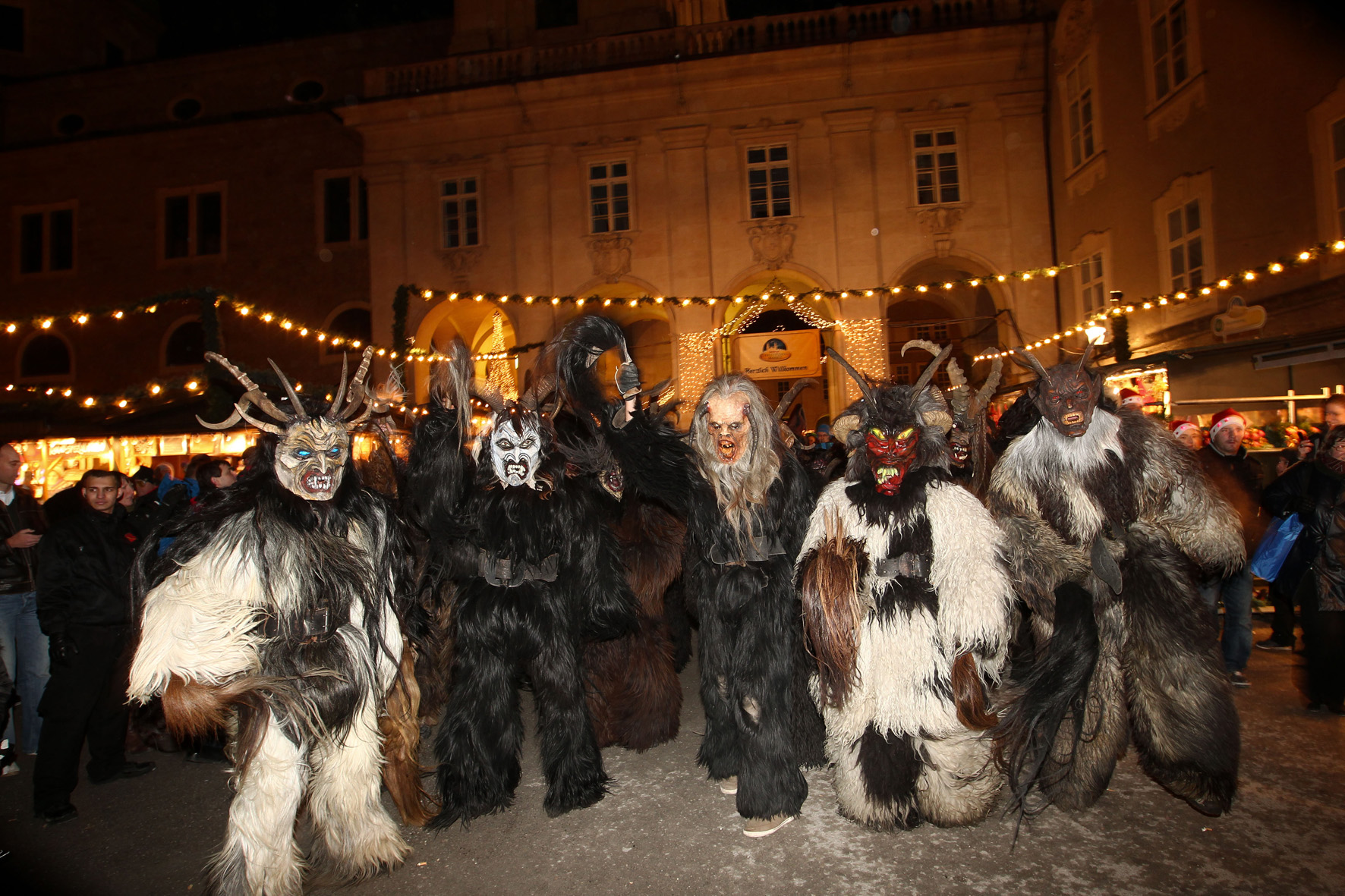
The figure of the Krampus is based on pre-Christian custom. The Krampusse not only punish the bad children but had the function at one time of driving out the winter devils and blizzard sprites. Originally the custom of the Krampus was spread over all of Austria but was forbidden by the Catholic Church during the Inquisition. It was prohibited by death to masquerade as a devil or an evil creature and so this custom only survived in some remote, inaccessible, regions of the Alps from where it slowly spread back across the western parts of Austria again. Today the Krampusse revels are especially popular in Salzburg. As many times as I have been to Salzburg, I have never been there during Krampusse-time; I would dearly love to be there to see the processions and parades of costumed characters in the streets.

St. Nicholas and the Krampus procession in Salzburg (2010); photo by Charlotte Anne Brady.

St. Nicholas and the Krampus procession in Salzburg (2010); photo by Charlotte Anne Brady.

Krampus revels at the Salzburg Christmas Market, 2011; photo by Neumayr/MMV 05.12.2011

Krampus revels at the Salzburg Christmas Market, 2011; photo by Neumayr/MMV 05.12.2011