Tarot for the New Year (2017)

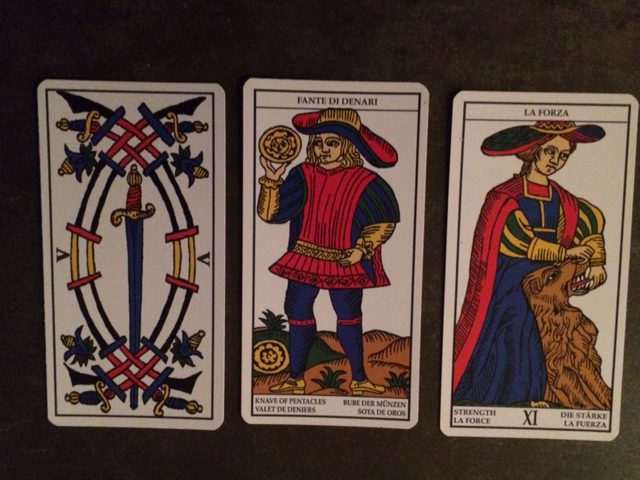
A tarot spread for the coming year, using the Tarot of Marseille (pub. Lo Scarabeo, 1996).

Many forms of divination were practiced by ancient and medieval societies. Most forms of divination were considered “science” originally but are labelled “magic” in current practice. We laugh at some nowadays while others are still enthusiastically embraced. Some have been long forgotten while others are being rediscovered. The most common forms of divination used today are reading stars and reading cards–astrology and tarot. Until only two or three hundred years ago, everyone agreed that the various aspects of the world were so interconnected that they could not help but influence each other. What early and medieval Christians condemned was using divination as a tool to know what MUST happen, denying the possibility of free will and human agency. (The one method of divination that was ALWAYS forbidden in absolute terms was to open the Bible and point to a random verse in order to discover the will of God!) But the Church used these tools of star-reading and card-reading, as did secular society, to anticipate likely outcomes of probable actions.

What does this 3-card spread reveal about the upcoming year (2017)? A quick and simple reading would be that the 5 of Swords indicates both material loss and loss of hope early in the year, followed by new determination to study and engage in personal growth (the Page of Pentacles/Coins), resulting in a renewed sense of personal integrity and strength to confront our difficulties (Strength). Another reader might see these cards indicating not a linear series of developments but a threefold series of interconnected attitudes that continue to revolve throughout the year.
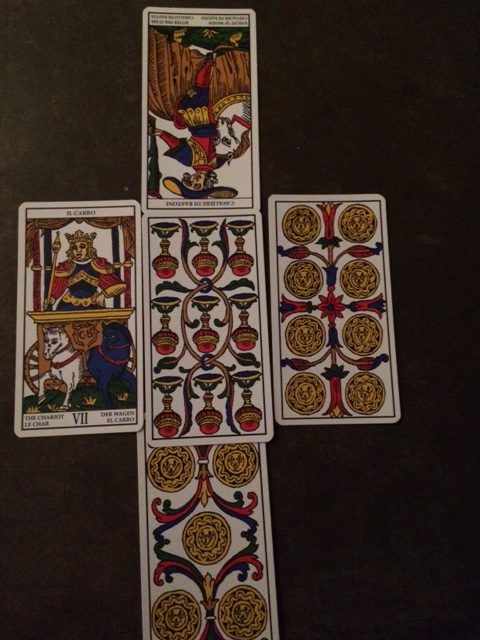
A 5-card spread for the upcoming year using the Tarot of Marseille deck.

A 5-card spread reveals a slightly more complex reading for 2017. The year begins with the Knight of Wands (reversed), followed in the spring by the 8 of Pentacles/Coins, a summer dominated by the 5 of Pentacles, and concluded by The Chariot in the autumn; the 9 of Cups (reversed) is present throughout the year. The quick-and-easy explication of this spread would warn us against an immature person who is headstrong, bossy or a bully-and a risk-taker, who can do dangerous things and convince others to do dangerous things and who dominates the beginning months of the year. In reaction to this person, everyone else must work harder at self-improvement and personal growth (spring) which forces us to confront our own pride or humility in the summer and take appropriate action based on these realizations. In the autumn, this implies a struggle and an eventual, hard-won victory over enemies, obstacles, nature, the uncertainties inside each of us. But this will require confidence as well as unity of purpose and control (between each of the struggling aspects of our personalities as well as in society as a whole) and, most especially, motivation.

The 9 of Cups (reversed) in the center? The card associated with the fulfillment of all our wishes but in a quiet, muted fashion. This can serve as a motivation for all the struggles we engage in throughout the year as well as indicate the result of those struggles.

When I first dealt these two spreads, I was VERY surprised at how much they reinforce and support each other. Do any other tarot readers out there have additional interpretations to suggest?
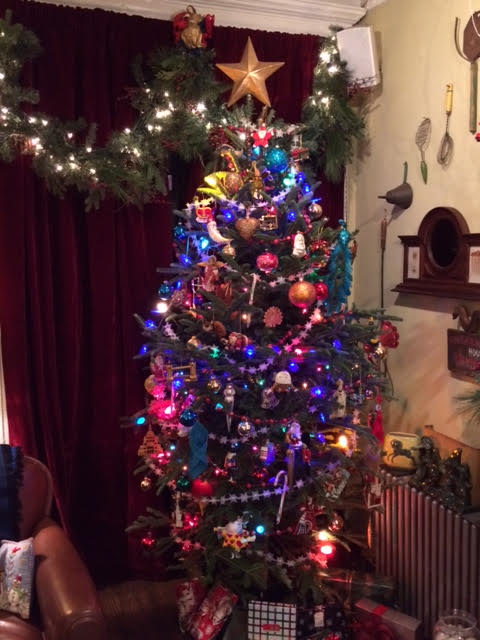
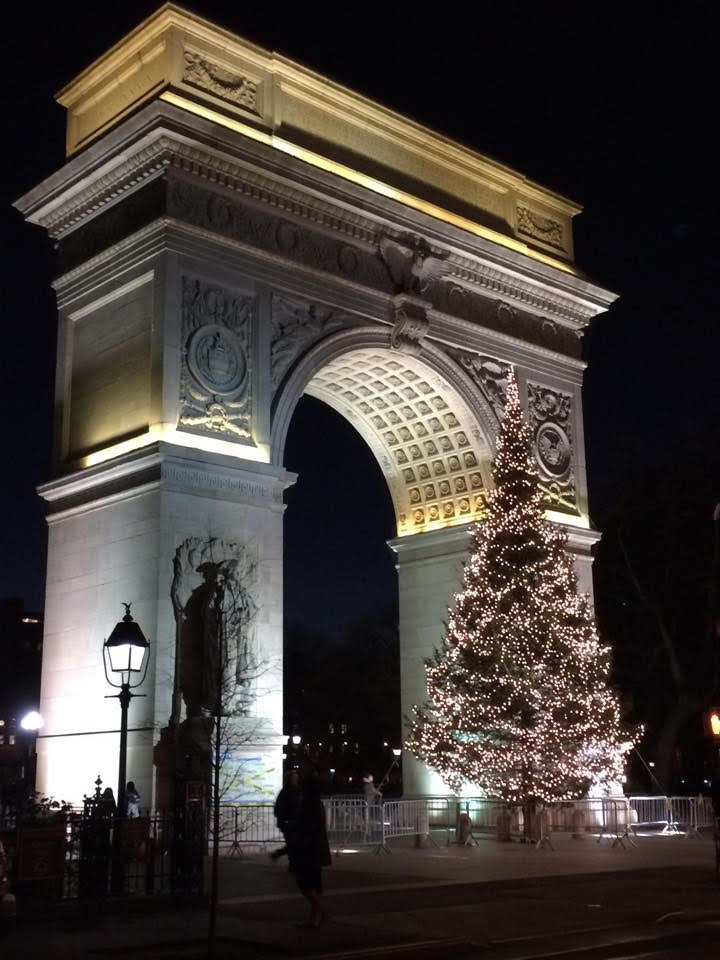
“…How Lovely Are Thy Branches!”

Our Christmas Tree at home this season (2016).

This season’s Christmas Tree in Washington Square Park (2016).

Christmas trees are among the most popular holiday customs of the modern world. Of all sizes and of many shapes, trees are set up in homes and shopping malls and store aisles to be decked with lights, tinsel, and ornaments. Children look forward to the arrival of the tree and share in its decoration. The decorated tree is the surest sign that the “holiday season” has arrived. But some disparage Christmas trees and call them little more than pagan intrusions into the Christian celebration. They cite the sacred trees of the Germanic tribes and assert that the decorated trees in modern houses are an ongoing homage to Thor, Odin, and the other gods of Valhalla. Although certain trees were considered sacred and might be decorated to celebrate certain days, no Germanic pagan would ever dream of cutting down the sacred trees or bringing them indoors. Cutting down the trees was the work of the Christian missionaries, especially St. Boniface of Mainz.

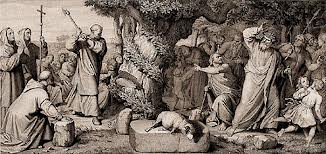
Depiction of St. Boniface cutting down Thor's Oak.

Depiction of St. Boniface cutting down Thor’s Oak.

Cutting down the holy trees was an act of desecration against the gods of Valhalla and an assertion that they were powerless to stop such a violation of their memory. When St. Boniface began to cut down Thor’s Oak, it is said that  “suddenly a great wind, as if by miracle, blew the ancient oak over. When the god did not strike him down, the people were amazed and converted to Christianity. He built a chapel dedicated to Saint Peter from its wood…”

Although the pagan Germanic celebration of the midwinter feast of Yule describes great feasting, there are no mentions of decorated trees. The “Yule logs” were ordinary trees that were cut down and brought in to be burnt, not the sacred trees. To cut down and bring the tree indoors, decorate it, and then burn it is an act specific to the newly-converted Germanic peoples to celebrate the end of the old gods and the birthday of the new.

Good King Wenceslaus — again!

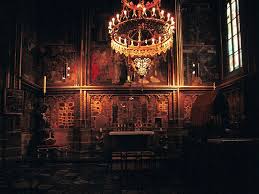
The shrine-chapel of St. Duke Vaclav (Wenceslaus) in St. Vitus' Cathedral (Prague).

The shrine-chapel of St. Duke Vaclav (Wenceslaus) in St. Vitus’ Cathedral (Prague).

Good King Wenceslas is a popular Christmas carol that tells a story of Good King Wenceslas braving harsh winter weather to give alms to a poor peasant on the Feast of Stephen (the second day of Christmas, December 26). During the journey, his page is about to give up the struggle against the cold weather, but is enabled to continue by following the king’s footprints, step for step, through the deep snow. The legend is based on the life of the historical Saint Wenceslaus I, Duke of Bohemia or Svatý Václav in Czech (907–935).

(I remember the first time I was in Prague and stood on the castle battlements looking out across the city during a light snowfall. The city seemed dusted with powder sugar and looked like a fairyland. It was magical. And then–I realized that I could more or less see the cloister of St. Agnes across the river, the famous “St. Agnes’ fountain” of the popular Christmas carol. I was standing more or less where the good king himself must have been standing when he asked his page about the identity of the poor man they saw struggling with his load of winter fuel! The cloister of St. Agnes now houses the National Museum’s breathtaking collection of medieval art. A day or so later, it was breathtaking to walk through the hallways and rooms of the thirteenth century cloister to view some of the most stunning medieval art I have ever seen — even better than the world-famous collection of the Metropolitan Museum of Art at the Cloisters! When you visit Prague, I cannot urge you too strongly to take the time to visit St. Agnes’ cloister along the bend of the river.)

Don’t recall the details of the story? Listen to it now.

In 1853, English hymnwriter John Mason Neale wrote the “Wenceslas” lyrics, in collaboration with his music editor Thomas Helmore, and the carol first appeared in Carols for Christmas-Tide, 1853. Neale’s lyrics were set to a tune based on a 13th-century spring carol “Tempus adest floridum” (“The time is near for flowering”) first published in the 1582 Finnish song collection Piae Cantiones.

Wenceslas was considered a martyr and a saint immediately after his death in the 10th century, when a cult of Wenceslas grew up in Bohemia and in England. Within a few decades of Wenceslas’s death, four biographies of him were in circulation. These hagiographies had a powerful influence on the High Middle Ages conceptualization of the rex justus, or “righteous king”—that is, a monarch whose power stems mainly from his great piety, as well as from his princely vigor.

Although Wenceslas was, during his lifetime, only a duke, Holy Roman Emperor Otto I posthumously “conferred on [Wenceslas] the regal dignity and title” and that is why, in the legend and song, he is referred to as a “king”. The usual English spelling of Duke Wenceslas’s name, Wenceslaus, is occasionally encountered in later textual variants of the carol, although it was not used by Neale in his version. (Wenceslas is not to be confused with King Wenceslaus I of Bohemia [Wenceslaus I Premyslid], who lived more than three centuries later).

[This post was very popular when I first published it in December 2013. This is a slightly revised version.]