
Spring is Sprung!

Snowdrops at a creek announce Imbolc. The first blooms of snowdrops or blackthorns or the first birth of the new lambs were often considered the announcement of Imbolc's arrival. (photo by Tony Eaglehart)

Snowdrops at a creek announce Imbolc. The first blooms of snowdrops or blackthorns or the first birth of the new lambs were often considered the announcement of Imbolc’s arrival. (photo by Tony Eaglehart)

The Celtic — and magical! — festival of Imbolc, celebrated February 1-2, was considered the first day of spring in Celtic cultures and across Europe in general during the medieval period. Although we nowadays generally consider the solstice or equinox the first day of a season (December 21 as the first day of winter, March 21 as the first day of spring, June 21 as the first day of summer, and September 21 as the beginning of autumn), those days were previously considered the mid-seasons. (That is why we can sing Christmas carols about “midwinter” in December and have Midsummer night dreams in June!) The traditional changes of the seasons were the “quarter days” which marked the midpoints between the mid-seasons. So we get the Celtic/magical festivals of Samhain (October 31, the first day of winter), Imbolc (February 1-2, the beginning of spring), Beltane (May, the first day of summer), and Lammas (August 1, the beginning of autumn).

Because Imbolc is the beginning of spring, it is often associated with various means of predicting the coming weather which is so crucial during the planting season of agricultural societies. Hence, we consult the groundhog to determine if he sees his shadow or not in order to know if cold and snow will last another six weeks or not. In Serbia, a bear who wakes from his hibernation to stumble out of his cave and see his shadow will know whether to go back to sleep for another six weeks or not, based on whether he sees his shadow. Imbolc was believed to be when the Cailleach—the divine hag of Gaelic tradition—gathers her firewood for the rest of the winter. Legend has it that if she wishes to make the winter last a good while longer, she will make sure the weather on Imbolc is bright and sunny, so she can gather plenty of firewood. Therefore, people would be relieved if Imbolc is a day of foul weather, as it means the Cailleach is asleep and winter is almost over. At Imbolc on the Isle of Man, where she is known as Caillagh ny Groamagh, the Cailleach is said to take the form of a gigantic bird carrying sticks in her beak.
Happy birthday to Wolfgang and Charles!

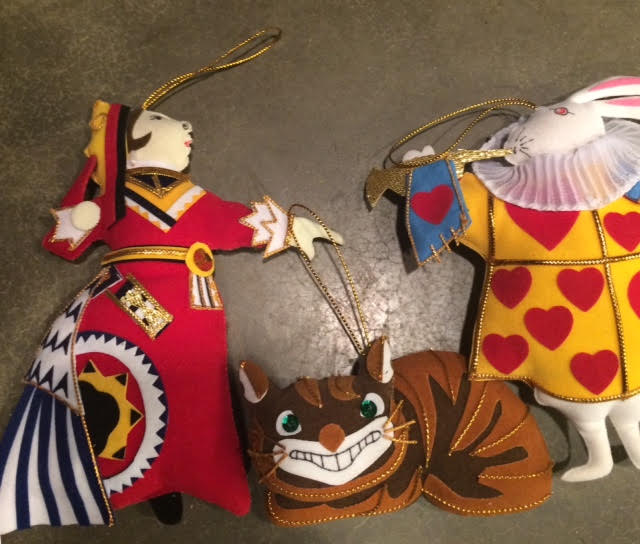
I got these Christmas tree decorations–the Red Queen, the Cheshire cat, and the White Rabbit–at the Alice in Wonderland shop in Oxford.

Happy birthday! Wolfgang Amadeus Mozart was born in Salzburg on January 27,1756 and Charles Lutwidge Dodgson (later known as “Lewis Carroll”) was born in Cheshire, England on January 27, 1832. Both created famous female characters steeped in mystery and magic.

Mozart’s opera The Magic Flute features the Queen of the Night. She is first introduced as the desperate mother whose beloved daughter was kidnapped. But it ultimately appears that she is the villain of the story, who wants to steal the powerful Circle of the Sun. In many ways the Queen of the Night can be regarded as an early symbol of a free woman, given that she claims something which she regards as her legitimate heirloom, but whose property she was denied because she is a woman. She strongly resents this, and is willing to defy the patriarchal order who denies her all authority by any mean she can. She can also be regarded as a symbol of ignorance, either one who covets the Enlightenment she was denied or one who wants to destroy said Enlightenment out of intolerance.

When Dodgson was a professor at Oxford, he created the Alice in Wonderland character. She is also a free woman who sets out on her own to explore the strange alternate universe known as “Wonderland.” Both Alice and the Queen of the Night seem to depend on magic–Alice needed the bottle marked “Drink me” as well as the cookie marked “Eat me” and the Queen’s power and position is threatened by the sorcerer Sarastro–but neither seem to be completely in control of the magic they depend on.

When I’ve been to Oxford, I have seen many of the places that also appear in the Alice stories, such as the tree that the Cheshire cat sat in and the small door known as the “rabbit hole” in the dining hall. There is a small store there that features nothing but Alice-related items.

You can see great spoofs of the famous Queen of the Night aria here and here. Enjoy!

St. Antony

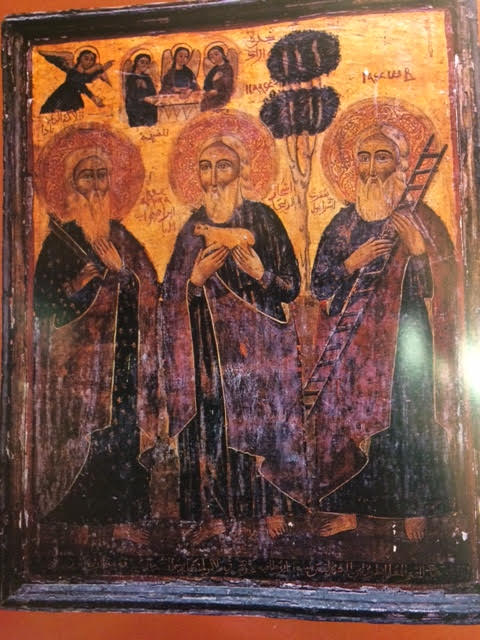
Coptic icon of Abraham, Isaac, and Jacob and the 3 angels at Mamre; dated AD 1497. An inscription along the bottom asks the Lord to remember an archpriest’s son named Antony.

My partner Elliot was recently in Egypt and brought me home a beautiful book of Coptic icons as a gift. (I took these photos from the icons in the book. So gorgeous! Thank you, Elliot!)

Although many saints from Egypt have played fundamental roles in establishing basic Christian understandings of God and Christ (such as SS. Athanasius and Cyril of Alexandria in the 4th and 5th centuries), another saint from Egypt has been nearly just as important: St. Antony, the first monk to found a monastic community. His life story, written down by St. Athanasius, has been said to have been nearly as popular as the New Testament and to have had nearly as big an impact on Western civilization.

Antony was not the first monk that we know of–that was St. Paul the hermit, who also lived in the Egyptian desert. But St. Antony was the first to establish a community of monks living in the desert. (There were also communities of nuns living in cities already when he went out into the desert for the first time.) There were soon thereafter huge “cities” of monks living in the deserts of Egypt and then across the Middle East and then across Western and Eastern Europe. The monastic centers that sprang up helped preserve ancient books and civilization and philosophy as well as spread Christian theology, literature, and liturgical practice.

St. Antony is the patron saint of butchers and pig farmers. His feast day, January 17, is an important date in Come Hell or High Water, Part 1: Wellspring.

In this chapter, a young man attempts to steal donations from a church in medieval Prague but it is the parish church of the butchers’ guild. The butchers find the young man and cut off his arm and hung it near the front door of the church as a warning to anyone who would attempt to steal from the church in the future. The arm is still hanging there in St. Jakub’s church, near the Old Town Square.

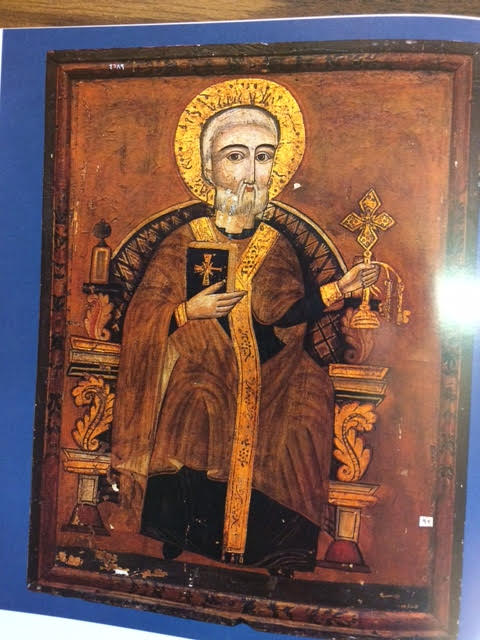
Coptic icon of Apostle Peter in the Coptic Museum (Egypt).