

Leap Year is Coming!

An extra day is added to February every 4 years; Julius Ceasar ordered that February begiven an extra day to keep the seasons in balance with the calendar dates.

This year, February has only 28 days. However, next year is a Leap Year and February will have 29 days. It’s time to start thinking about how to observe this day which occurs only once every four years.

For instance, according to an old Irish legend or history, St Brigid struck a deal with St Patrick to allow women to propose to men–and not just the other way around–every four years, on February 29. This was to balance the traditional roles of men and women in a similar way to how leap day balances the calendar. In Scotland however, to ensure success the woman should also wear a red petticoat under her dress–and make sure that it is partly visible to the man when they propose (as red is associated with love and passion).

In some places, Leap Day has been known as “Bachelors’ Day” for the same reason. A man was expected to pay a penalty, such as a gown or money, if he refused a marriage proposal from a woman on Leap Day.
In many European countries, especially in the upper classes of society, tradition dictates that any man who refuses a woman’s proposal on February 29 has to buy her 12 pairs of gloves. The intention is that the woman can wear the gloves to hide the embarrassment of not having an engagement ring. During the middle ages there were laws governing this tradition.

Also in Scotland, it used to be considered unlucky for someone to be born on Leap Day, just as Friday 13th is considered an unlucky day by many. Greeks consider it unlucky for couples to marry during a leap year, and especially on Leap Day.

Leap Day is also St. Oswald’s Day, named after the archbishop of York who died on February 29, AD 992. His memorial is celebrated on February 29 during leap years and on February 28 during other years.

According to the Guinness Book of Records, there is a family that holds the world record of having a baby born on February 29 for three generations in a row!

St. Valentine AND St. Hyacinth

Hyacinth and bluebells are traditionally associated with love and fidelity, telling the truth — and rabbits!

“Saint Hyacinth!” Who’d athunk it?!

Last year, a reader of Romanian background remarked that a post about St. Valentine and love magic made no reference to Eastern European legends or practice. She asked, “Who is the Orthodox version of St. Valentine?” I decided to look into that question and discovered that St. Hyacinth is the Eastern European answer to St. Valentine!

It seems that there are several men named Hyacinth in the Orthodox calendar of saints. The one most consistently associated with love, like Valentine, was a martyr who was put to death for his faith with his brother Protus during the reign of the emperor Trajan (AD 257-9). They were baptized as adults, spent time living with the hermits in Egypt, were beheaded for their faith, and buried together in one tomb. Their brotherly devotion to each other is one source of their association with matchmaking and love.

But that’s not the end of the story. Hyacinth and Protus are said to have been “brothers,” a frequent euphemism for male partners. Such male partnerships first developed among monks as a way to support their mutual prayer, Bible study, and ascetic effort. Among laymen, this “brotherhood” might or might not have included a sexual aspect. (I highly recommend Claudia Rapp’s excellent study of brother-making if you are interested in learning more about this.)

But that is still not all of the story. St. Hyacinth is also associated with love and devotion because the original Hyacinth, a male character from Greek mythology, was a beautiful young mortal man who was beloved by both Apollo (the sun god) and Zephyrus (the god of the west wind). According to the myth, Zephyrus became jealous of Apollo and angry at sharing the attentions of Hyacinth — Hyacinth was evidently more fond of Apollo. So one day as the three were throwing a discus (not unlike three friends tossing a Frisbee), Zephyrus caused the wind to blow the discus into Hyacinth’s head. Hyacinth died of the gash to his head and the first bluebells (also called “hyacinth”) bloomed where his blood spattered the ground. The small blossoms of the flowers are marked by dark spots that resemble the Greek letters AI, which spell the word “Alas!” in Greek.

Hyacinths and bluebells are said to prevent someone from telling a lie just as Hyacinth was honest about his feelings for Apollo. The flowers are also used to promote love and fidelity. They were used in folk medicine but the bulbs contain toxic drugs and are not usually used any more. They are sometimes called “harebells” because rabbits are frequently seen where the flowers bloom and are said by some to be used by witches as they transform into were-rabbits.

There is a wonderful series about bluebell and hyacinth folklore here.

And what about Eastern European love magic? I found a great article about contemporary folk magic in an area where Serbia and Romania meet.

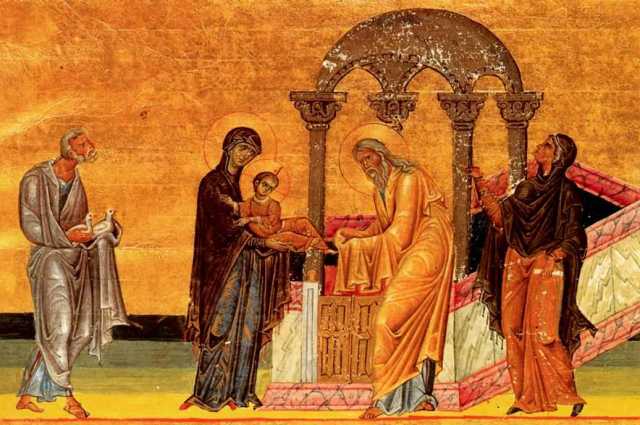
Presentation of Christ: The Encounter

This 10th century Byzantine manuscript illumination depicts the Presentation of Christ when he was 40 days old, described inthe Gospel of St. Luke.

In the Eastern Orthodox Church, the Presentation of Jesus–an early episode in the life of Jesus, describing his presentation at the Temple in Jerusalem is described in the Gospel of Luke and which combines the purification rite with the Jewish ceremony of the redemption of the firstborn (Luke 2:23–24)–is celebrated as one of the twelve Great Feasts, and is usually called Hypapante (“Meeting” or “Encounter” in Greek).

In this episode, Christ encounters the elderly Simeon and Anna, representatives of the Chosen People who anxiously await the coming of the Messiah. The emphasis is less on his presentation in the temple (which was to “buy back” the first-born son, a Jewish practice that looks back to the death of the first-born in Egypt) or the purification of his mother (women were considered impure because of the blood shed during childbirth) and more on this face-to-face meeting of Christ and those who look for him. This encounter becomes the model for the encounter between Christ and all those who pray, receive Holy Communion, or otherwise look to meet Christ in the circumstances of their own lives. Simeon and Anna become the model for all the faithful throughout history.

In Western Christianity, there is an additional name for this day: Candlemas. This feast day is also known as the Purification of the Blessed Virgin or the Presentation of the Lord. In the Roman Catholic Church, the Presentation is the fourth Joyful Mystery of the Rosary. Also, in the Latin Rite of the Catholic Church, the Anglican Communion and the Lutheran Church, the episode was also reflected in the once-prevalent custom of “churching” new mothers–coming to church for the first time–forty days after the birth of a child.