
Passiontide

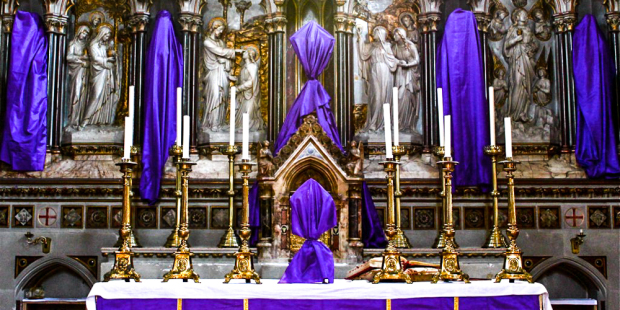
The statues and cross on this altar are veiled for the two weeks of Passiontide.

In western Christian liturgical practice, the last two weeks before Easter were commonly known as “Passiontide.” The statues and crosses would be veiled. Some think this dates from a time when Lent was itself only two weeks long and that the images were therefore veiled for all of Lent. Some think that as Lent became longer–finally becoming the 40-day fast it is now–that the statues and crosses were veiled for all of Lent. Practices varied a great deal across western Europe. In some places the crosses were covered on Ash Wednesday; in others on the first Sunday of Lent. In England it was customary on the first Monday of Lent to cover up all the crucifixes, images of every kind, the reliquaries, and even the cup with the Blessed Sacrament. In other places, veils were still only used during the two weeks of Passiontide itself.

Why cover the cross and other images? Scholars suggest that at the time when veiling was introduced, the image of Christ on the Cross was still that of Christ Triumphant: his eyes are open, he is calm, and he is robed as a king or priest. He is ruling the world from the throne of the Cross, as many iturgical hymns say. The image of Christ on the Cross as the Man of Sorrows (his body twisted in agony, his eyes often closed in death, the pain and agony of Crucifixion on full display) did not become popular until much later. The veils were thus used to hide the triumphant images of Christ as the faithful were preparing to celebrate that triumph. (The saints are likewise images of Christ triumphant in the lives of believers and would therefore be covered as well during the time of preparing to celebrate Christ’s triumph over Death.) By the time the image of the Man of Sorrows on the Cross–which would be appropriate for veneration during the preparation for Easter–became popular, the veils had become too entrenched in popular custom and so the images of Christ on the Cross continue to be covered.

Even in the Orthodox world, the two weeks before Easter are distinct liturgical periods: the Week of Palms which leads up to Palm Sunday and the Passion Week which culminates in Good Friday-Holy Saturday-Pascha (Easter). But the images are not veiled in Orthodox churches.

A beautiful example of Christ Triumphant on the Cross from 13th century Pisa–currently in the collection of the Cleveland Museum of Art–can be seen here.
St. Mary of Egypt

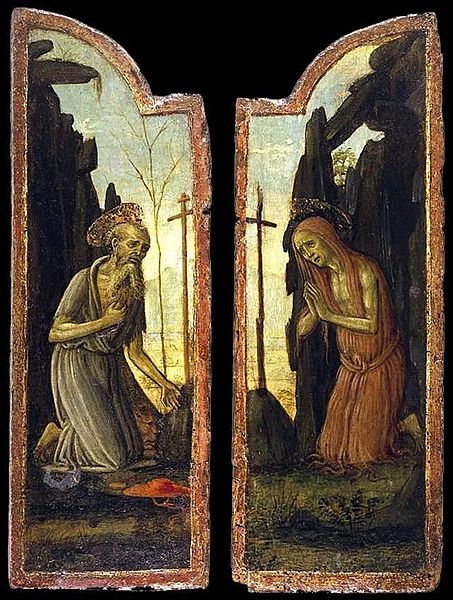
St Jerome and St Mary of Egypt (first half of 16th century)

St. Mary of Egypt was among the most popular saints of the Middle Ages. She is still extremely well-known in the Orthodox Church although she is not as well known anymore among Western Christians. She is considered a model of repentance and commemorated on April 1 (the anniversary of her death) and the 5th Sunday of Lent (in the Orthodox liturgical tradition).

According to her life (written by Sophronius, 7th century patriarch of Jerusalem and available in the Golden Legend), Mary was a sexually active young girl who ran away from home in Egypt when she was 12. Her parents never heard from her again and never knew what befell their daughter. She made her way to Jerusalem, seducing men along the way. She had a conversion experience in Jerusalem and fled into the desert, where she lived as a hermit for several decades. A lone monk discovered her one spring and learned the story of her life. He brought her Holy Communion the next year. When he attempted to meet her a third time, he discovered her body and realized that she had died only hours after he had given her Holy Communion.

She was clearly a headstrong young woman. She used the resources available to her to make her way in the world. Coming from a poor, rural family, that meant her only resource was her body. But her conversion experience made her realize that relying on her sexuality to survive was a dead-end; she wanted more than a collection of sensual experiences and memories to give meaning to her life. So she embraced an extreme form of desert asceticism as a hermit. Just as her sexual behavior was extreme, her asceticism was as well. She was not given to half-measures.

There were many versions of her life available in medieval Europe, a testimony to her popularity. Many of them are still available, in translation. Her image was painted many times as well.

“Beware the Ides of March 2019!”

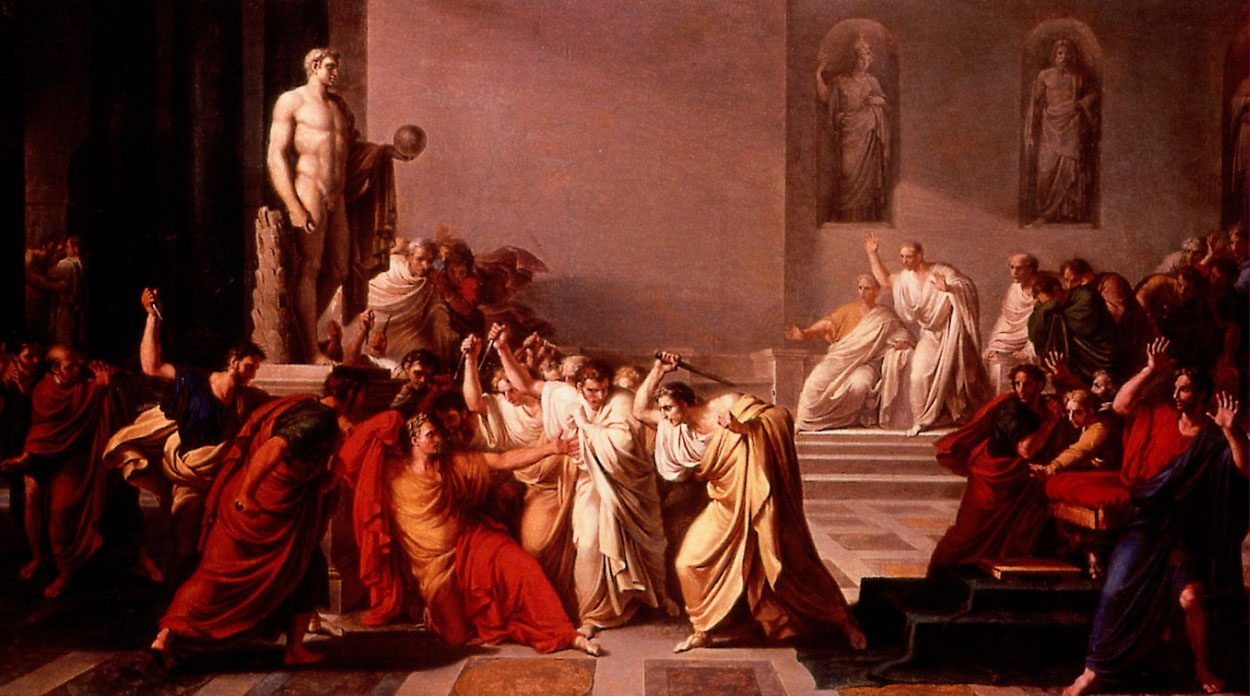
Vincenzo Camuccini, "Morte di Cesare", 1798,

Vincenzo Camuccini, “Morte di Cesare”, 1798,

“Beware the ides of March!” the prophet warned Julius Caesar in 44 B.C. and Caesar was assassinated shortly thereafter, on the ides. Ever since, the Ides of March has been a day associated with doom, disaster, or failure in some form. But what is the “ides”?

Unlike currently used dates, which are numbered sequentially from the beginning of the month, the Romans and medieval Europeans counted backwards from three fixed points: they designated the “kalends,” the “nones,” and the “ides” and all other dates were based on these. (ex. the kalends = the 1st, the nones = the 5-7th, and the ides = the 13-15th days of the month). For instance, rather than saying, “Today is March 3” they would say, “Today is three days before the nones of March.” The kalends marked the new moon, the nones was the half-moon and the ides was the full moon.

The ides of the month marked the full moon and thus the following days of each month were governed by the waning moon, a good time for curses as dark magic grew more powerful as the nights grew darker. Not only would dark magic grow stronger but the darker nights also made crime in general more likely. That the last half of each month was steeped in evil and disaster was underscored by its association with the assassination of Caesar.

Even before the assassination of Caesar, the Ides of March had been important in Roman religion. The Ides of each month were sacred to Jupiter and the Flamen Dialis, Jupiter’s high priest, led the “Ides sheep” in procession along the Via Sacra to the place where it would be sacrificed.

In addition to the usual Ides monthly sacrifice, the Ides of March was also the occasion of the Feast of Anna Perenna, a goddess of the year (Latin annus, hence words like “annual” in English) whose festival originally concluded the ceremonies of the New Year. The day was enthusiastically celebrated among the common people with picnics, drinking, and revelry. One source from late antiquity also places the Mamuralia on the Ides of March. This observance, which has aspects of a scapegoat ritual, involved beating an old man dressed in animal skins and perhaps driving him from the city. The ritual may have been a new year festival representing the expulsion of the old year.

In the later Imperial period, the Ides of March began a “holy week” of festivals celebrating Cybele and Attis, marking first the day when Attis was born and found among the reeds of a Phrygian river. He was discovered by either shepherds or the goddess Cybele (known as the Magna Mater or “Great Mother”). A week later, on March 22nd, the solemn commemoration of Arbor intrat (“The Tree enters”) commemorated the death of Attis under a pine tree. A college of priests, the dendrophoroi (“tree bearers”) annually cut down a tree, hung from it an image of Attis, and carried it to the temple of the Magna Mater with lamentations. The day was formalized as part of the official Roman calendar under Claudius (who died in AD 54). A three-day period of mourning followed, culminating with celebrating the rebirth of Attis on March 25th, the date of the vernal equinox on the Julian calendar.