St. Ursula and the Virgin Martyrs of Cologne

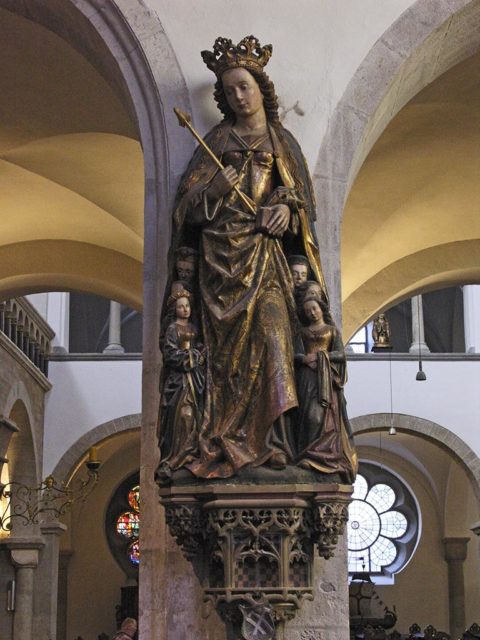
Statue of St. Ursula and her companions (clustered together beneath her cloak) in the church of St. Ursula in Cologne.

St. Ursula (Latin for “little bear”) was among the most popular saints of Western Europe during the Middle Ages. She and her companions–later versions of her life story report that she had 11,000 women with her although there were doubtless a much smaller group of women actually with her, probably 11 that was later expanded by a error in transcription–travelled to Cologne from Wales and were martyred in Cologne; there are records indicating that the women were executed AD 400.

The church of St. Ursula in Cologne is Romanesque, built in the 11th century atop the ancient ruins of a Roman cemetery, where the virgins associated with Saint Ursula are said to have been buried. The church has an impressive reliquary created from the bones of the former occupants of the cemetery. It is one of the twelve Romanesque churches of Cologne and was designated a basilica in the canonical, if not architectural, sense in June 1920.

The “Golden Chamber” of the church contains the remains of St. Ursula and her companions who are said to have been killed by the Huns. The walls of the Golden Chamber are covered in bones arranged in designs and letters along with relic-skulls. The exact number of people whose remains are in the Golden Chamber remains ambiguous but the number of skulls in the reliquary is greater than 11 and less than the 11,000. These remains were found in 1106 in a mass grave and were assumed to be those of the legend of St. Ursula and the virgins. Therefore, the church constructed the Golden Chamber to house the bones.

The small village of Llangwyryfon, near Aberystwyth in west Wales, has a church dedicated to St. Ursula. The village name translates as ‘Church of the Virgins’. She is believed to have come from this area. The Order of Ursulines, founded in 1535 by Angela Merici, and devoted to the education of young girls, has also helped to spread Ursula’s name throughout the world. St. Ursula was named the patron saint of school girls.

It has been theorized that the character of St. Ursula is a Christianized form of the Norse goddess Freya, who welcomed the souls of dead maidens. Other 19th-century scholars have referred to the goddesses Nehalennia, Nerthus and Mother Holda.
Walsingham and Prague and Loreto… and Nazareth

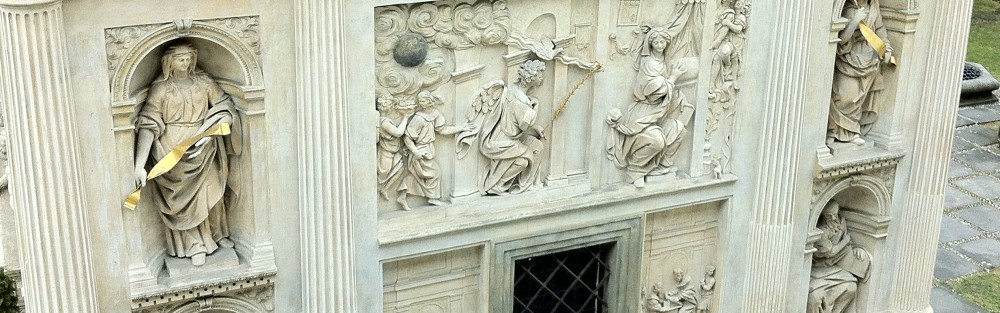
Detail from the marble chapel built around the Prague replica of the Holy House from Nazareth. Construction started in 1626 and the Holy House was blessed on 25 March 1631.

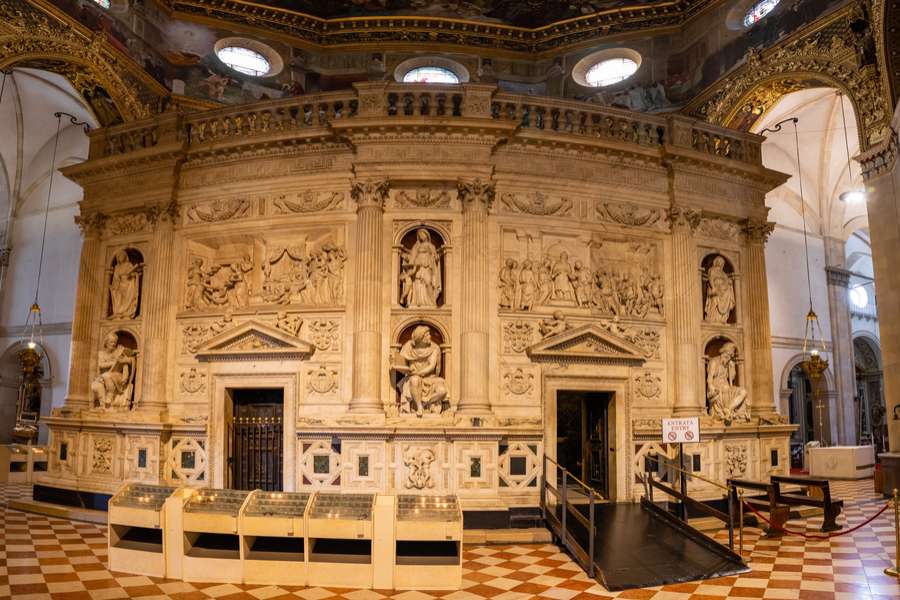
The marble facade of the Holy House in Loreto, Italy is very similar to the marble facade of the Holy House in Prague.

Everyone agrees that Jesus grew up in Nazareth. He lived there with the Virgin Mary and St. Joseph. So how can so many places in Europe claim to have the Holy House of the Virgin Mary?

There was a chapel of the Virgin in Loreto, Italy since the late AD 1200s. It contained a small replica of the house in Nazareth for the faithful to visit if they could not go on pilgrimage to the Middle East. Monks (often referred to as “angels”) brought a few stones from Nazareth to add to the Holy House in Loreto. During the Renaissance, an elaborate marble façade was built around the Holy House to protect it and then a large church was built around the marble chapel. “Our Lady of Loreto” is the title of the Virgin Mary with respect to the Holy House of Loreto and her statue, carved from Cedar of Lebanon, is a “Black Madonna” (owing to centuries of lamp smoke).

Other replicas of the Holy House were constructed in many places. The most famous are in Prague and Walsingham. (The Holy House in Walsingham was destroyed by order of King Henry VIII but new shrines of the Mother of God were built there in the late 1800s and early 1900s.) The original statue of the Mother of God was thought to be destroyed when the Holy House–often called “England’s Nazareth”–was destroyed but it might have been cleverly hidden instead. A statue of the Virgin in the Victoria and Albert Museum might be the original; read about it here.

Protection of the Mother of God (Part 2)

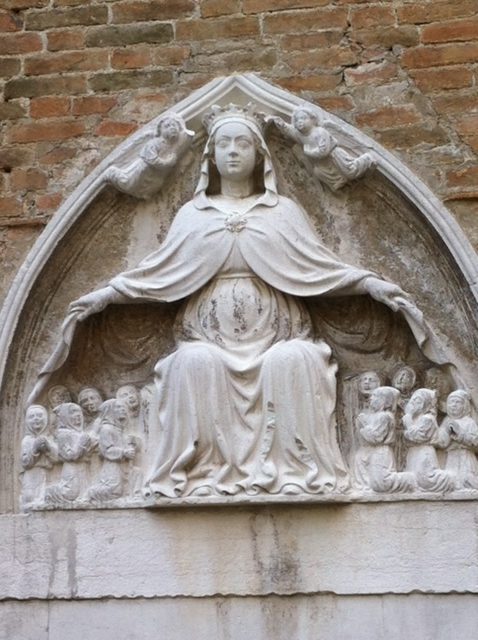
A medieval bas relief in Venice of the Mother of God protecting the faithful gathered under her veil.

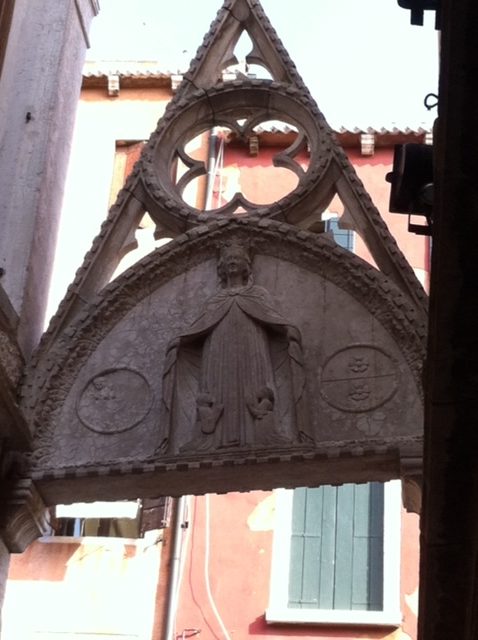
An archway atop a small pedestrian bridge in Venice depicts the Mother of God protecting the faithful with her veil.

Western Christian depictions of the Protecting Veil of the Mother of God are often called “the Virgin of Mercy” and are sometimes associated with Christ’s remarks that He “longed to gather your children [the people of Jerusalem] together, as a hen gathers her chicks under her wings….” (Matthew 23:37) The Mother of God is shown with the faithful of many social ranks and classes gathered on their knees beneath her outstretched cloak. As she is the bridge that unites earth to heaven, having nurtured Christ in her womb and giving birth to God-made-man, her image is frequently seen near bridges. (The Latin word for “priest” (pontifex) comes from the Latin for bridge-builder because priests also act as bridges between Heaven and earth, divinity and humanity.

Probably the oldest Western version of this image is a small panel by Duccio of c. 1280, with three Franciscan friars under the cloak, in Siena. The Franciscans seem to have been devoted to the idea of the Virgin’s protecting veil and were important in spreading this form of iconography, which remains important in much of Latin America.

The image of Our Lady in Walsingham was not the Virgin of Mercy with her protecting veil but the shrine of Walsingham did celebrate the feast of Our Lady of Mercy as its patronal feast day. The popularity of the Walsingham shrine led many to call England “the dowry of the Virgin” and thus celebrate the Virgin of the Dowry on the same day as well.

The importance of the Virgin’s mercy and protection underlines the communal nature of Christianity and the dependence of the faithful on each other–as well as on particular saints–in times of adversity. In the gospel, it is rare that a sick person is healed because of their own faith; usually the sick are healed because their friends had the faith to approach Christ and ask that He heal the sick or cast out the demon(s) from the possessed. It is the faith of their friends which heals and saves those most in need.