A great podcast with fascinating episodes–especially the episode about the acoustics of Hagia Sophia and the experience of singing the Divine Liturgy there. Anthony, the host, recently interviewed me about When Brothers Dwell in Unity: Byzantine Christianity and Homosexuality (McFarland, 2016). Listen to the interview here.
An icon of St. Nicholas with scenes from his life around the edge. Christ and the Mother of God are shown returning his vestments to him, based on a dream-vision he had while he was in prison, deprived of serving his flock because the emperor disagreed with his theology.
St. Nicholas was a bishop in 4th-century
Turkey but is commonly known as “Santa Claus” in much of the Western World. He
brings gifts to good children on his feast day (December 6) or on Christmas
Day; in some places, he is said to take away bad children in his empty gift
bag. He is sometimes accompanied by a servant or devil who takes away the bad
children or leaves switches for their parents to beat them.
His tomb is in Myra (a small town
in modern Turkey) but many of the remains were stolen by Italian sailors and
taken to Bari in 1087. The sailors
from Bari only took the main bones of Nicholas’s skeleton, leaving all the
minor fragments in the grave. The city of Venice had interest in
obtaining the remaining fragments of his skeleton and, in 1100, a fleet
of Venetian ships sailed past Myra on their way to Palestine for the First Crusade. The Venetians took the remaining bones of
Saint Nicholas, and brought them to Venice. This story was lent credence in two scientific
investigations of the relics in Bari and Venice, which confirmed that the
relics in the two cities are anatomically compatible and may belong to the same
person.
In
the late 1950s, while the crypt was undergoing much-needed restoration, the bones were
removed from it for the first time since their interment in 1089. A
special Pontifical Commission permitted Luigi Martino, a professor of human
anatomy at the University of Bari, to examine the bones under the Commission’s supervision.
Martino took thousands of measurements, detailed scientific drawings,
photographs, and x-rays. These examinations revealed the saint to have
died at over seventy years of age and to have been of average height and
slender-to-average build. He also suffered from severe chronic arthritis
in his spine and pelvis.
Another
test in 2017 in Oxford involved radiocarbon dating, which confirmed that the bones
date to the fourth century AD, around the same time that Saint Nicholas would
have died, and are not a medieval forgery.
A great introduction to the basic theology of the Incarnation and our experience of salvation.
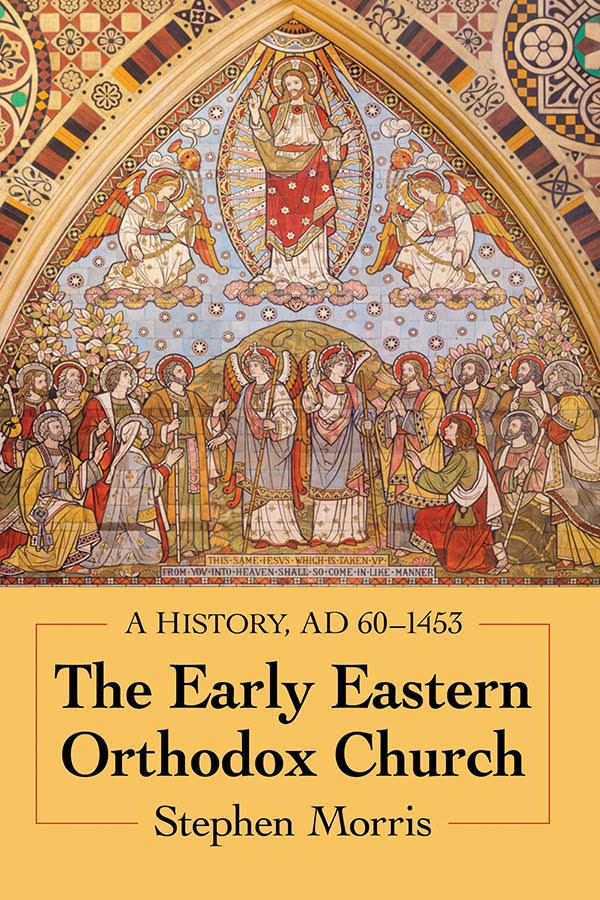
Looking for a book to read this Advent? Look no further! A great introduction to the basic theology of the Incarnation and our experience of salvation, The Early Eastern Orthodox Church: A History (AD 60-1453), provides what you are looking for. Easy-to-read, user-friendly chapters give the background of the great controversies about how divinity and humanity are present in Christ. Excerpts from the leading theologians of the 4th to 7th centuries are given. Their ideas are discussed and explained in language modern readers can easily grasp.
What better way to prepare for Christmas than to spend time with St. Athanasius of Alexandria, St. Cyril of Alexandria, and St. Maximus the Confessor in order to better understand the mystery of God becoming human in Christ? The early Christian struggle to understand how Jesus is both 100% divine and 100% human is described. The vital role of Mary–and the importance of her title “Mother of God” as the way to adequately describe who her Son truly is–is the subject of one chapter as is the harmonization of our struggling, combative wills with Christ’s will for us.
Although Jesus is the unique God-made-human whose birth we celebrate at Christmas, we are able to share in His life.
“The Word of God, born once in the flesh (such is His kindness and His goodness), is always willing to be born spiritually in those who desire Him. In them, He is born as an infant as He fashions Himself in them by means of their virtues. He reveals Himself to the extent that He knows someone is capable of receiving Him. He diminishes the revelation of His glory not out of selfishness but because He recognizes the capacity and resources of those who desire to see Him. Yet, in the transcendence of mystery, He always remains invisible to all.” (St. Maximus the Confessor)
Get your copy of The Early Eastern Orthodox Church: A History (AD 60-1453) now and celebrate Christmas with a new or deeper understanding and appreciation for the coming together of humanity and divinity in the manger at Bethlehem.