The Seventh Seal

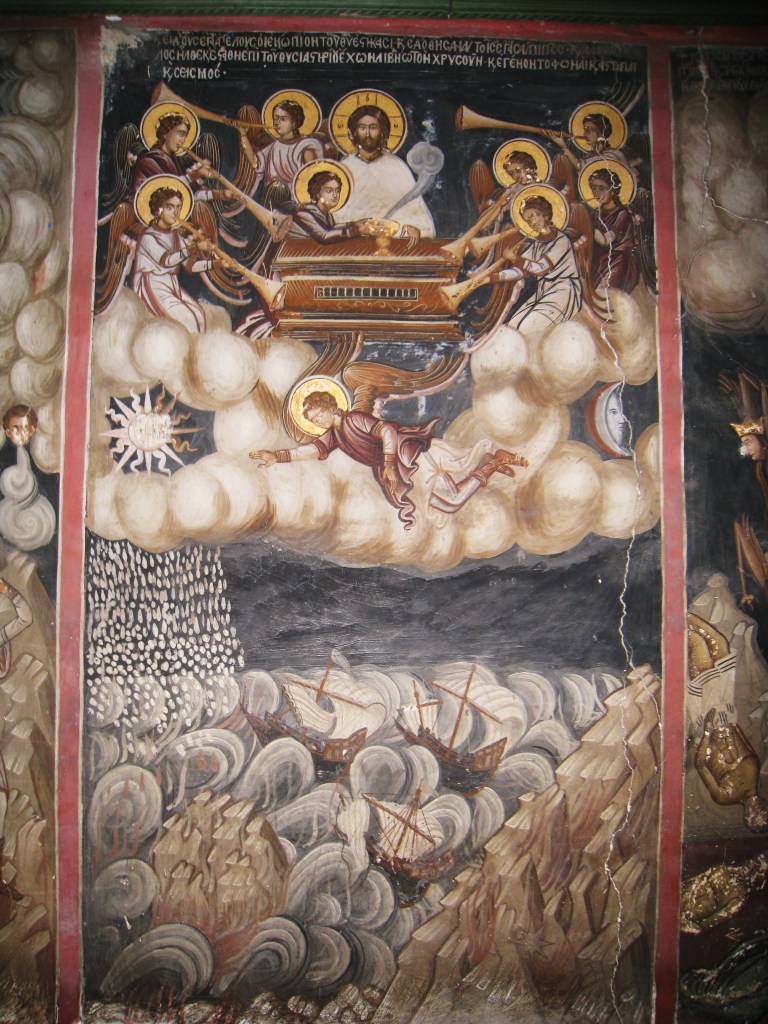
Dionysiou Monastery on Mt. Athos was founded in 1374. In its refectory (dining hall) is a magnificent series of frescoes that illustrate the Apocalypse. In this illustration of chapter 8, we see the seven angels with trumpets, the censer with smoke, a mountain in the sea, the bloody sea water, destroyed ships, the fountain of water, the star Wormwood (in the rocks in the right corner), a darkened sun, etc.

When the Lamb broke the seventh seal, there was silence in heaven for about half an hour. I saw the seven angels who stand before God and they were given seven trumpets. (Apoc. 8:1)

The silence in heaven is momentous. It grabs the attention. It is louder than the thunder and commotion that either precede or follow it. Silence is not simply the absence of noise or the lull between events, one thing having finished and the other not yet having started as sometimes happens when a reader or performer is not ready to begin. Silence is a living presence.

I read many years ago that the most brilliant moment in music is the silence before the Et incarnatus of Bach’s “B Minor Mass.” The silence in heaven is like that. It is the sudden silence that follows Dorothy’s house crashing into Munchkinland as it drops from the cyclone in which she has seen Miss Gulch become the Wicked Witch.

This silence in heaven is an echo of the silence in heaven that preceded God’s first utterance: “Let there be light.” (see 4 Ezra 7:30-33) The apocalyptic silence in heaven is liturgical silence, the moment when all creation holds its breath seeing the Word of God crucified. It is the silence of the Great Entrance on Holy Saturday: God the Word has died and descended into Hades. It is the moment before all creation is turned topsy-turvy by Life himself tearing Death to shreds from the inside out.

Before the angels blow their trumpets, another angel-deacon comes to offer incense at the heavenly altar. There is “much incense” offered. The smoke creates an impenetrable cloud, much like the cloud of incense that the prophet Isaiah also saw (Isaiah 6). It was said that when the High Priest offered incense in the Holy of Holies on Yom Kippur that there was not enough smoke if he could still see his hand in front of his face. The smoke creates a buffer that serves to protect the human from the brilliant glory of God that would annihilate anything or anyone that dared stand unprotected in the terrible light.

In the Our Father, we pray, “Thy kingdom come.” Before the kingdom comes, all creation holds its breath and peers through the smoky clouds of incense, waiting to see what will happen when God reveals himself.
The Seven Seals

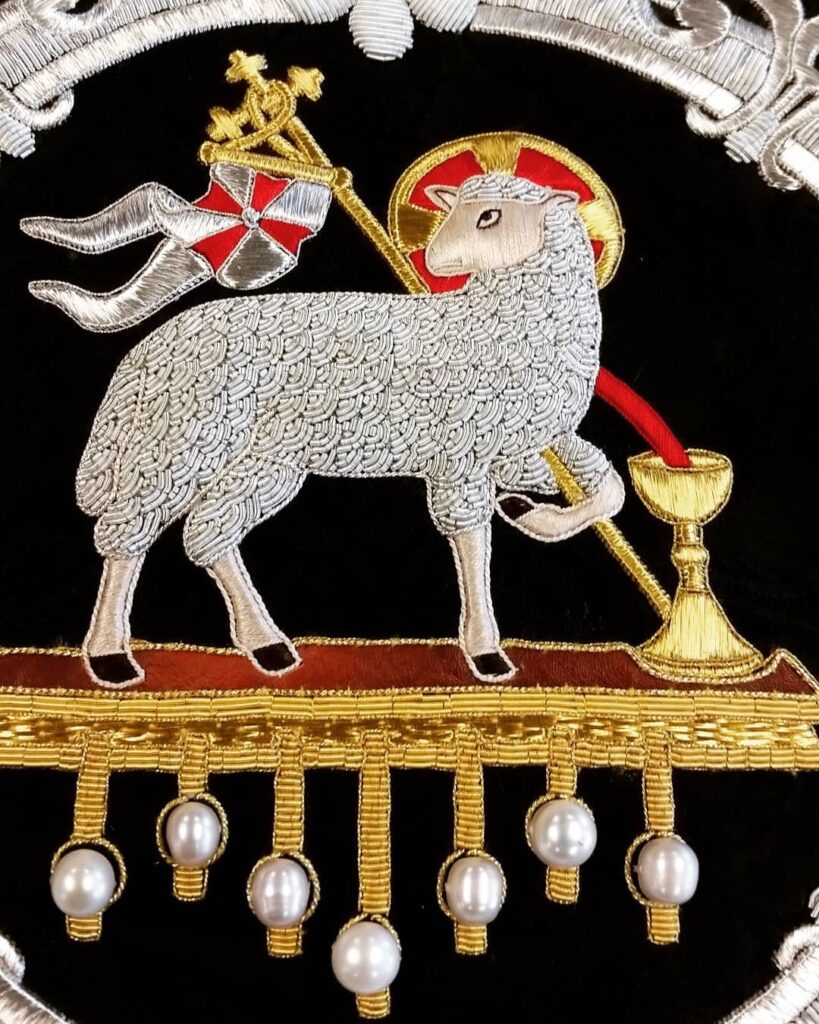
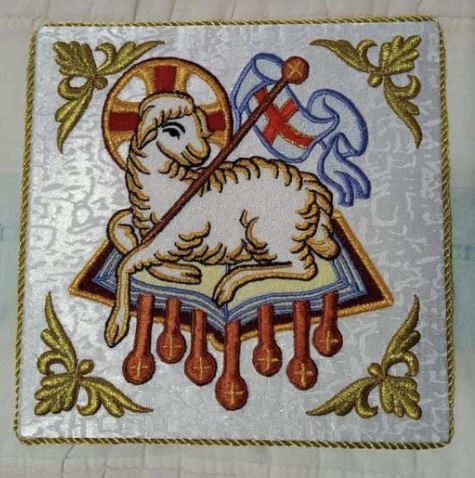
I watched as the Lamb broke the first of the seven seals and …. as I watched, there was a pale horse. Its riders name was Death and Hades followed with him. (Apocalypse 6:1-8)

The book/scroll with the seven seals is among the most well-known images from the Apocalypse. Even if people don’t know the biblical source of the image, they at least know about the last, the Seventh Seal, from the famous movie by Ingmar Bergman. The seals and the riders or other visions that are revealed as each seal is broken have appeared many times in books and movies, whether in Agatha Christie mysteries or horror-fantasies or even comedies.

The seals reveal aspects of the liturgy–such as the relics of the martyrs contained in the altars on which the Eucharist is celebrated–as well as aspects of life that are judged by liturgical participation throughout history. Famine, plague, pestilence, and misery are constants throughout human experience. Many expect these to become especially intense just before the world ends; because of this, when these experiences have become intense in the past, many people expected that the world was about to come to an end.

Everyone loves to calculate and predict when exactly the End will come. Even St. Augustine has to tell his congregation, “Give your fingers a rest!” when they spend too much time and energy doing complicated math problems, trying to figure out when exactly the apocalypse will come. (Full disclosure: I still depend on my fingers to do even simple math problems!)

But it has not yet come to an end.

But the world does come to an end each time we celebrate the Eucharist and take our places in the eternal Kingdom of God. The apocalypse happens every time we proclaim, “Blessed is the Kingdom of the Father, and of the Son, and of the Holy Spirit.”

The apocalypse happens every time we lift up our hearts.

The apocalypse happens every time we ask the Father to send down the Holy Spirit on us and on these Holy Gifts of bread and wine.

The apocalypse happens every time we say, “Our Father… thy kingdom come.”

The apocalypse happens every time because the Holy Spirit lifts us up from earth to heaven to see Christ revealed in all his glory.

When will the seals be broken? They are always being broken, throughout time (during what we call “secular” history) and eternally (in the celebration of the Eucharist).

A New Song

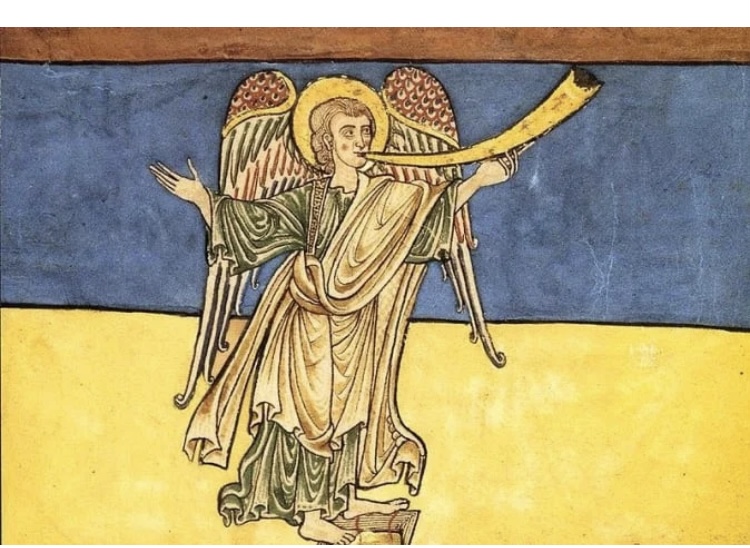
The seventh angel of the Apocalypse (illumination approx. 1180)

And they sang a new song, saying: “You are worthy to take the scroll and to open its seals, because you were slain, and with your blood you purchased for God persons from every tribe and language and people and nation.” (Apocalypse 5:9)

The angels lead the singing of the “new song” around the Throne of God. Several times, the “new song” is mentioned in the Apocalypse, together with many other “new” things — a new name, a new heaven and a new earth, the New Jerusalem. These “new” things are not simply more recent than what they replace but are different in quality as well. The “newness” is a description of their character and purity as well as their permanence. They will not be replaced or supplanted, much like the “new covenant-testament” established by Christ at the Last Supper.

The psalms frequently mention a “new song” as well — Psalms 33, 40, 96, 98, 144, 149. Again, the “new song” is an eschatological hymn, a song to be sung at the End of Days when God’s people are vindicated and God’s final triumph is celebrated. But what is the “old song” that the new one is being contrasted with? The “old song” — maybe, the “first song” is a better way to describe it–is the Song of Miriam and Moses that God’s people sang on the shore of the Red Sea after escaping from Egypt. This song that celebrates the Exodus is also a celebration of God’s victory and the vindication of his people; it is a dress rehearsal for the victory God will win over his cosmic enemies at the End of Days.

During the Middle Ages, it was common for rabbis to identify the “old-first song” as the song sung when King Solomon dedicated the Temple in Jerusalem and the “new song” being that which was sung when the Temple was rebuilt and rededicated after the people returned from exile in Babylon. This can also be understood as a hymn sung to celebrate God’s deliverance of his people from their enemies and his re-establishment of them in the Promised Land.