Woman Clothed With the Sun

The woman clothed with the sun attacked by the seven-headed red dragon depicted in a 17th-century fresco in a Mt. Athos monastery.

A great sign appeared in heaven: a woman robed with the sun, with the moon under her feet, and a crown of twelve stars on her head. She was with child and she cried out in her pangs of birth …. Then a second sign appeared in heaven: a great red dragon with seven heads …. (Apocalypse 12:1-6)

The woman clothed with the sun is one of my favorite characters or episodes in the New Testament. In the earliest commentaries, she is understood to be the Church, the New Israel, and the baby she gives birth to is the new Christian–at this period, typically an adult–who emerges newborn from the baptismal font. The red dragon with seven heads is the Roman imperial system who attacks the Church and slays the martyrs. The woman and her baby–the Church and the newly baptized–escape to safety in the wilderness, which is where the early ascetics and first monastics fled to pray and fast.

One of my favorite patristic texts–one of the first I ever read in its totality, as a freshman in the Sterling Library at Yale–is The Banquet by St. Methodius of Olympus. The Banquet is the one of the first and is the most extensive of the early Christian discussions of the woman clothed with the sun.

In the third century, commentators begin to see the woman clothed with the sun as the ever-virgin Mother of God who gives birth to Christ. They are attacked by Herod and flee to safety in Egypt. The importance of this interpretation of the Mother of God grows in importance as she becomes a model for the ascetics and monastics in the desert-wilderness, usually in Egypt but also near the Jordan River.

The image of the woman clothed with the sun becomes associated with the “falling asleep” (the Dormition or Assumption) of the Mother of God. She is taken into eternal glory in the Kingdom of God because she is the Mother of God who gives her flesh to the Word. Everything human about the Word-made-flesh came from her; his DNA is her DNA. She is the first believer to be taken into glory as a pledge of what all members of the Body of Christ will experience.

The woman clothed with the sun is one of the most frequently depicted figures in the New Testament. If the Apocalypse is a multi-valent and many layered text, the woman clothed with the sun is one of the most multi-valent and many layered figures in the New Testament.
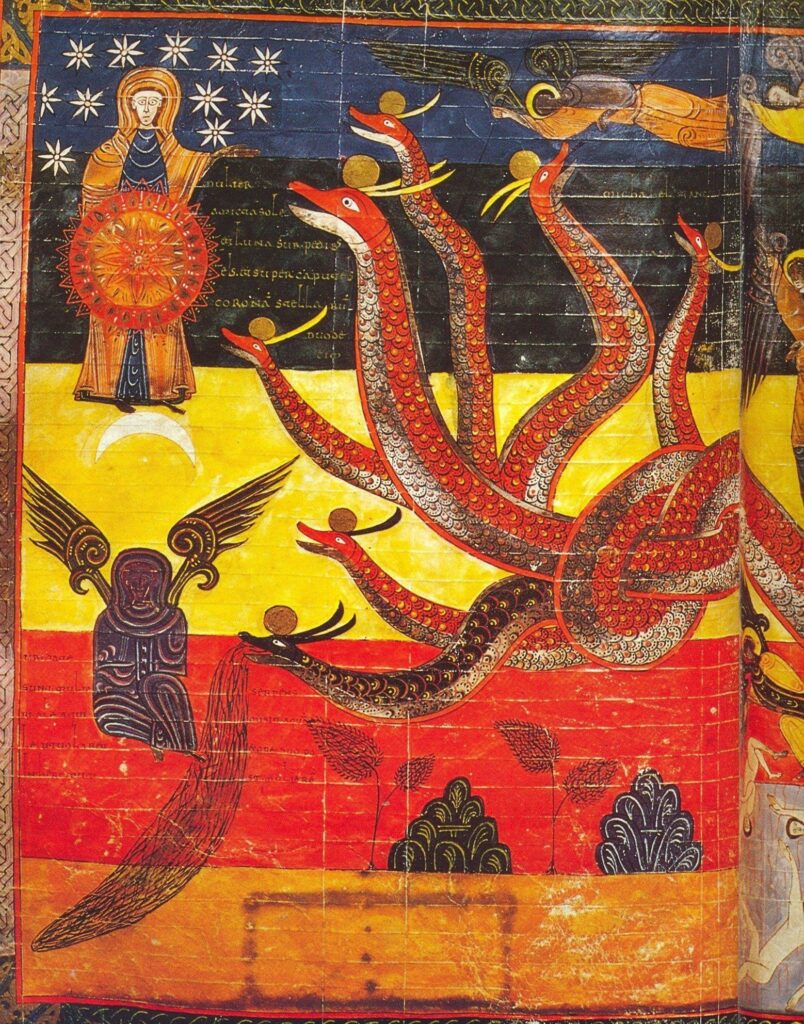
The woman clothed with the sun in an illumination from the Beatus manuscript of the Apocalypse.
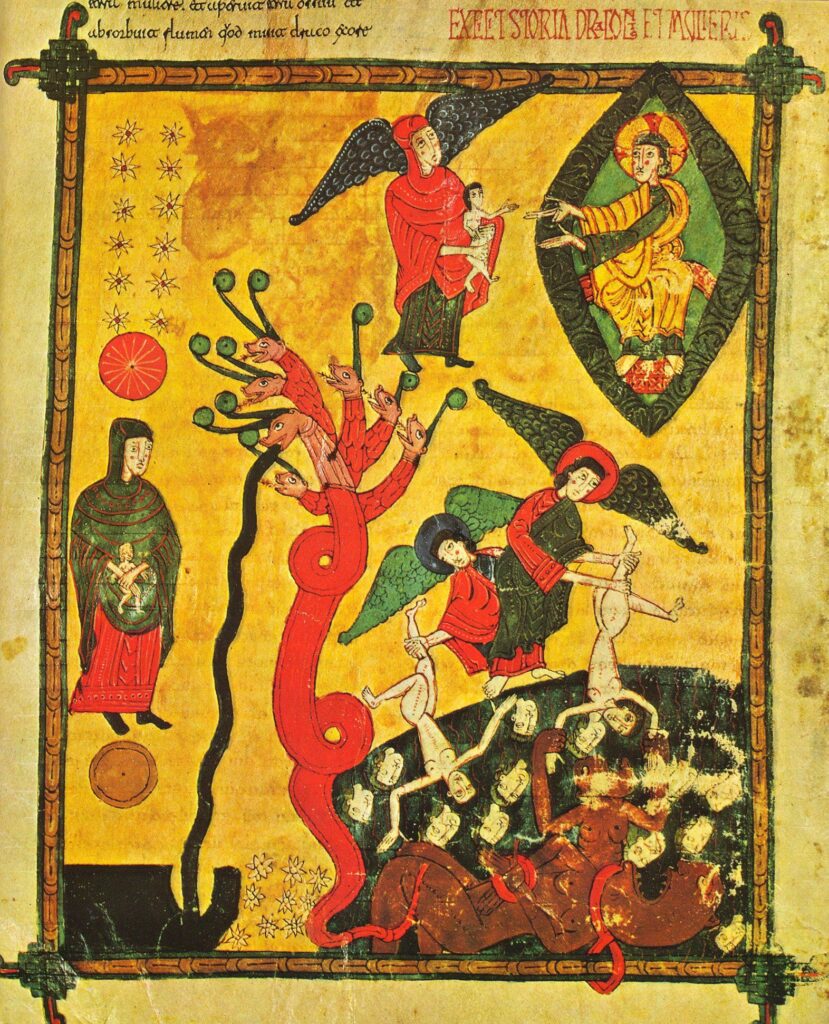
Another medieval manuscript illumination depicting the woman clothed with the sun escaping from the great dragon.

A Little Scroll

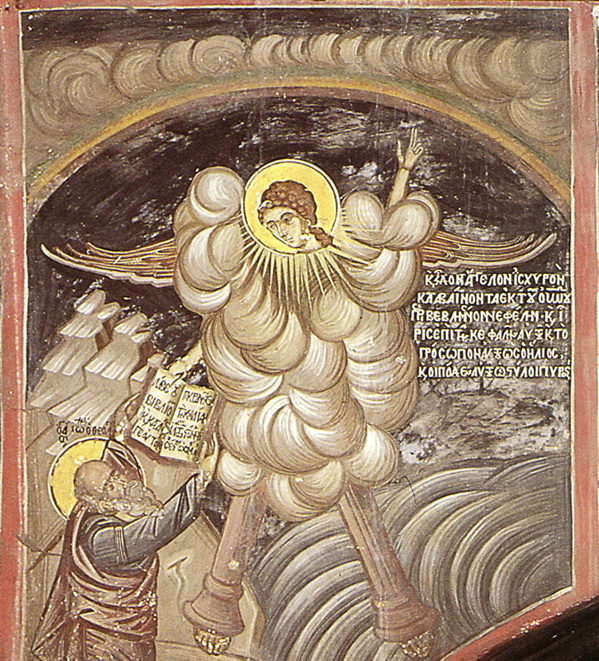
This fresco on Mt. Athos from the 17th century depicts the opening of chapter 10 of the Apocalypse: St. John sees the massive angel, standing with a foot in the sea and a foot on land, who gives him a little scroll to eat.

Then I saw another mighty angel coming down from heaven, wrapped in a cloud, with a rainbow over his head: his face was like the sun and his legs like pillars of fire. He held in his hand a little scroll which was open…. He said to me, “take it and eat it.” (Apocalypse 10:1-2, 9)

St. John takes the small, open scroll and eats it although the angel warns that it will taste sweet in his mouth and then turn his stomach sour. “You must prophesy over many peoples and nations and tongues and kings,” St. John is told after eating the scroll.

Eating a scroll is often the first thing a prophet is told to do (Ezekiel 3). The prophet ingests the message he is to deliver and integrates it into himself. It becomes his message as well as the message of God. (The scroll that Ezekiel eats is also sweet to taste but produces “laments and words of woe.” Both Ezekiel and the Apocalypse are associated with the liturgical season of Eastertide; the Death and Resurrection of Christ are simultaneously blessing and judgement which are described in terms of the Last Days by the prophet and the apostle.)

Given that the Apocalypse is a liturgical commentary, what does this episode correspond to in the Eucharist? Consuming the little scroll can also correspond with receiving Holy Communion, as does Isaiah’s lips being touched by a heavenly coal. Each communicant is called to the same vocation as the seer although details of how that vocation is exercised may differ.

Although this scroll is small, unlike the others mentioned in the Apocalypse, its most important distinguishing feature is that it is open rather than closed. An open message is one that will be fulfilled shortly after it is proclaimed; a closed message is about an event that will happen long after the proclamation is made. The message that will be accomplished soon is the preaching of the Gospel to “many peoples and nations and tongues and kings.” Prophets like Ezekiel were sent only to the Israelites; John–and the Church as a whole–are sent to the whole world. The ingathering of the nations to join Israel in receiving the blessings of God was proclaimed by the prophets as one of the signs that the Last Days had finally come; the nations responding to the preaching of the Gospel is a sign that the Last Days have now arrived.

The Apocalypse is, in many ways, the proclamation of the same message that the prophets proclaimed but that message has now been fulfilled-accomplished. The Last Judgement–while still a distant event in linear time–has begun and is already present in the spiritual-liturgical life of the Church. Eternity has begun to erupt into the world of space-time. The Apocalypse is not a blueprint or a timeline for something to happen in the future; it describes the life of the Church now.

The fancy theological way to refer to this is “realized eschatology.” Eschatology is the Greek word for “last things.” The last things have been realized/accomplished in the life-ministry-Passion of Christ and are now playing out in the life of the Church. Sometimes “realized eschatology” is contrasted with consistent eschatology, which insists that the Last Days are still entirely in the future. The two concepts are combined by some modern authors in inaugurated eschatology.

Wormwood

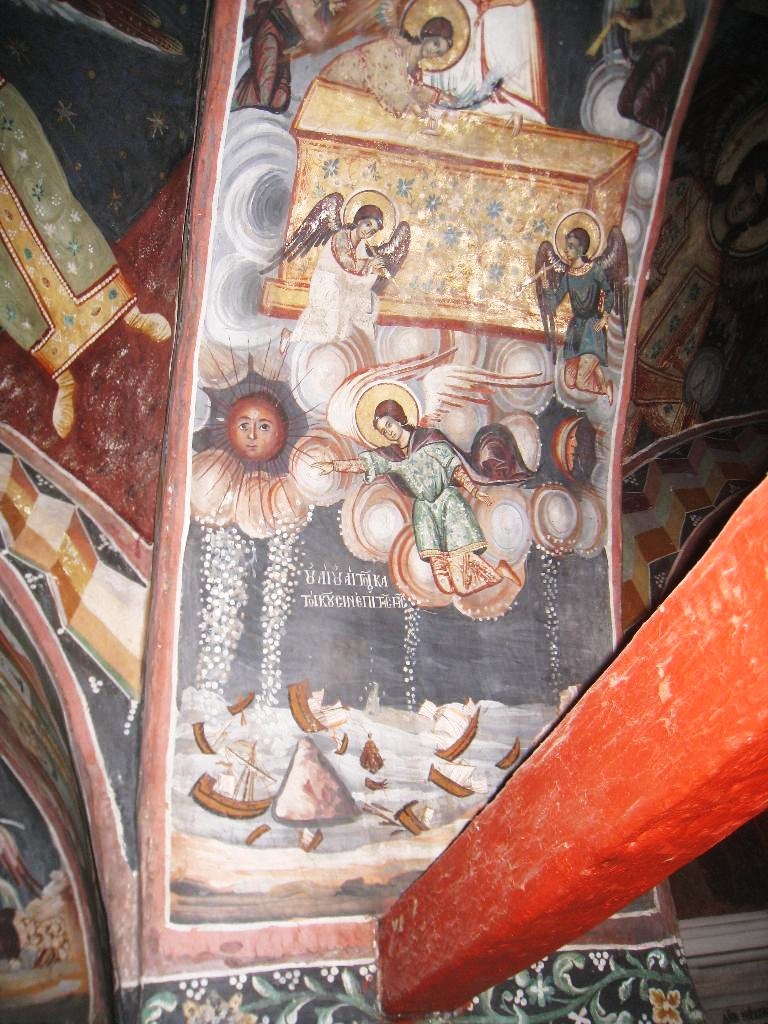
Monastic fresco on Mt. Athos illustrating chapter 8 of the Apocalypse: the angels at the heavenly altar cast judgement/ hail onto the earth and sea.

The first angel blew his trumpet; there came hail… cast upon the earth…. The third angel blew his trumpet and a great star fell from the sky…. The name of the star was Wormwood. (Apocalypse 8:7, 10-11)

The angels begin to blow their seven trumpets and unleash a series of destructive judgements: hail with fire, a flaming mountain thrown into the sea, a falling star. Repeatedly, a third of everything is destroyed: a third of the earth is burnt up, a third of the trees are burnt up, a third of the sea is turned to blood, a third of the sea creatures die, a third of the sun-moon-stars are wiped out, a third of the ships are destroyed (see illustration above). This repetition of the destruction of one-third of everything suggests to many Early Church readers that one-third of the angels rebelled against God and became the demons of hell.

The destructive plagues released by the trumpet blasts mimic the plagues that God sent to destroy Egypt in the book of Exodus. In both cases, creation is undone and refashioned. Many of the prophets in the Old Testament describe similar plague-judgements that God will unleash at the End of Days: the sun and moon and stars will go dark, the sea will be consumed by fire, darkness will envelop the earth. Jeremiah describes a mountain that will be reduced to a burning, smoldering ruin and 1 Enoch describes 7 stars that are like 7 fiery mountains. These are not the acts of a vindictive God; these are the descriptions of what happens when creation rises up in rebellion and goes-against-the-stream that is cooperation (synergy) with God.

One of the most interesting images of judgement-destruction is the star called Wormwood. This name, which in Slavonic is Chernobyl, was often mentioned by evangelical Christians when the Chernobyl nuclear accident happened. It was popular to muse in the United States if the nuclear accident was the great portent of the End described in the Apocalypse; timelines for the coming judgement were eagerly discussed.

Wormwood is a plant with a bitter taste and is a metaphor for divine judgement (Jeremiah, Lamentations, Amos, Proverbs). This plague is the reverse of the miracle at Mara in the desert: there, poison water was made fresh but the star Wormwood makes fresh water poison. “Wormwood” is the perversion of justice in Amos: the blazing star that falls from the sky in the Apocalypse can be viewed as the downfall of the Devil himself, the father of lies and deception (John 8:44).