The Magi and Their Dream

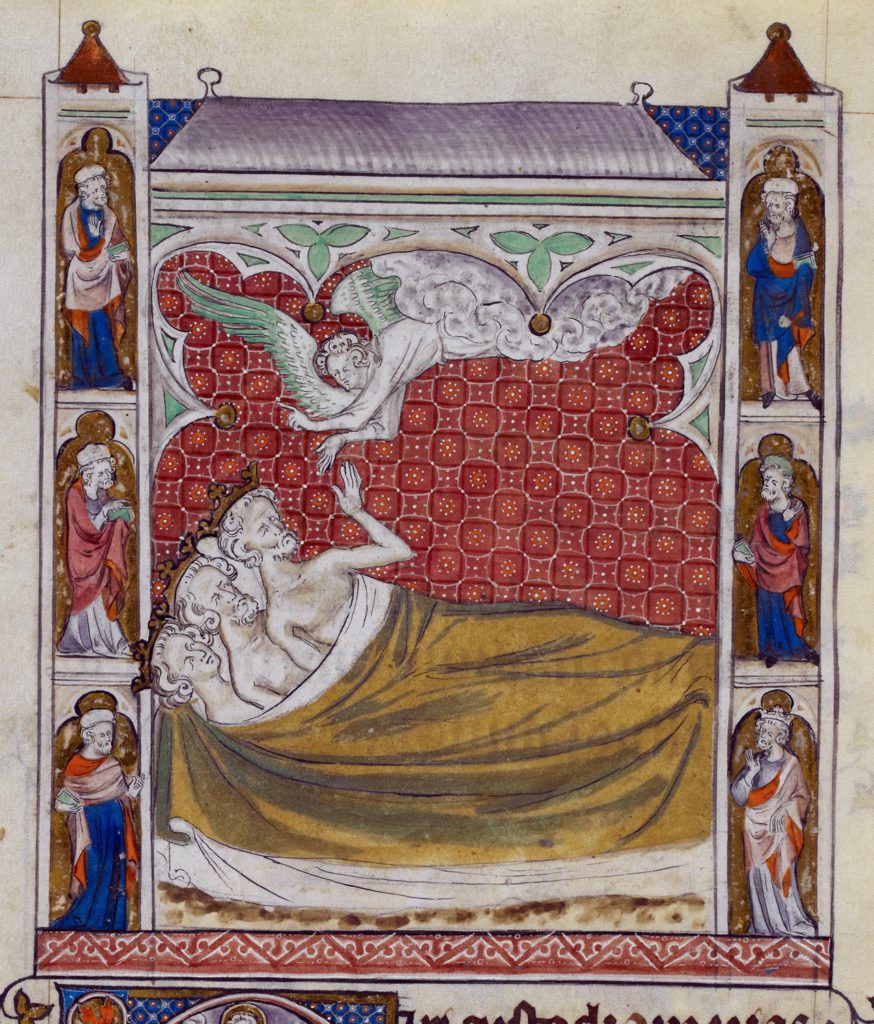
The magi have a dream in which an angel warns them to avoid revealing the location of the Christ-child to King Herod. So they go home via another route; as a result, King Herod slays all the boys in the region of Bethlehem who are 2 years old or younger.

In the gospel according to St. Matthew, we read that the Magi–the 3 kings–were on the road for 2 years, following the star that announced the birth of Christ to Judea but had to consult King Herod about where in Judea the new-born king might be located. Herod consulted religious authorities and scholars who told him that Bethlehem was the most likely location. He sent the Magi there but asked them to come and tell him where in Bethlehem they found Christ. They did locate Christ, worshipping him with gold, frankincense, and myrrh. (One story says that the gold was later stolen by the two thieves who were later crucified alongside Jesus. Another tradition suggests that Joseph and Mary used the gold to finance their travels when they fled to Egypt from Bethlehem.) But an angel warned the Magi all in a dream not to reveal the location of the Christ-child to King Herod and so they returned home via a different route, avoiding Herod. When Herod realized the Magi were not coming back to him, he ordered all the baby boys in the Bethlehem region to be killed, hoping to eradicate the baby who was the threat to his rule. But an angel had warned Joseph in a dream to take his family to Egypt and so they escaped, just in the nick of time; they returned to Judea only after Herod was dead.

The star the magi had followed was most likely a conjunction of Saturn (indicating the Last Days) and Jupiter (indicating a great king) in Pisces (associated with Judea and the people of Israel). Dreams were taken seriously as visitations of God, the angels, or other spirits. Dreams and astrology were acceptable tools of divination to discover or understand the will of God and were not considered “magic” by most people until fairly recently. But people who had such dreams might become proud or arrogant, telling others how special they were for having received such a visitation from God in a dream; many spiritual teachers had to warn their disciples against taking such dreams too seriously or becoming arrogant because of them. Rules were established for how to interpret such dreams and how much attention they should be given. But dreams can still inspire us or lead to new inventions, as this recent New Yorker article attests.

A shrine of the Three Kings at Cologne Cathedral, according to tradition, contains the bones of the Magi. Reputedly they were first discovered by Saint Helena on her famous pilgrimage to Palestine and the Holy Lands. She took the remains to the church of Hagia Sophia in Constantinople; they were later moved to Milan before being sent to their current resting place by the Holy Roman Emperor Frederick I in 1164.
Read more about the Magi in previous posts here and here.

Circumcision of Christ (Holy Name)

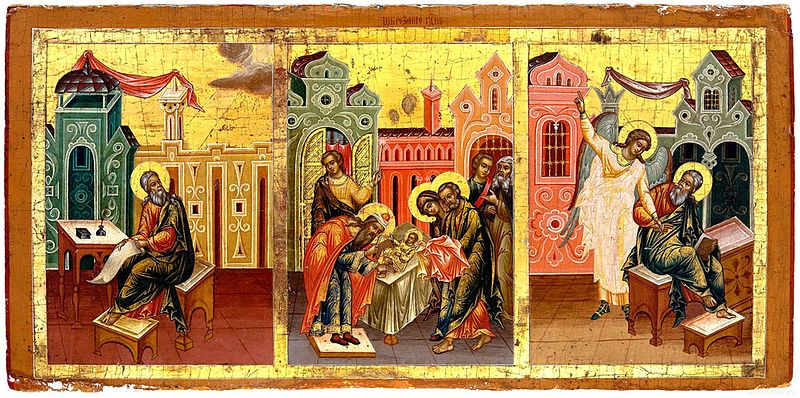
The central panel depicts the circumcision of Christ. The two side panels depict the Gospel writers Luke and Matthew who relate how Jesus was circumcised or given his name on the 8th day after his birth.

The Feast of the Circumcision of Christ is a Christian celebration of the circumcision of Jesus in accordance with Jewish tradition, eight days after his birth, the occasion on which the child was formally given his name. Eight days after Christmas (December 25), Circumcision (nowadays the feast is often called “Holy Name”) is thus celebrated on January 1.

The circumcision of Jesus has traditionally been seen, as explained in the popular 14th-century work the Golden Legend, as the first time the blood of Christ was shed and thus the beginning of the process of the redemption of man, a demonstration that Christ was fully human and of his obedience to Biblical law.

Circumcision was first practiced by Ethiopians and Egyptians, according to Herodotus, and they practiced it mainly for reasons of health (Hist. 2:2, 104). In the Old Testament, God established circumcision as a sign of his covenant with Abraham that would mark his descendants as different from the other peoples of the world. “This covenant, which you shall keep, is between me and you and between your seed after you for their generations. Every male among you shall be circumcised. Circumcise the flesh of your foreskin, and that shall be the mark of the covenant between you and me. And a child, when he is eight days old, shall be circumcised.” (Genesis 17:12)

The Greeks and Romans thought circumcision was a horrible disfigurement of the male body. Many Romans admired Jewish religious practice and thought but refused to actually convert because of the social stigma associated with circumcision. Several of these “God-fearers” appear in the New Testament.

Patristic literature associates the timing of the Circumcision on the eighth day with Resurrection. Seven is the number of completion and fullness as the world was created in seven days and is due to pass through seven ages. But if seven is perfect, then seven-plus-one is super-perfect. Eight, therefore, stands for renewal, regeneration — whence the architectural tradition of eight-sided baptistries. And Christ rose from the dead on the day superseding the Sabbath, on the Eighth Day just as the world’s seven ages will be followed in the eighth age by the General Resurrection. This imagery is attached almost from the beginning to all theological meditation on Christ’s Circumcision. It is the sense of the mystery that the Circumcision on the eighth day prefigures Christ’s Resurrection, and thereby, implicitly, the resurrection of all.

Hot Off the Press!

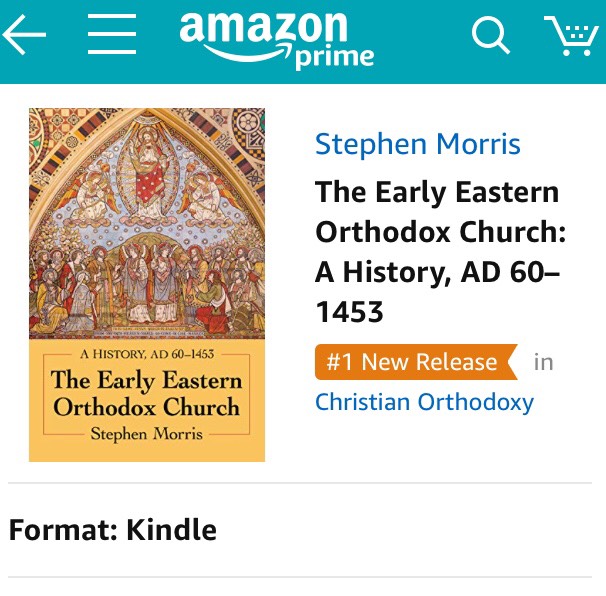
The book was a #1 New Release in one category and a Top 10 in another on Amazon.

My newest book, The Early Eastern Orthodox Church: A History, AD 60-1553, has just been released by McFarland. It was #1 and #4 in two different categories on Amazon. Order yours now–Kindle version or paperback!

One reader has already written that the book “is a delightful romp through Church history!” Another reader reports: “Super informative and easy to follow. Really interesting stuff. The pages practically turn themselves.” 👍

Although the book focuses on Church life in the Eastern Mediterranean region, much of the book is about the common heritage of both east and west (formation of the New Testament, development of church order and hierarchy, as well as the role of the ecumenical councils, etc). Many issues—the interaction of science and faith, divinity and humanity, Church and State—continue to be pertinent today.

Add your review to the book’s Amazon page as well.

There will be a Book Launch on Monday, November 12 at St. John’s-in-the-Village Church (West 11 Street @7 Avenue) with Evensong at 6:15 p.m. and Book Reading and Signing at 6:45 p.m. Discussion with Q & A will follow. Drinks will be served. Come celebrate even if you already have your copy. Books will be available for purchase—at a special discount!