Holy Week: The Death of Death

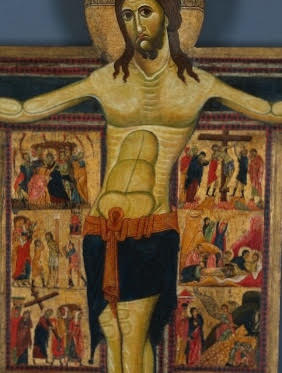
This 13th century crucifixion from Pisa also depicts scenes from Holy Week: Christ’s arrest, his scourging, carrying the Cross, as well as his death, burial, and resurrection. (Cleveland Museum of Art)

Holy Week is the opportunity to celebrate and contemplate the last week of Christ’s ministry, from his entrance into Jerusalem on Palm Sunday to his Resurrection. The heart of Holy Week–the heart of the Christian year–is the nexus of Good Friday-Holy Saturday when Christ’s death and resurrection are celebrated and proclaimed.

Christ’s death was more than a tragic event for a particular person. His death was the encounter between God and Death itself. Once Death had entered the world, following the sin of Adam and Eve, it consumed everything. But when God allowed himself to be consumed by Death, then Death consumed itself. Christ’s resurrection is the pledge that Death has been rendered powerless although it can still be frightening–like a serpent or a chicken with its head cut off, squirming around and spewing blood but harmless apart from whatever fear or disgust we give it.

“Christ concealed the hook under the bait by hiding his strength under weakness. Therefore that murderer who from the beginning thirsted for human blood, rushing blindly upon weakness, encountered strength; he was bitten in the act of biting, transfixed [with nails] as he grasped at the Crucified…. I behold the jaws of the serpent pierced through, so that those who had been swallowed may pass through them…. Well may he be angry, roar, and waste away, for the prey has been snatched from his teeth.” (St. Guerric of Igny, Sermon 30)

In the Middle Ages, many images of Christ on the Cross–especially those based on Byzantine models–contain images of the other events in Holy Week as well.
Presentation of Christ: The Encounter

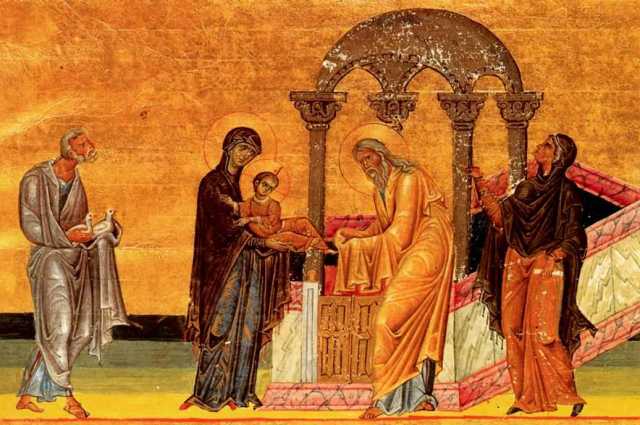
This 10th century Byzantine manuscript illumination depicts the Presentation of Christ when he was 40 days old, described inthe Gospel of St. Luke.

In the Eastern Orthodox Church, the Presentation of Jesus–an early episode in the life of Jesus, describing his presentation at the Temple in Jerusalem is described in the Gospel of Luke and which combines the purification rite with the Jewish ceremony of the redemption of the firstborn (Luke 2:23–24)–is celebrated as one of the twelve Great Feasts, and is usually called Hypapante (“Meeting” or “Encounter” in Greek).

In this episode, Christ encounters the elderly Simeon and Anna, representatives of the Chosen People who anxiously await the coming of the Messiah. The emphasis is less on his presentation in the temple (which was to “buy back” the first-born son, a Jewish practice that looks back to the death of the first-born in Egypt) or the purification of his mother (women were considered impure because of the blood shed during childbirth) and more on this face-to-face meeting of Christ and those who look for him. This encounter becomes the model for the encounter between Christ and all those who pray, receive Holy Communion, or otherwise look to meet Christ in the circumstances of their own lives. Simeon and Anna become the model for all the faithful throughout history.

In Western Christianity, there is an additional name for this day: Candlemas. This feast day is also known as the Purification of the Blessed Virgin or the Presentation of the Lord. In the Roman Catholic Church, the Presentation is the fourth Joyful Mystery of the Rosary. Also, in the Latin Rite of the Catholic Church, the Anglican Communion and the Lutheran Church, the episode was also reflected in the once-prevalent custom of “churching” new mothers–coming to church for the first time–forty days after the birth of a child.