St. Michael and the Dragon: Victory in Heaven

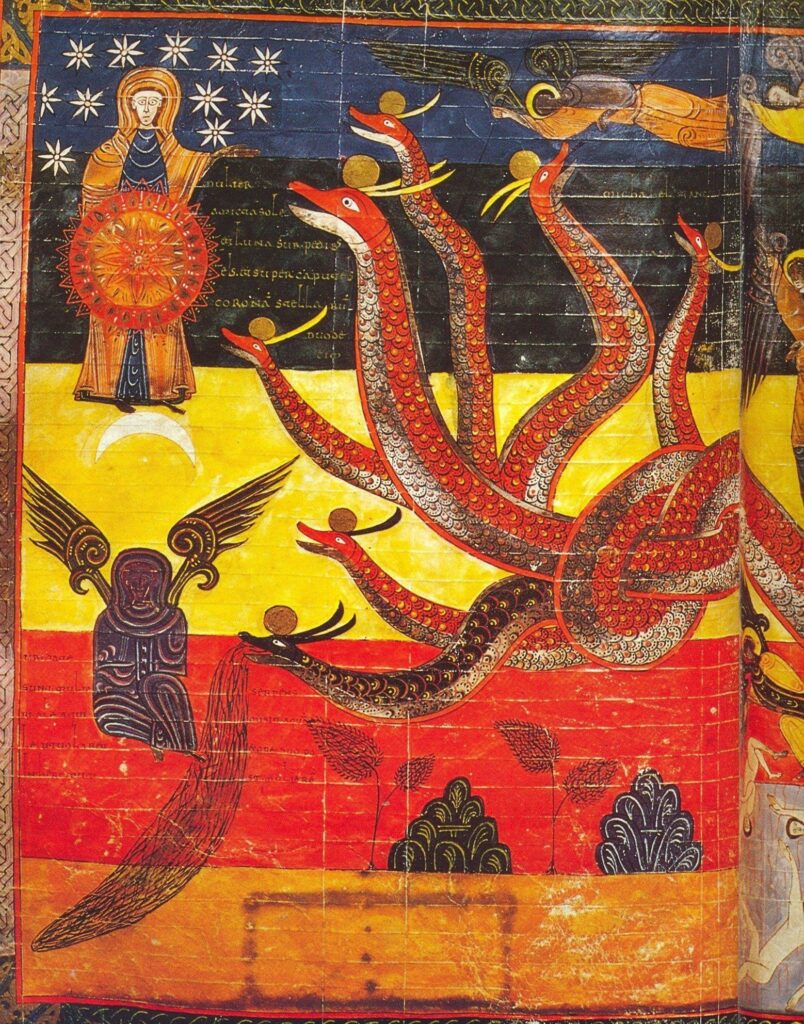
The war in heaven depicted in “Las Huelgas Apocalypse,” Spain AD 1220; the commentary of Beatus of Liebana.

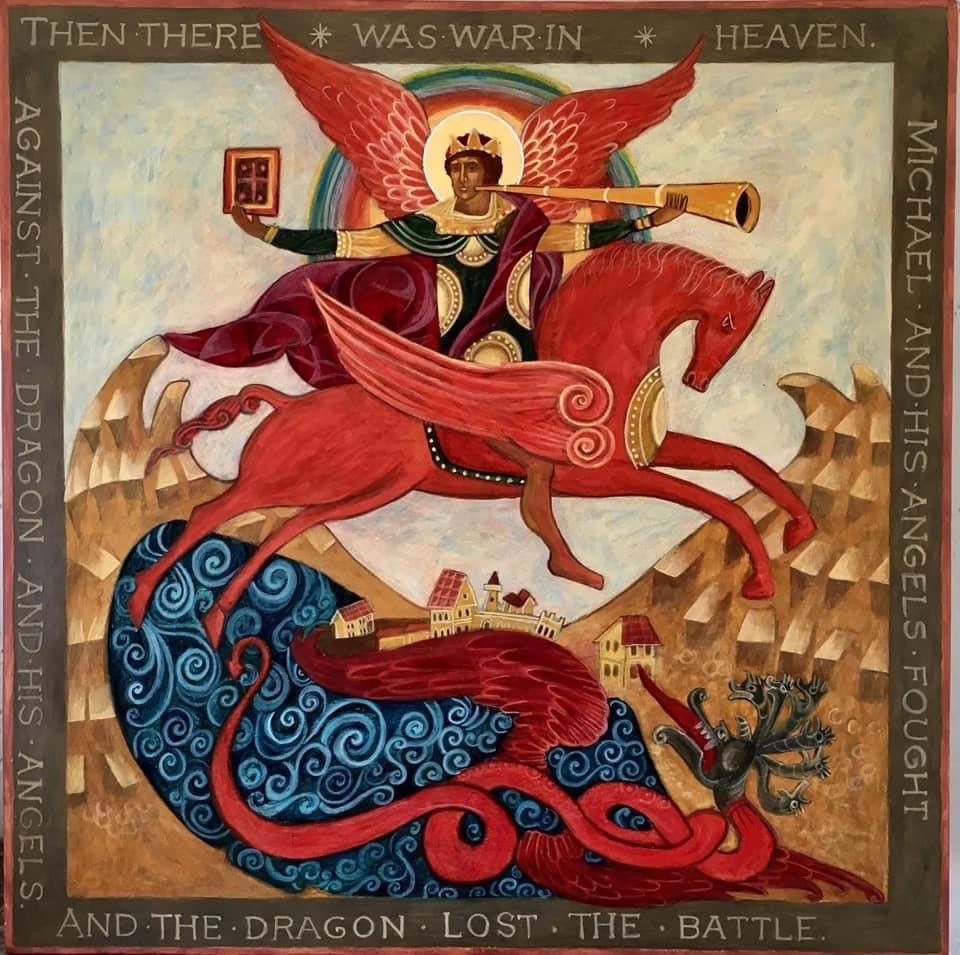
Then war broke out in heaven. Michael and his angels fought against the dragon. The dragon and his angels fought back and he did not prevail…. The great dragon was thrown down, that ancient serpent who is called Devil and Satan, the deceiver of the whole world…. (Apocalypse 12:7-9)

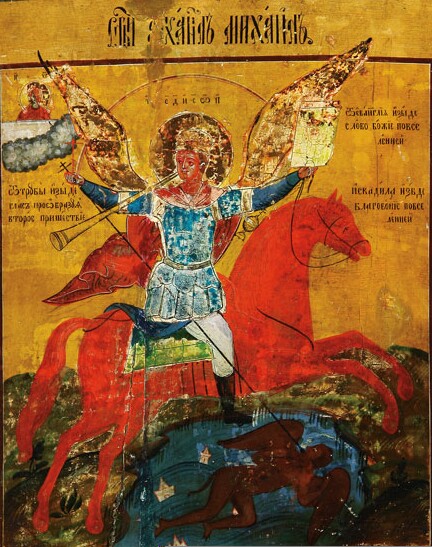
The Archangel Michael (Jude 9) is the captain of God’s armies and the champion of the Chosen People (Daniel 10:21, 12:1); in the Old Testament, he is the most powerful figure, second only to God. Although Satan does occasionally appear in heaven (Job 1), he is definitively cast down and overthrown here.

The dragon is identified both with the serpent who tempted Eve and with the adversary, the accuser who demanded that God allow him to test the sincerity of both Job and the Apostle Peter (Luke 22:31). Satan wanted to ruin them both but did not succeed. Satan, the dragon, wants to ruin the human race. He wants to ruin the entire creation. His jealousy goads him to want to destroy everything (Wisdom 1-2) but in the end, his jealousy destroys only himself.

Often the spear that St. Michael uses to fight the dragon with is a wooden lance; it is by the wood of the Cross that the dragon is overthrown. The archangel Michael’s victory is the heavenly and symbolic counterpart of Jesus hanging-dying on the Cross. The martyrs, as members of the Body of Christ, who testify-witness about the victory of the Cross, share in this victory but the victory is demonstrated by their dying as Christ died on the Cross. The events described in chapter 12 of the Apocalypse—the woman clothed with the sun, the dragon, the war in heaven—are the central events of the Apocalypse, around which everything else revolves, because they are the representation of the central events of earthly history.

“I saw Satan fall like lightning from heaven,” says Jesus (Luke 10:18); therefore the apostles are able to cast out devils who possess humans. The Lamb, “who was slain from the foundation of the world,” is both eternally the victor and the one who wins the victory at a particular time-place in the world. Both the eternal victory and the victory in time are true; neither victory cancels or outweighs the other.

The dragon is not simply THE Devil, a single angelic personality. The dragon is all the enemies of God at once; in Ezekiel 29:3 and 32:2-3, we read that the Pharaoh of the Exodus is “like a dragon in the sea,” a great water monster who attempts to devour the Chosen People. The dragon is the Roman system which attempts to eradicate the Church. The dragon is everything and everyone who attempts to deny the victory of the Cross.
Woman Clothed With the Sun

The woman clothed with the sun attacked by the seven-headed red dragon depicted in a 17th-century fresco in a Mt. Athos monastery.

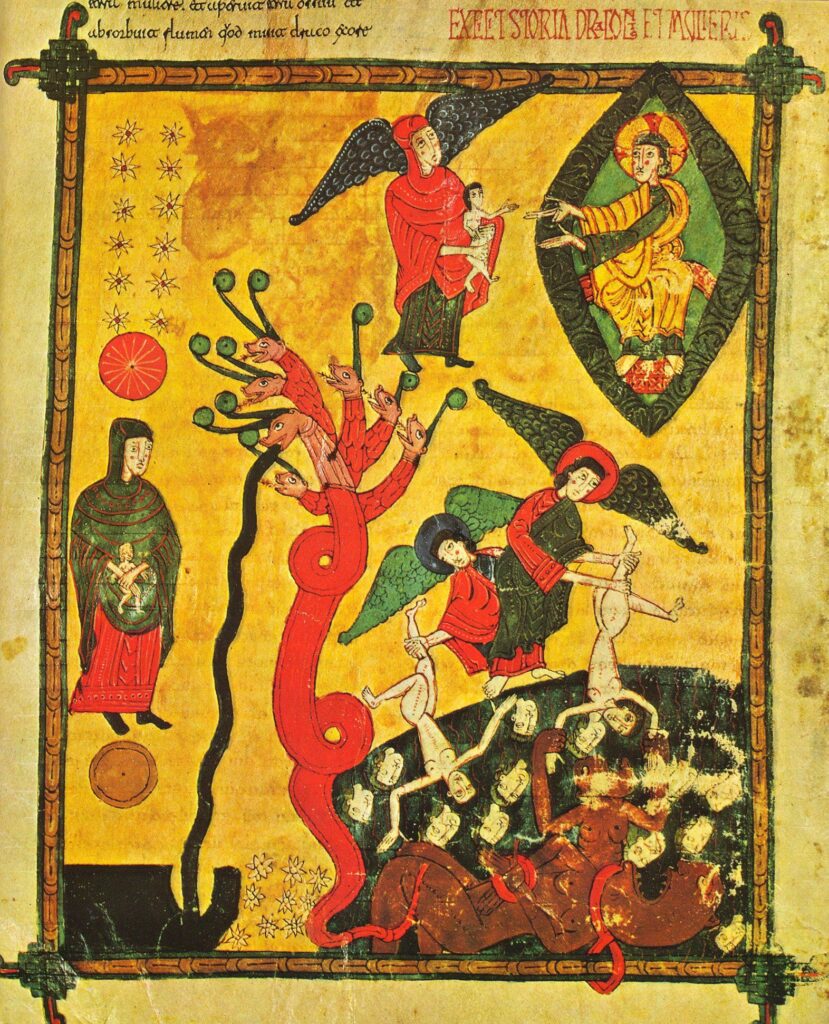
A great sign appeared in heaven: a woman robed with the sun, with the moon under her feet, and a crown of twelve stars on her head. She was with child and she cried out in her pangs of birth …. Then a second sign appeared in heaven: a great red dragon with seven heads …. (Apocalypse 12:1-6)

The woman clothed with the sun is one of my favorite characters or episodes in the New Testament. In the earliest commentaries, she is understood to be the Church, the New Israel, and the baby she gives birth to is the new Christian–at this period, typically an adult–who emerges newborn from the baptismal font. The red dragon with seven heads is the Roman imperial system who attacks the Church and slays the martyrs. The woman and her baby–the Church and the newly baptized–escape to safety in the wilderness, which is where the early ascetics and first monastics fled to pray and fast.

One of my favorite patristic texts–one of the first I ever read in its totality, as a freshman in the Sterling Library at Yale–is The Banquet by St. Methodius of Olympus. The Banquet is the one of the first and is the most extensive of the early Christian discussions of the woman clothed with the sun.

In the third century, commentators begin to see the woman clothed with the sun as the ever-virgin Mother of God who gives birth to Christ. They are attacked by Herod and flee to safety in Egypt. The importance of this interpretation of the Mother of God grows in importance as she becomes a model for the ascetics and monastics in the desert-wilderness, usually in Egypt but also near the Jordan River.

The image of the woman clothed with the sun becomes associated with the “falling asleep” (the Dormition or Assumption) of the Mother of God. She is taken into eternal glory in the Kingdom of God because she is the Mother of God who gives her flesh to the Word. Everything human about the Word-made-flesh came from her; his DNA is her DNA. She is the first believer to be taken into glory as a pledge of what all members of the Body of Christ will experience.

The woman clothed with the sun is one of the most frequently depicted figures in the New Testament. If the Apocalypse is a multi-valent and many layered text, the woman clothed with the sun is one of the most multi-valent and many layered figures in the New Testament.

The woman clothed with the sun in an illumination from the Beatus manuscript of the Apocalypse.
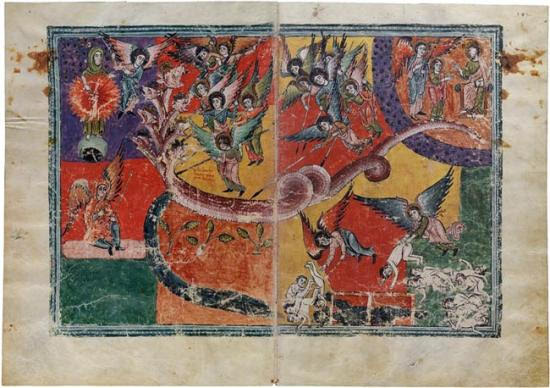
Another medieval manuscript illumination depicting the woman clothed with the sun escaping from the great dragon.

Two Witnesses

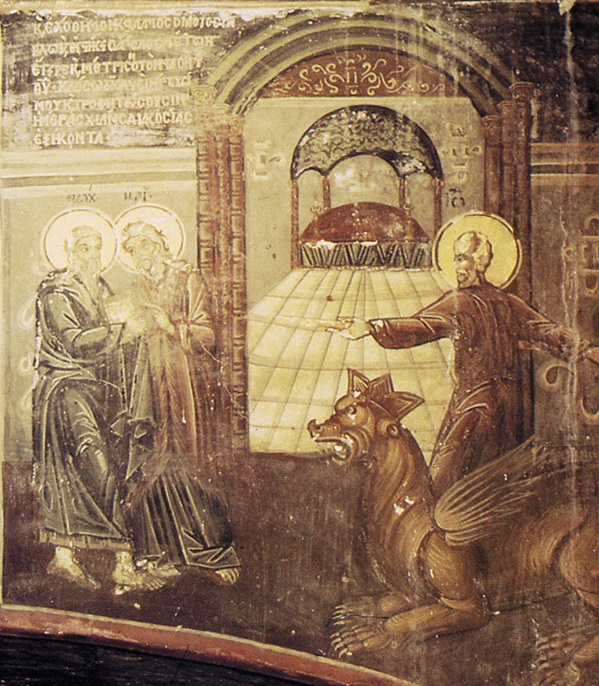
The two witnesses of Apocalypse 11, about to be attacked by the beast from the abyss. They are standing before the Temple, described earlier in chapter 11; the witnesses are identified by the names “Enoch” and “Moses” above their heads.

I will commission my two witnesses to prophesy for those 1,260 days, dressed in sackcloth. These are the two olive-trees and the two lamps that stand before the Lord of the earth…. But when they have completed their testimony, the beast that comes up from the abyss will wage war on them and overcome them and kill them. (Apocalypse 11:3-4, 7)

The two witnesses–lit. martyrs–are spokesmen for God that are killed by the powers that oppose God. Their corpses will remain in the streets to be mocked and defiled but they will be raised from the dead and ascend into heaven. The murder of the two witnesses is the second of the “three woes” that are expected (Apoc. 9).

The witnesses are dressed as prophets, in sackcloth, and preach for more than a thousand days (the symbolic length of history). They are compared to the king Zerubbabel and the high priest Joshua (Zech. 2 and 4). Some authors thought the two witnesses would be Moses and Elijah (who was taken into heaven without dying), come to proclaim the judgement of God; frequently others think the two witnesses will be Moses and Enoch (who was also taken into heaven without dying).

The beast from the abyss slays the witnesses after they have been preaching for 1,000+ days. Later in the Apocalypse, we read the same story from another perspective: “When the 1,000 years are ended, Satan will be let loose from his prison and he will come out to deceive the nations” (Apoc. 20:7-8). We also read the same story from another perspective in the next chapter of the Apocalypse when the dragon attacks the woman clothed with the sun–one of my favorite episodes in the New Testament!

Repeatedly in the Gospel and throughout the history of the Church, the devil and the powers of Death that rebel against God attack and seem to triumph but are finally overthrown and defeated. This is the most basic message of the Apocalypse: the Enemy will seem to triumph but–take heart!–can never win the final victory.