Hymns in the Apocalypse

I was about to write my next entry on the Apocalypse when the new issue of Worship arrived in the mail. Worship is one of the leading academic journals about liturgy and liturgical studies; it always has essays and book reviews that fascinate and illuminate. There was an essay in this issue about liturgical hymnography and look what I discovered: a mention of liturgical hymns in the Apocalypse!

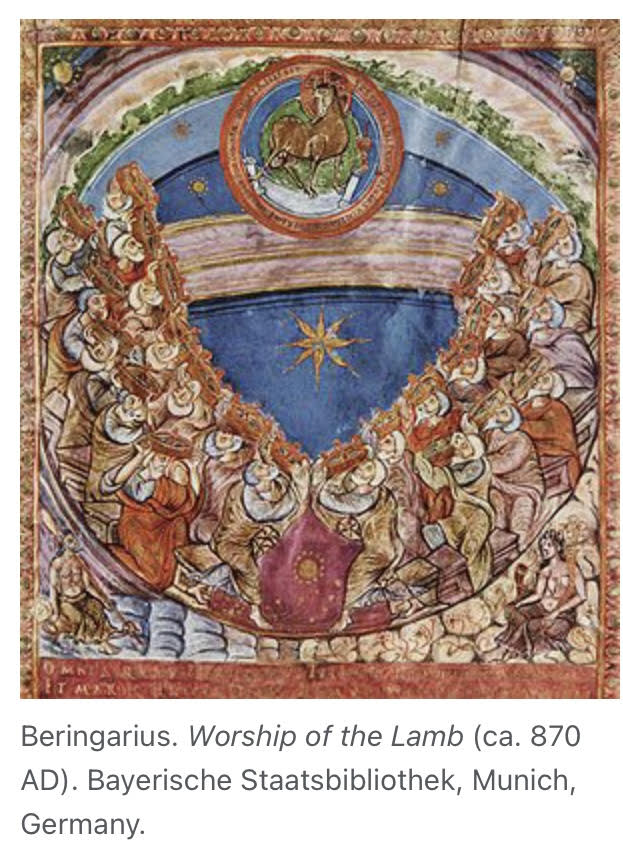
The portrayal of the heavenly liturgy in the Book of Revelation features many hymns that must surely reflect the worship experience of the author and intended audience. Again, they are clearly in a psalm style and their diction mines the Psalter extensively, but they would also have been immediately recognized as a “send-up” of the hymns commissioned for the imperial cult. Take, for example, Revelation 11:17-18.

We give you thanks, O Lord God, the sovereign over all (pantokrator) who are and who were, that you have taken your great power and begun to reign. (Rev. 11:17)

The Christians of the seven churches in the Roman province of Asia would have immediately recognized this as a parody of the acclamations of the divinized Roman Emperor sung at the imperial festivals that were a regular feature of life in their cities.

(Margaret Daly-Denton, “Instilling the Word” in Worship (July 2021), pp. 200-201.

In the Apocalypse, not only do we encounter the history of the Church and the wonderful works of God’s power (told over and over, from a variety of perspectives), we also encounter the Christians thumbing their noses at the imperial power hell-bent on destroying them.

We should remember that as St. Paul and other New Testament authors were urging the Christians to “obey the civil authorities” and “Give unto Caesar the things that are Caesar’s,” it was those same civil authorities and the same imperial policies that were actively putting the Christians to death; the same authorities that were to be obeyed were making martyrs.

Modern Christians who urge cooperation with civil authorities when they think the authorities will legislate in their favor and resistance when they don’t care for the civil policies, quoting those New Testament authors, should remember that: submission to civil authorities was first and foremost given to civil authorities that oppose everything the Church stands for.

Early Christian political theory can be summed up in one sentence: Don’t give your enemies any more reason to arrest you than they already have.
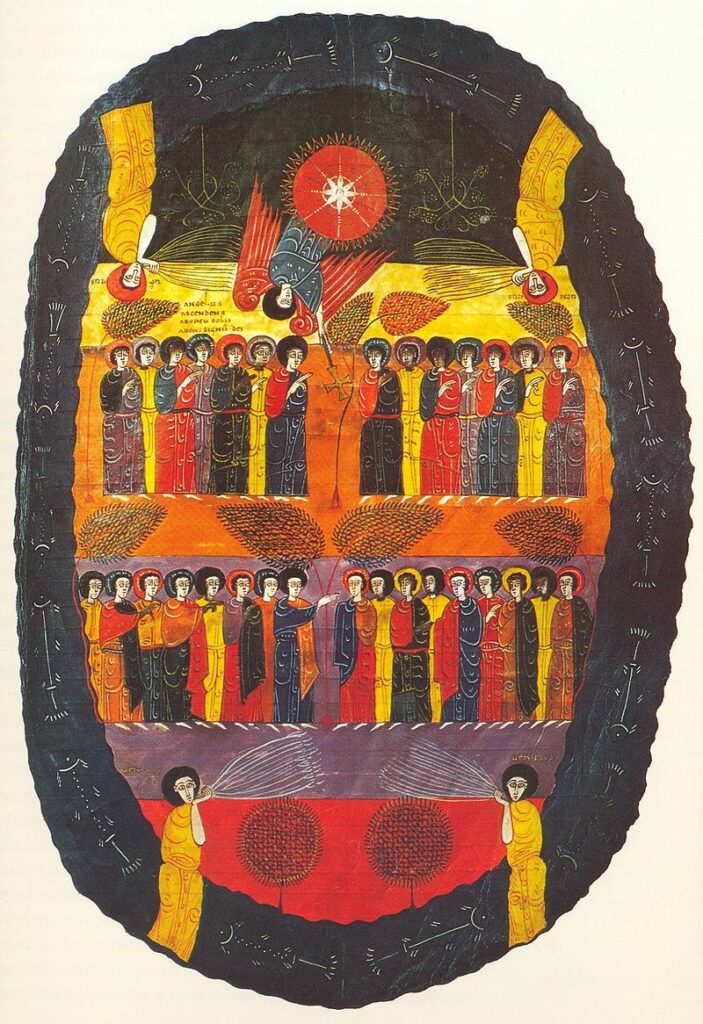
The Lamb and the 144,000

Page from a famous illuminated manuscript painted by an unknown artist, depicting the 144,000 from Revelation 7, from a copy of the Commentary on the Apocalypse by Saint Beatus of Liébana

Then I looked, and there before me was the Lamb, standing on Mount Zion, and with him 144,000 who had his name and his Father’s name written on their foreheads. And I heard a sound from heaven like the roar of rushing waters and like a loud peal of thunder. The sound I heard was like that of harpists playing their harps. And they sang a new song before the throne and before the four living creatures and the elders. No one could learn the song except the 144,000 who had been redeemed from the earth. (Apocalypse 14:1-3)

SO much to say about such a brief passage! Modern commentaries often claim that the 144,000 are the Messianic Jews who accept that Jesus is the Messiah but in the early Church there was no such distinction between ethnic Jews and Gentile Christians. Classic commentaries by church Fathers interpret the 144,000 as emblematic of the perfected Church–12x12x1000 being the 12 apostles x 12 tribes of Israel x 1000 (perfection). That is also why the 1,000 year reign of Christ is an emblem of history perfected, not a literal 1,000 years as we know the cycle of 365 days x 1000.

The new song of the new day of salvation grows out of the song of deliverance sung by Israel on the shore of the Red Sea after the Exodus. (Have I told y’all about this already? I think I have.) The new song is also the Sanctus (“Holy! Holy! Holy!”) sung by the angels as they stand around the Throne of God and which we join them singing during the celebration of the Eucharist. During the Eucharist, we stand with the 144,000 before the Throne–together with the elders (presbyters) and four living creatures; together, we sing the Sanctus and give thanks for all that the Holy Trinity have done for us.

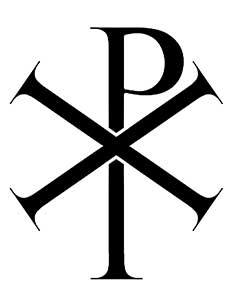
The saved are marked with the name of the Lamb and his Father, just as the followers of the Beast are marked by the diabolic number. But the classic commentary on the Apocalypse by Tyconius has something very different to say: according to Tyconius, the diabolic mark of the Beast is not described in Chapter 13. Rather, the number at the end of Chapter 13 is “616” and is “the number of a [certain] man,” i.e. the Son of Man, the Lamb of God. The number 616 is the total of alpha and omega, the first and last letters of the Greek alphabet and refer to Christ. It is also the total of the letters XIS, the first and last letters of “Christ Jesus.” Therefore, Tyconius understands the numbers 616 to indicate the famous Chi Rho emblem of Christianity. It is this emblem which is described as marked on the 144,000 at the beginning of Chapter 14.

Other early commentators say that the sign marked on the 144,000 is the cross drawn in chrism-oil by the bishop with his thumb when converts were baptized.

How’s that for a totally unexpected set of ideas about the 666 that we discussed last week?!

666 is the Number of the Beast

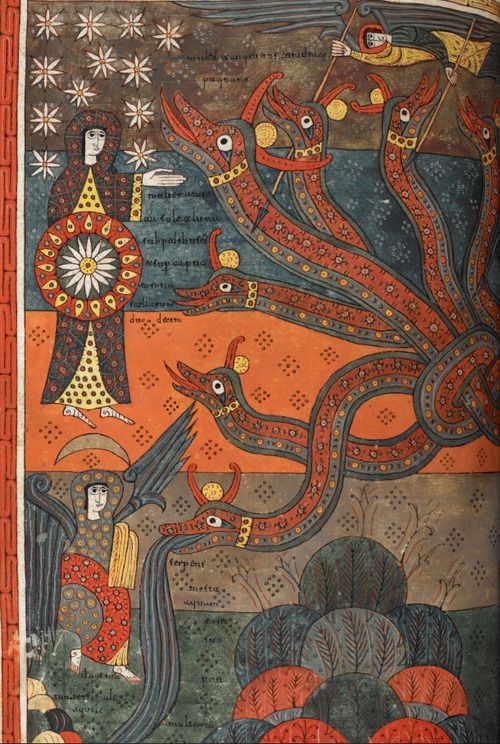
Dragons and beasts abound in the Apocalypse and always attack the Church in some way, whether by martyrdom or financial and economic constraints. The number 666–which is used to impinge on Christian economic activity—has been interpreted in a variety of ways.

Then I saw another beast rising out of the land; it had two horns like a lamb’s but spoke like a dragon…. This calls for wisdom. Let anyone who has intelligence figure out the number of the beast for it is the number of a human being; and it’s number is six hundred and sixty-six. (Apocalypse 13:11, 18)

“This calls for wisdom.” That’s probably one of the greatest understatements ever! The debate about the identity of the Beast and the meaning of the number 666 is ongoing and seemingly endlessly fascinating.

One beast arises from the sea. Another beast arises from the land. The sea monster Leviathan and the land-monster Behemoth are a team, symbolic of a nation-state or political system-regime intent on destroying the Church. Some preachers say that the first beast is the political system that wants to destroy the Church while the second, land-based monster is the religious opposition to the Church: it is a mockery of the Lamb as it attempts a masquerade, looking like the Lamb but speaking with the voice of the dragon who attacked the woman clothed with the sun.

The land-monster causes all the people under the dominion of the first beast to “have a mark put on the right hand or on the forehead and no one was allowed to buy or sell unless one had the mark, the name of the beast or the number of its name.” (Apoc. 13:16-17) In order to participate in economic and social life, people had to be marked with the number or the name of the beast–the beast commonly identified as Nero as the numeric value of the letters in his name add up to the infamous “666.” This mark is an official stamp. Perhaps a tattoo. Certainly a travesty of the sign of the cross marked with chrism on the hands and forehead of the newly baptized.

Some modern evangelicals say “the mark of the beast” is a certain credit card or identification card. In the ancient and medieval world, membership in business guilds was an important–sometimes necessary–aspect of economic life and in the Roman world such guilds often expected members to participate in pagan religious rites. Ancient commentaries say the mark of the beast were the coins issued by the emperor with his image on them. If the early Christians could not use coins in the market, they would be effectively marginalized and exiled to rural communes where they lived “off the grid” and supplied all their own goods. But that was just as highly unlikely to be a functional way to live in the first century AD as it is in the twenty-first century AD.

How to navigate the demands of mainstream culture is a constant question in the Church, even if that mainstream culture has been formed in large measure by the Church–the most superficial study reveals that Byzantium or Holy Russia or Christian Europe were societies that often opposed the most basic Christian teachings and practices. The most overtly Christian regimes were often the most oppressive, rigid, and cruel. How to avoid receiving the mark of the beast today?