
Leo the Lion


The Lion, long considered the "king of beasts," rules the sky from July 23 to August 23.

The Lion, long considered the “king of beasts,” rules the sky from July 23 to August 23.

Leo was one of the earliest recognized constellations, with archaeological evidence that the Mesopotamians had a similar constellation as early as 4000 BCE. The Persians called Leo Ser or Shir; the Turks, Artan; the Syrians, Aryo; the Jewish, Arye; the Indians, Simha, all meaning “lion”. In Babylonian astronomy, the constellation was called UR.GU.LA, the “Great Lion”; the bright star Regulus was known as “the star that stands at the Lion’s breast.” Regulus also had distinctly regal associations, as it was known as the King Star.

In Greek mythology, Leo was identified as the Nemean Lion which was killed by Hercules during one of his twelve labours, and next put into the sky.

The Roman poet Ovid called it Herculeus Leo and Violentus Leo. Bacchi Sidus (star of Bacchus) was another of its titles, the god Bacchus always being identified with this animal. However, Manilius called it Jovis et Junonis Sidus (Star of Jupiter and Juno).

In standard western astrology, the Sun is considered to be in the sign Leo from July 23 to August 23. People born under this sign are considered confident, ambitious, generous, loyal, and encouraging though they can also manifest less-desirable characteristics and be considered pretentious, domineering, melodramtic, stubborn, and vain.

Ruby, the birthstone of July

Rubies are the birthstone of July and are said to guarantee health, wisdom, wealth and success in love.

Rubies are the birthstone of July and are said to guarantee health, wisdom, wealth and success in love.

Rubies are associated with the sun and were thought to preserve mental and physical health. In the middle ages, rubies were viewed as a stone of prophecy. It was thought the stone darkened when danger was near. Ivan the Terrible of Russia stated that rubies were good for the heart, brain and memory. A 13th century prescription to cure liver problems called for powdered ruby. In the 15th-16th centuries, rubies were thought to counteract poison. When rubbed on the skin, they were also thought to restore youth and vitality.

If a ruby were cast into water it would cause it to boil, and if carved and pressed into wax, would melt the wax.

Although the most well-known magical rubies in modern society are the ruby slippers Dorothy wore in the Wizard of Oz movie, the slippers were silver inthe book. The silver shoes, however, did not show well against the yellow brick road inthe film and so the silver shoes were replaced with ruby slippers, which coukld be more clearly seen.

Take a look at my previous post about the ruby slippers in the Wizard of Oz, “I’ll get you, my pretty… and your little dog too!”

Cherries


A love spell from Japan involves tying a strand of hair to a cherry tree in blossom.

A love spell from Japan involves tying a strand of hair to a cherry tree in blossom.

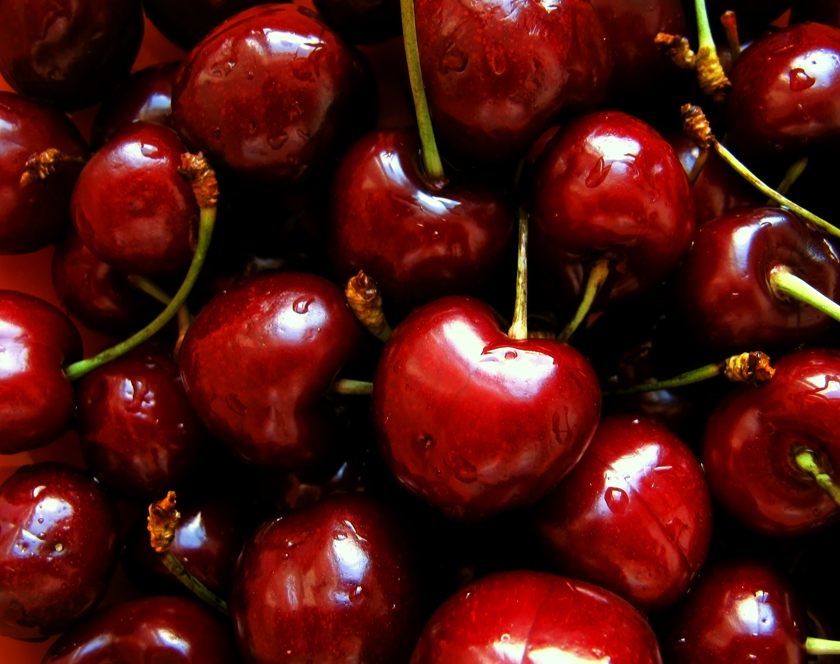
Cherries are associated with Venus, water, love, divination, and death. One method to discover how many years of life remain for you is to stand beneath a cherry tree and shake it and count the number of cherries which fall around you, indicating the number of years that remain until your death. Perhaps because of this practice, cherry juice can be used as a substitute for blood in magical recipes.

Drawing of Mary and cherry tree

In the former Czechoslovakia it was customary to cut cherry branches on the Feast of St Barbara on 4 December and bring these into the warmth of the house to have blossom at Christmas. However, the tree of course flowers naturally at or around Easter, especially if Easter is late, and in England, in the Chilterns, some of the abundant blossoms were used to decorate churches at Easter.

A cherry orchard will be certain of having a rich crop if the first ripe cherry is eaten by a woman who has just given birth to her first child. However, another Bohemian tale which brings together the Virgin, cherries, birth and death goes: When a mother loses a child, she eats neither strawberries nor cherries until the day of St. John the Baptist (June 24, the traditional date of Midsummer). It is said that at that time the Virgin goes about heaven giving this fruit to the little children. If a mother has not been self-denying, and has eaten of this fruit, when the Virgin comes to the child of such a one, she says: “Poor child, there isn’t much left for you, your mother ate your share.” So mothers of deceased children abstain from fruit until the Midsummer following the child’s death.

Wild cherry folklore has unusual associations with the cuckoo, whereby the bird has to eat three good meals of cherries before it may stop singing. Another use of cherries in predicting death is a children’s oracular rhyme from Buckinghamshire:

‘Cuckoo, cherry tree,
Good bird tell me,
How many years before I die’,

with the answer being the next number of cuckoo calls the singer heard.