
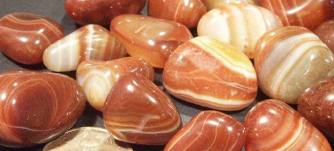
Sardonyx

sardonyx

Onyx is a chalcedony quartz that is mined in Brazil, India, California and Uruguay. Originally, almost all colors of chalcedony from white to dark brown and black were called onyx. Today when we think of onyx we often preface the word with black to distinguish it from other varieties of onyx that come in white, reddish brown, brown and banded. A variety of onyx that is reddish brown with white and lighter reddish bands is known as sardonyx, from the Greek sarx (flesh) because of these flesh tones in the gem.

The name also comes from the Greek word onyx which means nail of a finger or claw. Legend says that one day while Venus was sleeping Eros/Cupid cut her fingernails and left the clippings scattered on the ground. Because no part of a heavenly body can die, the gods turned them into stone which later became known as onyx.

Sardonyx is said to grant intelligence and courage, dispel nightmares and meloncholy, and break curses. Sardnyx is one of the stones in the ‘Breastplate of Judgement’ of Aaron, described in the Bible (Exodus 28:15-30). Sardonyx is also included in the listing of the gems of the King of Tyre (Ezekiel 28:13) and is one of the gems the New and Heavenly Jerusalem is said to be built of (the book of Revelation).

One of the earliest writers to associate the symbolism of the gems given in Revelation  with the apostles is Andrew, bishop of Caeserea. He gives says the sardonyx represents James, the (step) brother of Christ, a son of Joseph from his first marriage.

During the Renaissance in Europe it was believed that this stone gave speakers eloquence when talking. In Ancient Greece people used to carve them into the shape of scarab beetles, a mythological creature that was believed to eat people! The gem also has many links with royalty and it is said that Queen Elizabeth I gave the Earl of Essex a large Sardonyx gold ring as a present.
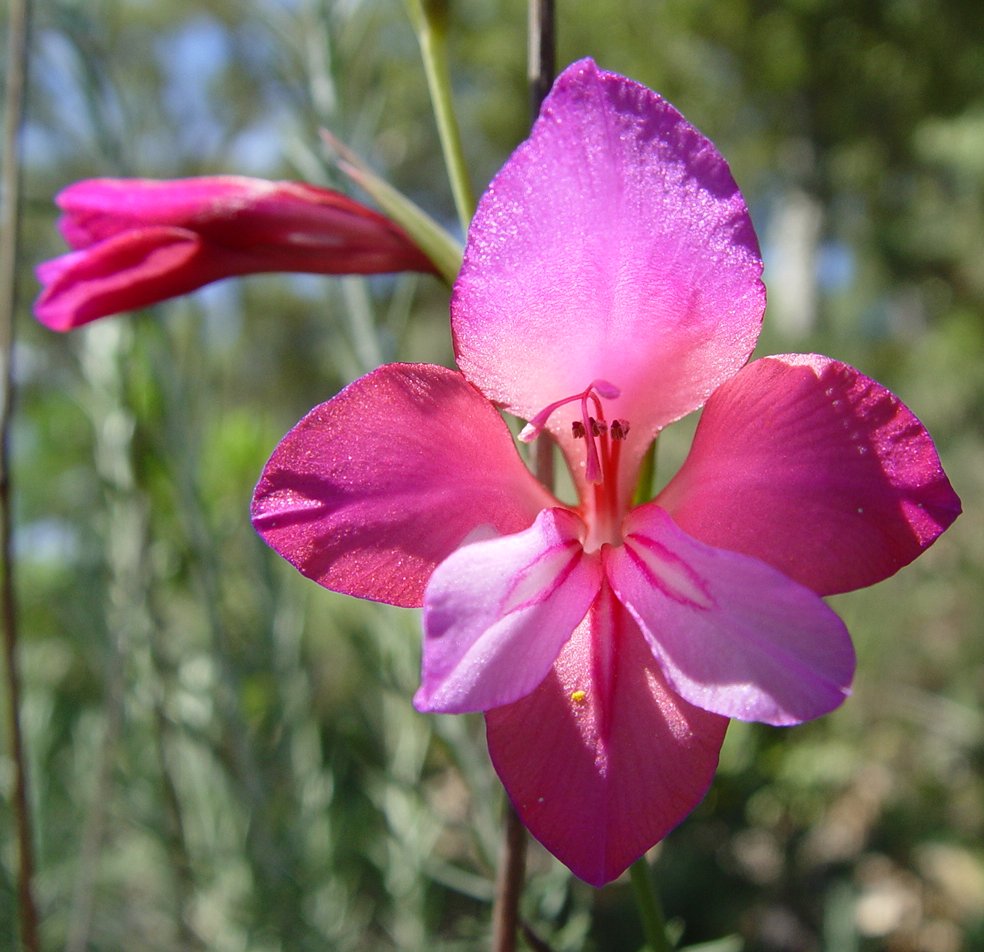

Gladiolus


Gladiolus_illyricus

The long, lovely gladiolus is the birthday flower for August. A member of the iris family, “glads” are also called sword lilies because of their sharply pointed leaves and tall stalks of flowers with pointed tips. The Latin name for Gladiolus is gladius, a clear reference to the sword-swinging gladiators of ancient Rome.

There are 255 species of gladiolus and the plants range in size from two to five feet tall with elegant trumpet-shaped blossoms that grow in a double row along the stem. You can find hybrid varieties with ruffled, wavy or frilled petals and the flowers can be found in every color.

Gladiolus is native to tropical Africa and areas around the Mediterranean and Middle East. It is believed that gladiolus plants were first brought to Europe in the early 18th century. Around the 1820s, gardeners began to seriously cultivate gladiolus and create hybrid varieties that became very popular in gardens and as cut flowers.

In floral history, gladiolus flowers have several different meanings. Because of their association with gladiators, they traditionally symbolize strength, sincerity and moral integrity. Gladiolus flowers also represent remembrance. And even though their sword-shaped leaves hark back to ancient swords and battles, Victorian romantics determined that gladiolus flowers were capable of piercing someone’s heart with their beauty, adding infatuation to the list of traditional floral meanings.

Lammas Day, the beginning of autumn

Lammas bread loaves, fresh from the oven on my kitchen counter.

Lammas bread loaves, fresh from the oven on my kitchen counter.

August 1 is Lammas Day (Anglo-Saxon hlaf-mas, “loaf-mass”), the festival of the wheat harvest, and was considered the first day of autumn in the traditional calendar of the pre-modern West (much as Labor Day is the beginning of autumn in the culture of the modern United States). On this day it was customary to bring to church a loaf made from the new crop, which began to be harvested at Lammastide. The loaf was blessed, and in Anglo-Saxon England it might be employed afterwards to work magic; a book of Anglo-Saxon charms directed that the Lammas Bread be broken into four bits, which were to be placed at the four corners of the barn, to protect the garnered grain. In many parts of England, tenants were bound to present freshly harvested wheat to their landlords on or before the first day of August. In the Anglo-Saxon Chronicle, where it is referred to regularly, it is called “the feast of first fruits”. (In Eastern Europe, the first honey of the season was brought to church to be blessed on August 1.)

As the wheat must have run low in the days before Lammas, and the new harvest began a season of plenty, of hard work and company in the fields, reaping in teams, [7] there was a spirit of celebratory play. In the medieval agricultural year, Lammas also marked the end of the hay harvest that had begun after Midsummer. At the end of hay-making a sheep would be loosed in the meadow among the mowers, for him to keep who could catch it.

In Shakespeare’s Romeo and Juliet (1.3.19) it is observed of Juliet, “Come Lammas Eve at night shall she [Juliet] be fourteen.” Since Juliet was born Lammas eve, she came before the harvest festival, which is significant since her life ended before she could reap what she had sown and enjoy the bounty of the harvest, in this case full consummation and enjoyment of her love with Romeo.