
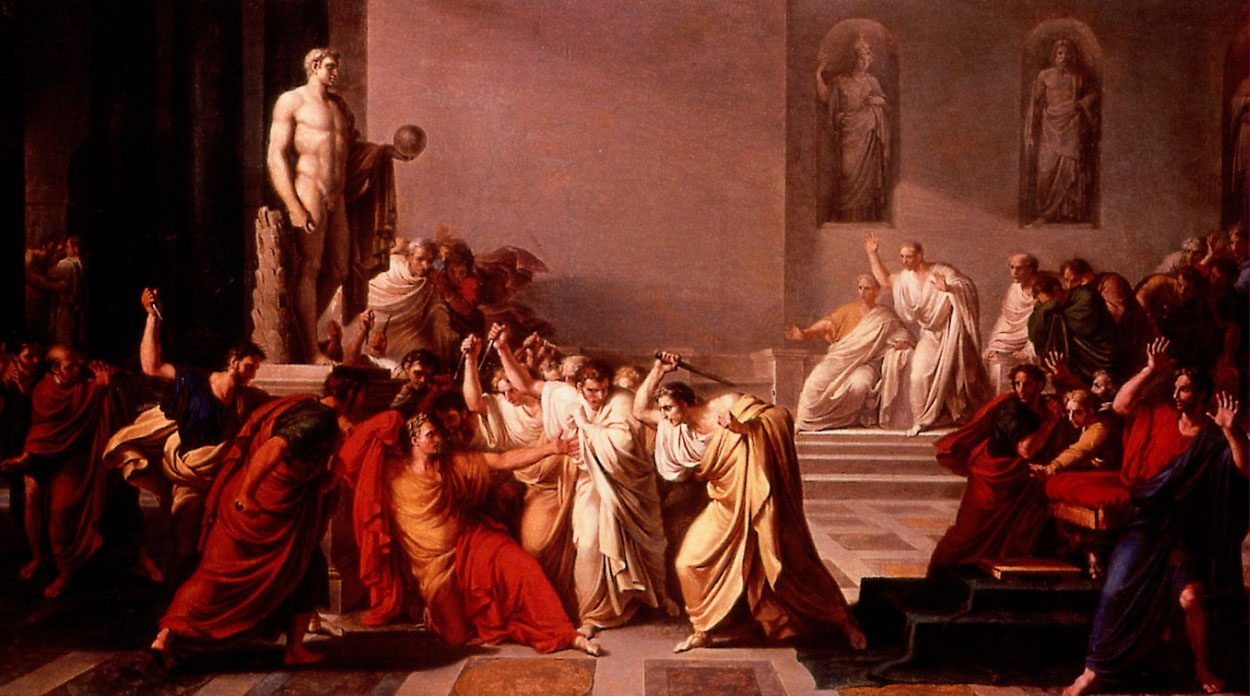
Vincenzo Camuccini, “Morte di Cesare”, 1798,
“Beware the ides of March!” the prophet warned Julius Caesar in 44 B.C. and Caesar was assassinated shortly thereafter, on the ides. Ever since, the Ides of March has been a day associated with doom, disaster, or failure in some form. But what is the “ides”?
Unlike currently used dates, which are numbered sequentially from the beginning of the month, the Romans and medieval Europeans counted backwards from three fixed points: they designated the “kalends,” the “nones,” and the “ides” and all other dates were based on these. (ex. the kalends = the 1st, the nones = the 5-7th, and the ides = the 13-15th days of the month). For instance, rather than saying, “Today is March 3” they would say, “Today is three days before the nones of March.” The kalends marked the new moon, the nones was the half-moon and the ides was the full moon.
The ides of the month marked the full moon and thus the following days of each month were governed by the waning moon, a good time for curses as dark magic grew more powerful as the nights grew darker. Not only would dark magic grow stronger but the darker nights also made crime in general more likely. That the last half of each month was steeped in evil and disaster was underscored by its association with the assassination of Caesar.
Even before the assassination of Caesar, the Ides of March had been important in Roman religion. The Ides of each month were sacred to Jupiter and the Flamen Dialis, Jupiter’s high priest, led the “Ides sheep” in procession along the Via Sacra to the place where it would be sacrificed.
In addition to the usual Ides monthly sacrifice, the Ides of March was also the occasion of the Feast of Anna Perenna, a goddess of the year (Latin annus, hence words like “annual” in English) whose festival originally concluded the ceremonies of the New Year. The day was enthusiastically celebrated among the common people with picnics, drinking, and revelry. One source from late antiquity also places the Mamuralia on the Ides of March. This observance, which has aspects of a scapegoat ritual, involved beating an old man dressed in animal skins and perhaps driving him from the city. The ritual may have been a new year festival representing the expulsion of the old year.
In the later Imperial period, the Ides of March began a “holy week” of festivals celebrating Cybele and Attis, marking first the day when Attis was born and found among the reeds of a Phrygian river. He was discovered by either shepherds or the goddess Cybele (known as the Magna Mater or “Great Mother”). A week later, on March 22nd, the solemn commemoration of Arbor intrat (“The Tree enters”) commemorated the death of Attis under a pine tree. A college of priests, the dendrophoroi (“tree bearers”) annually cut down a tree, hung from it an image of Attis, and carried it to the temple of the Magna Mater with lamentations. The day was formalized as part of the official Roman calendar under Claudius (who died in AD 54). A three-day period of mourning followed, culminating with celebrating the rebirth of Attis on March 25th, the date of the vernal equinox on the Julian calendar.