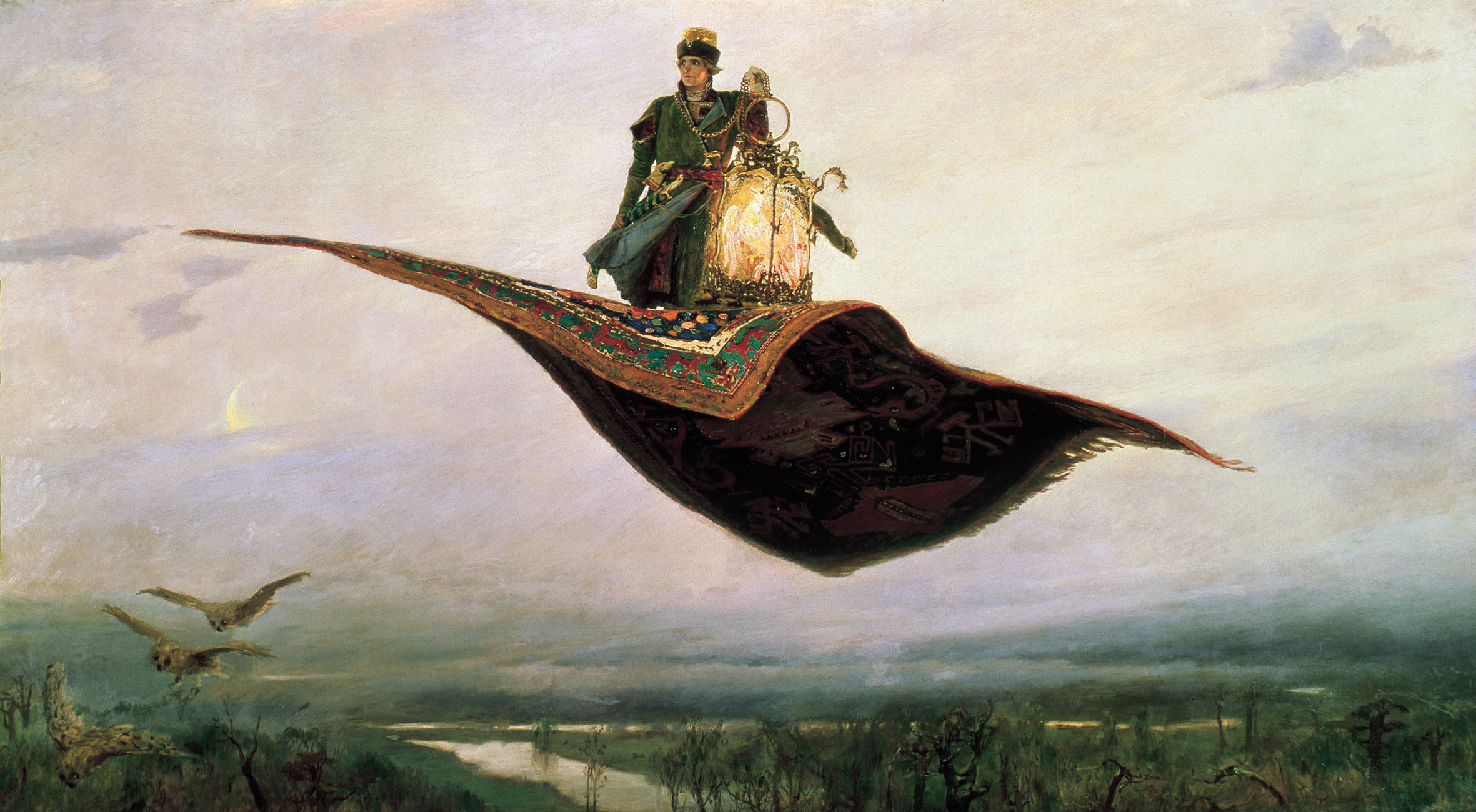
Riding a Flying Carpet, an 1880 painting by Viktor Vasnetsov
Flying carpets seem to be the single most famous object in the Abrian Nights stories. well, flying carpets and magic lamps. But everyone knows flying carpets fill the stories of the Arabian Nights.
Or do they? I just read a fascinating essay by Ruth B. Bottigheimer in the most recent issue of Gramarye, the journal of the Sussex Centre for Folklore, Fairy Tales, and Fantasy. Bottigheimer points out that only a few of the Arabian Nights tales include flying carpets and those tales are all late additions to the collection. A flying carpet first appears in the tale Prince Ahmed and Pari Banou which was written by Hanna Dyab, a Syrian Christian who travelled to Paris and wrote his story after reading French fairy tales. His story follows a basic European fairy tale plotline which is different from the usual plots of the Arabian Nights tales.
The tale of Prince Ahmed and Pari Banou is based on a French story by Madame d’Aulnoy called White Cat. The French story has a beautiful carpet that does not fly and so a beautiful carpet appears in Pari Banou as well. But there is a wooden horse that can fly in the White Cat story and so the beautiful carpet in Pari Banou DOES fly. Before Hanna Dyab retold White Cat, the only Arabic mention of “magical carpets” were actually wooden platforms in the Koran which says that King Solomon was able to control the wind and travel great distances in a single day, with a large wooden platform travelling with him to carry all his servants, possessions, and soldiers.
Jewish stories from the Middle Ages also say that King Solomon was given the power to control the winds by God. In the Jewish stories, Solomon rides a green carpet with all his servants. But these Jewish stories were apparently unknown to Arabic storytellers. It seems that one of the most apparently Arabic magic objects–flying carpets–actually came from a Syrian Christian who retold a French fairy tale to the man collecting the Arabian Nights stories.