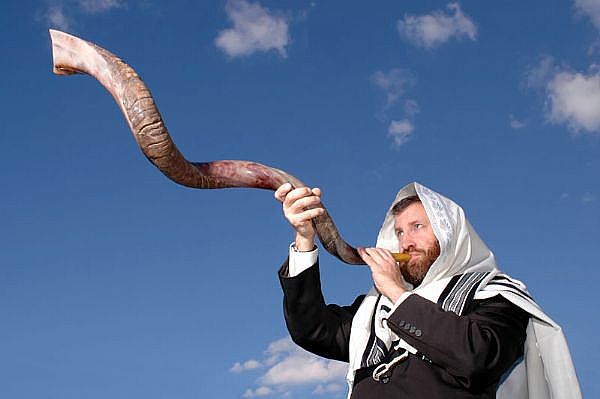
A man blows the shofar.
This year the Jewish celebration of the High Holy Days falls in very early September. Considered the birthday of Adam and the “Days of Awe” during which God judges the world to decide who will live or die during the coming 12 months, the celebration of the New Year and Day of Atonement are especially solemn. One of the most noted New Year’s practices is the blowing of the shofar during the New Year services. When the walls of Jericho fell, it was in response to the blowing of shofars by the army of Israel. Hebrew folklore also indicates that blowing a shofar was used to implore God to bring rain during times of drought and serve as a warning blast to the people when a disaster was looming on the horizon. It was a heavenly shofar that sounded when God gave Moses the 10 Commandments on Mt. Sinai and it is a shofar the angels will blow to announce the End of the World.
Because of the association of the High Holy Days with repentance, judgement, and death it also a time when the division between the living and the dead is considered thin indeed. One way the dead or other spirits interact with the living is by possesion. Some spirits that attack the living are ghosts but others are demonic entities. Some demons are fallen angels but according to some Kabbalistic thought, a man who masturbates, has a “wet dream,” or has a seminal emission under other unhallowed circumstances, his semen gives birth to “spiritual children” which gravitate against him [and his family] as negative spiritual forces. The man may redeem these spiritual children through remorse and repentance and end their damaging influence upon himself and his loved ones.
A ghost that posses the living is called a “dybbuk.” The term first appears in a number of 16th century writings, and earlier accounts of possession (such as that given by Josephus) were of demonic possession rather than that by ghosts. The 16th century accounts advocated orthodoxy among the populace as a way to prevent possession by a dybbuk. For example, it was suggested that a sloppily made mezuzah or entertaining doubt about Moses’ crossing of the Red sea opened one’s household to dybbuk possession.
There are also other accounts of soul transmigration in Jewish mythology. In contrast to the dybbuk, the “Ibbur” is a positive possession, which happens when a righteous soul temporarily possesses a body. This is always done with consent, so that the soul can perform a good deed, known as a “mitzvah.” Some kabbalists put forth the idea that a soul must live through many lives before it gains the wisdom to rejoin with God.