
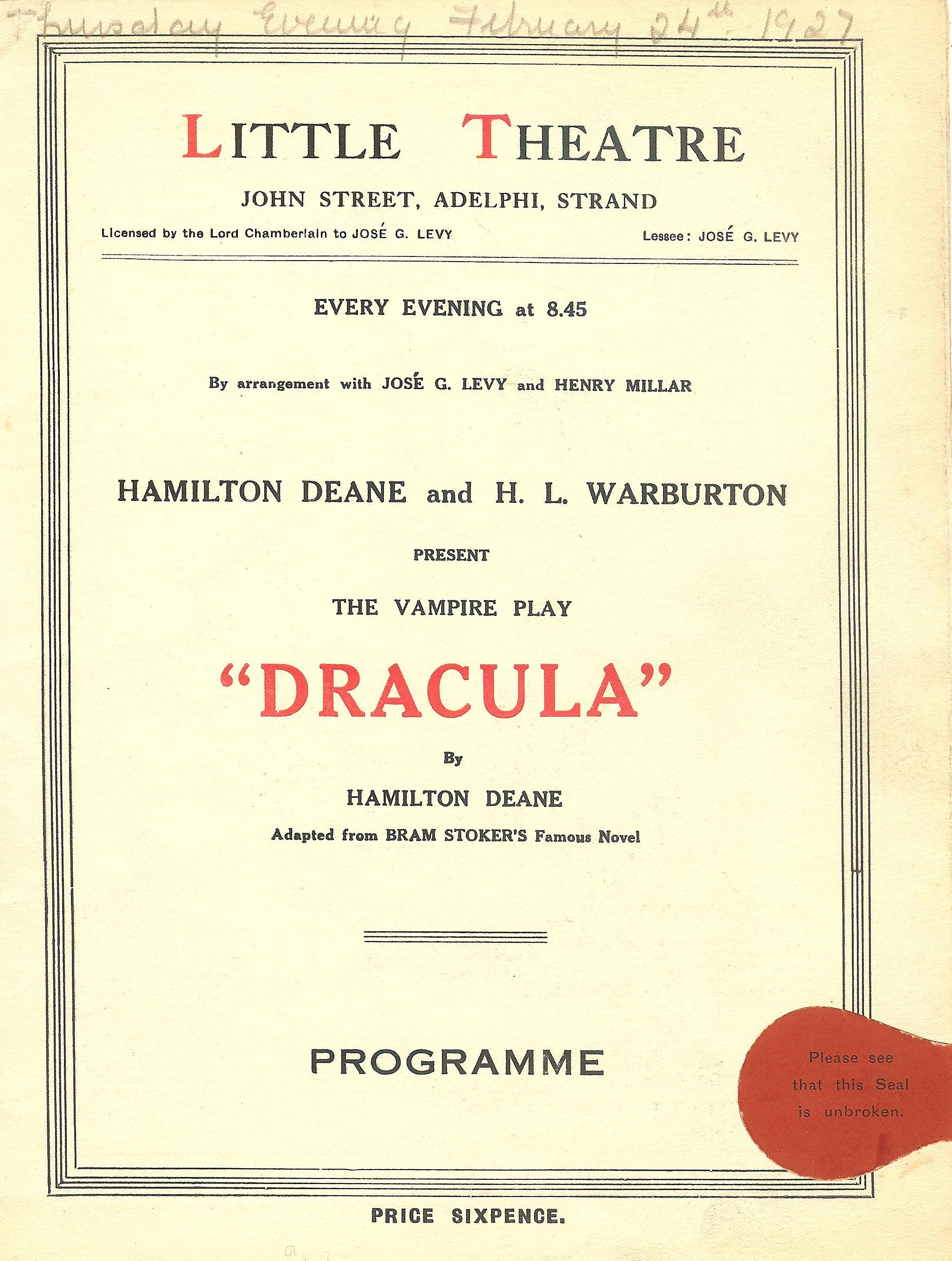
Dracula Arrives in New York

Dracula Rare Original 1927 progm

The play Dracula opened in New York’s Schubert Theatre on September 19, 1927. Originally a 1924 stage play adapted by Hamilton Deane from the novel of the same name by Bram Stoker, it was substantially revised by John L. Balderston in 1927. It was the first adaptation of the novel authorised by Stoker’s widow, and has influenced many subsequent adaptations.

In 1927 the play was brought to Broadway by Horace Liveright, who hired John L. Balderston to revise the script for American audiences. The American production starred Bela Lugosi in his first major English-speaking role, with Edward Van Sloan as Van Helsing; both actors reprised their roles in the 1931 film version, which drew on the Deane-Balderston play.

In addition to radically compressing the plot, the 1927 rewrite by Balderston, reduced the number of significant characters, combining Lucy Westenra and Mina Murray into a single character, making John Seward this Lucy’s father, and disposing of Quincey Morris and Arthur Holmwood. In Dean’s original version Quincey was changed to a female to provide work in the play for more actresses.

The play was revived in 1977, in a production featuring set and costume designs by Edward Gorey and starring Frank Langella as Dracula. The production won Tony Awards for Best Revival and Best Costume Design, and was nominated for Best Scenic Design and Best Leading Actor in a Play (Langella). Langella, like Lugosi, went on to reprise the role in the 1979 film version. Subsequent actors in the title role for the Broadway revival included David Dukes, Raul Julia and Jean LeClerc, while the London production starred Terence Stamp and American touring companies starred Martin Landau and Jeremy Brett.

(Related to the theatrical opening of Dracula, the popular television series The Addams Family debuted on September 18, 1964 and Romania issued a stamp depicting Vlad Dracul in honor of the 500th anniversary of the founding of Bucharest on September 20, 1959.)
Come to the Brooklyn Book Fair on September 22!


I will have half-price discount copies of WOLFBANE, the novella that sets the stage for the adventures of Alexei the werewolf, at Booth #185. Find me beneath the “Stephen Morris, Author” sign, on SEPTEMBER 22, 2013 from 10am-6pm. The festival will be held

Brooklyn Borough Hall and Plaza
209 Joralemon Street, Brooklyn NY 11201

The festival can be easily reached by several subway lines:

take the M, R, 2, 3, 4, or 5 trains to Court St/Borough Hall, or take the A, C, F trains to Jay St/Borough Hall.

More information about the annual festival can be found here.

If you cannot drop by and say, “Hello!” at the Book Festival, you can order WOLFBANE on Amazon here.

Discount copies of the Come Hell or High Water trilogy will be available at the Brooklyn Book Festival as well. Buy a set of the entire trilogy and get a FREE copy of Wolfbane!

Sapphire, the birthstone of September

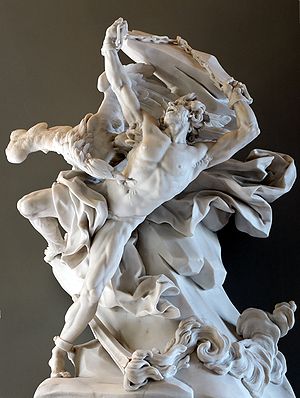
Prometheus, depicted in this 1762 statue by Nicolas Sebastien Adam, was punished for stealing a sapphire from Olympus as well as fire.

Prometheus, depicted in this 1762 statue by Nicolas Sebastien Adam, was punished for stealing a sapphire from Olympus as well as fire.

September’s birthstone is also the birthstone for the astrological signs of Taurus, Virgo, Sagittarius and Pisces. The sapphire is the gem commemorating the 5th, 23rd and 45th wedding anniversaries.

Ancient folklore claims the sapphire bestows spiritual enlightenment and inner peace upon its wearer, as well as providing protection from harm. Because sapphires were thought to hold the power of wisdom, those wearing these gemstones would be guided to make the correct decision when faced with obstacles and difficult situations. Sapphires have been credited with the ability to detect purity and faith, as well as possessing the power to foretell the future and attract divine favour. Because the sapphire represents purity of purpose and deed, medieval-era church officials chose the gemstone to decorate their rings and sceptres.

The Ten Commandments handed to Moses by God in the Bible were said to have been carved on sapphire. Different English Bible translations believe the word “Sapir” in Exodus 28:18 is “sapphire”, referring to the stone on the garments of the priest of the Issacar tribe.

Eastern cultures treasure the sapphire as a talisman for warding off evil; in India a sapphire necklace affords its wearer powerful protection. In the West, the unique star sapphire is known as the Stone of Destiny, with the three lines crossed lines that form the “star” representing Faith, Hope and Charity. Such is the power of the star sapphire it is believed the gemstone will continue to guide and protect its first wearer even after it has been passed to other people.

Greek mythology claims that when Prometheus stole fire from the gods to give to mortals he also stole a sapphire. The dreadful punishment exacted by the gods for this misdeed would indicate the sapphire failed to protect the unfortunate Prometheus. Ancient Persians believed the earth rested on a giant blue sapphire, and the gemstone’s colour was reflected onto the sky.

In the Middle Ages blue gemstones were used to treat eye diseases and as an antidote to poison. Members of royalty wore sapphire around their necks to protect them from envy, poison and harm. Sapphires were considered to be an effective treatment for colic and rheumatism, as well as being used to ease certain mental illnesses.