
.
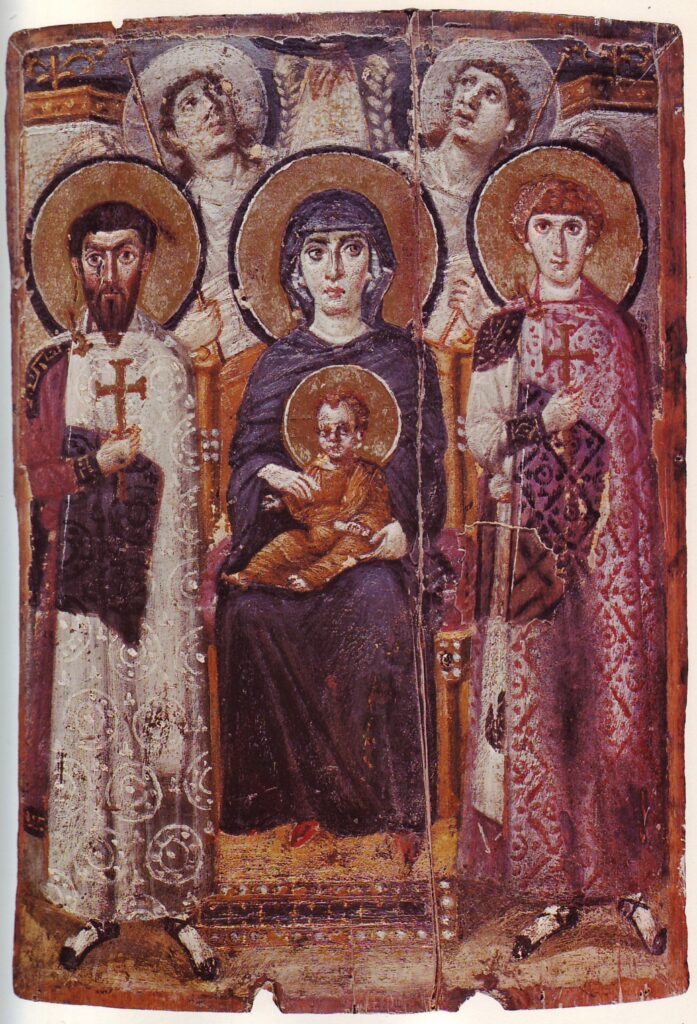
There was an early Christian folktale that the damned in Hell got a short reprieve every year: their suffering was reduced–or stopped altogether–for the fifty days between Easter and Whitsunday (Pentecost) or Trinity Sunday. Around the year AD 1000, this reprieve was said to be the result of the prayer of the Mother of God who was said to have gone to Hell to see the suffering of the damned. Escorted by St. Michael the Archangel, she went on a tour of the Underworld and was moved to tears at what she saw. She pleaded with her Son to spare the damned as much of their suffering as possible. So it became common practice in the Middle Ages to offer special prayers for the dead at Pentecost as the punishment of the damned began again.
In one story, a man makes a deal with the devil and sells his soul in exchange for special favors from the devil during life. As the man was dying, he is sorry about his decision and begs the Mother of God to help him. Mary is infinitely merciful, so she does. She girds her loins for battle, descends into hell, and steals back the contract giving the man’s soul to the devil!
In this story, Mary’s mission to hell is portrayed as warfare. The tale evokes the devil’s anger, and uses the language of violence and theft to describe Mary’s actions. In her guise as empress of hell–that is, more powerful even than Satan–she is not the mother of mercy, she is the “queen of vengeance” against the devil and the powers of Hell.
I think these stories are all trying to express an intuition about the power of the Mother of God to save us from ourselves and our own worst choices and behavior. They also show the inability of Hell to confine anyone who really wants to escape, underlining the original understanding that when Christ smashed down the gates of Death and Hell, everyone who wanted to escape did and now only those who choose to remain in Hell–unable to accept responsibility for their actions and thus unable to accept forgiveness–are there.
Curious about these stories? Read more here and here. This is another good one to read. See how many of them there are?
Fascinating. So…I love your interpretation, and cannot but note that you seem to open the door to Universal Salvation. I for one view the notion with favor, but is it really what you mean to imply?
Thank you for writing, Chauncey. I do indeed find myself leaning more and more into the idea of universal salvation these days. My thinking began to shift many years ago but only in the last few years has it really taken that decisive a turn. What started you thinking along those lines?
Hi, I am a Protestant and recently read the poem “When the Mother of God Went to Hell” after reading “The Grand Inquisitor.” This isn’t an argument, but I’m curious why people call Mary the Queen of Heaven.
The term “Queen of Heaven” is mentioned in the Bible and has been associated with various goddesses by scholars, such as Anat, Astarte or Ishtar, and Ashtoreth. In the Book of Jeremiah, the Prophet condemns the worship of a “Queen of Heaven,” indicating that it provoked God’s anger and led to the removal of His people from the land.
For example, Jeremiah 7:17-18 states:
“Seest thou not what they do in the cities of Judah and in the streets of Jerusalem? The children gather wood, the fathers light the fire, and the women knead the dough and make cakes of bread for the Queen of Heaven. They pour out drink offerings to other gods to provoke me to anger.”
Additionally, in Jeremiah 44:15-18:
“Then all the men who knew that their wives were burning incense to other gods, along with all the women who were present—a large assembly—and all the people living in Lower and Upper Egypt, said to Jeremiah, ‘We will not listen to the message you have spoken to us in the name of the LORD! We will certainly do everything we said we would: We will burn incense to the Queen of Heaven and will pour out drink offerings to her just as we and our fathers, our kings and our officials did in the towns of Judah and in the streets of Jerusalem. At that time we had plenty of food and were well off and suffered no harm. But ever since we stopped burning incense to the Queen of Heaven and pouring out drink offerings to her, we have had nothing and have been perishing by sword and famine.'”
I am also puzzled by the title “Empress of Hell” used for Mary. You mentioned that this relates to the understanding that Christ broke down the gates of Death and Hell, but I haven’t found such references in the Bible. I would appreciate your thoughts on this concept.
Thank you.