Good Yule 2017!

Yule Holiday Scene

Yule or Yuletide (“Yule time”) was a religious festival observed by the Germanic peoples, later being absorbed into and equated with Christmas. Scholars have connected the celebration to the Wild Hunt, the god Odin and the pagan Anglo-Saxon Modranicht.

Terms with an etymological equivalent to Yule are used in the Nordic countries for Christmas with its religious rites, but also for the holidays of this season. Yule is also used to a lesser extent in English-speaking countries to refer to Christmas. Customs such as the Yule log, Yule goat, Yule boar, Yule singing, and others stem from Yule.

Yule is the modern English representative of the Old English words ġéol or ġéohol and ġéola or ġéoli, with the former indicating the 12-day festival of “Yule” (later: “Christmastime”) and the latter indicating the month of “Yule”, whereby ǽrra ġéola referred to the period before the Yule festival (December) and æftera ġéola referred to the period after Yule (January). Both words are thought to be derived from Common Germanic, and are cognate to Gothic (fruma) jiuleis and Old Norse (Icelandic and Faroese) jól (Danish and Swedish jul and Norwegian jul or jol) as well as ýlir, Estonian jõulud and Finnish joulu. The etymological pedigree of the word, however, remains uncertain, though numerous speculative attempts have been made to find Indo-European cognates outside the Germanic group, too.

The noun Yuletide is first attested from around 1475.

The word is attested in an explicitly pre-Christian context primarily in Old Norse. Among many others, the long-bearded god Odin bears the names jólfaðr (Old Norse ‘Yule father’) and jólnir (Old Norse ‘the Yule one’). In plural (Old Norse jólnar; ‘the Yule ones’) may refer to the Norse gods in general. In Old Norse poetry, the word is often employed as a synonym for ‘feast.’

Santa Lucia

Check out this website to make your own wreath-and-candle crown!

I remember studying about Santa Lucia in third grade when Scandinavia was the Social Studies unit. (I also remember the teacher saying that reindeer herding was one of the primary occupations in Finland and I wanted to ask, “How can anyone herd reindeer when they can fly?!” But something told me to keep my mouth shut. I’m glad I did.) Three years ago, I was also able to visit her relics which are currently kept in Venice.

Saint Lucy’s Day, is celebrated on 13 December, commemorating Saint Lucy (a 3rd-century martyr under the Great Persecution of Diocletian), who according to legend brought “food and aid to Christians hiding in the catacombs” wearing a candle-lit wreath on her head to “light her way and leave her hands free to carry as much food as possible”. Her feast once coincided with the Winter Solstice, the shortest day of the year before calendar reforms, so her feast day has become a Christian festival of light.

Saint Lucy’s Day is celebrated most commonly in Scandinavia, with their long dark winters, where it is a major feast day, and in Italy, with each country highlighting a different aspect of the story. In Scandinavia, where Saint Lucy is called Santa Lucia, she is represented as a lady in a white dress (a symbol of a Christian’s white baptismal robe) and red sash (symbolizing the blood of her martyrdom) with a crown or wreath of candles on her head. In Norway, Sweden and Swedish-speaking regions of Finland, as songs are sung, girls dressed as Saint Lucy carry cookies and saffron buns in procession, which symbolizes bringing the light of Christianity throughout world darkness.

St. Lucy is the patron saint of the city of Syracuse (Sicily). On 13 December a silver statue of St. Lucy containing her relics is paraded through the streets before returning to the Cathedral of Syracuse. Sicilians recall a legend that holds that a famine ended on her feast day when ships loaded with grain entered the harbor. Here, it is traditional to eat whole grains instead of bread on 13 December. This usually takes the form of cuccia, a dish of boiled wheat berries often mixed with ricotta and honey, or sometimes served as a savory soup with beans.

St. Lucy is also popular among children in some other regions of Italy, where she is said to bring gifts to good children and coal to bad ones the night between 12 and 13 December. According to tradition, she arrives in the company of a donkey and her escort, Castaldo. Children are asked to leave some coffee for Lucia, a carrot for the donkey and a glass of wine for Castaldo. They must not watch Santa Lucia delivering these gifts, or she will throw ashes in their eyes, temporarily blinding them.

I think that in the United States, Santa Claus might appreciate a cup of coffee as well, more than milk and cookies!

Who Comes to YOUR House on December 6?

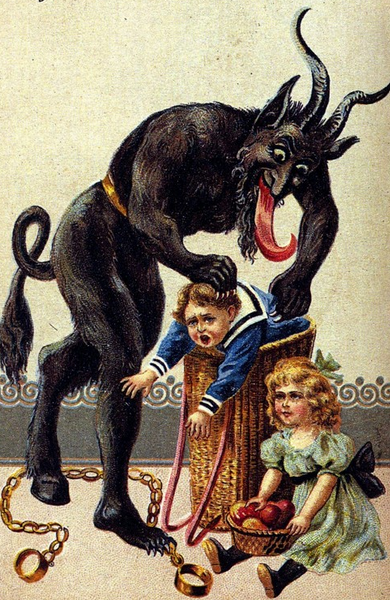
krampus-stuffing-children-into-basket

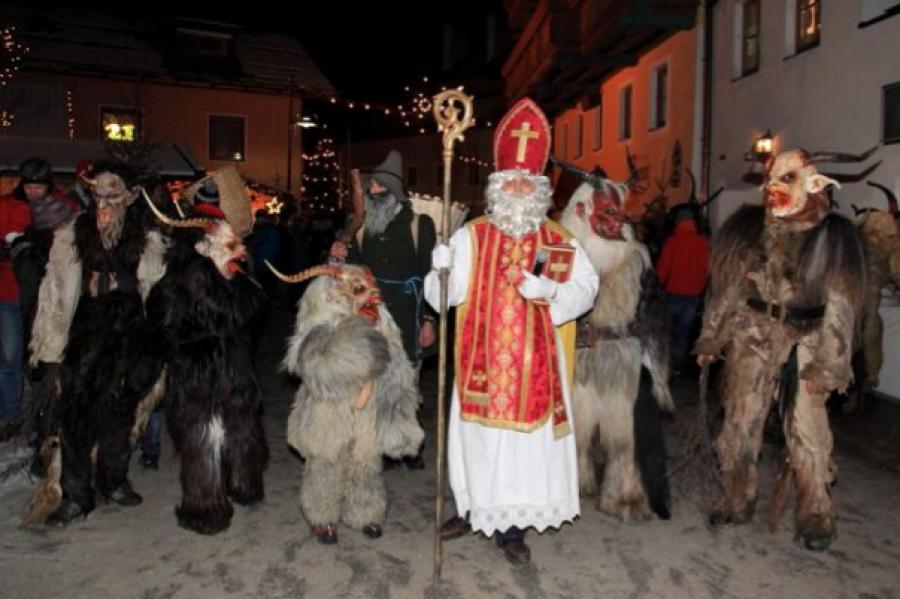
Traditionally on December 5th and 6th, St. Nicholas walks from house to house in the cities and villages of Alpine and Central Europe to admonish and laud young and old. In the Alpine regions, he is accompanied by a Krampus (an evil creature, a devil of sorts), who is going to punish the bad children and adults on St. Nicholas′ command. For the honest children he normally has little presents. In Prague and the Czech-speaking areas of Central Europe, the čert (a clearly demonic character) accompanies St. Nicholas.

In Come Hell or High Water, both St. Nicholas and his čert appear:

“It was commonly supposed [in 1356] that St. Nicholas, as he made his rounds bestowing gifts on children and the needy, was accompanied by both a tar-covered čert, a pitch-black devil, as well as a bright and glorious andel, an angel of light, who each argued for or against the worthiness of the recipient of the saint’s benefactions. The čert was always ready, at the slightest nod from the saint, to carry away the unworthy beggar or misbehaving child and–throughout the year–parents could always warn their children that they might be carried away by the čert….”

St. Nicholas himself is a Christian figure, the fourth century bishop of Myra. As son of a well-situated family, he started to help poor people who lived in deep poverty. He was supposed to have miraculous vigor and so he became patron of the seamen, children and poor people. (See a previous post about St. Nicholas and his care for the poor here.) In most modern versions of the St. Nicholas story, he is accompanied by a monster or servant (the Dutch describe his assistant as Black Peter) who punishes the bad children while Nicholas himself rewards the well-behaved children.

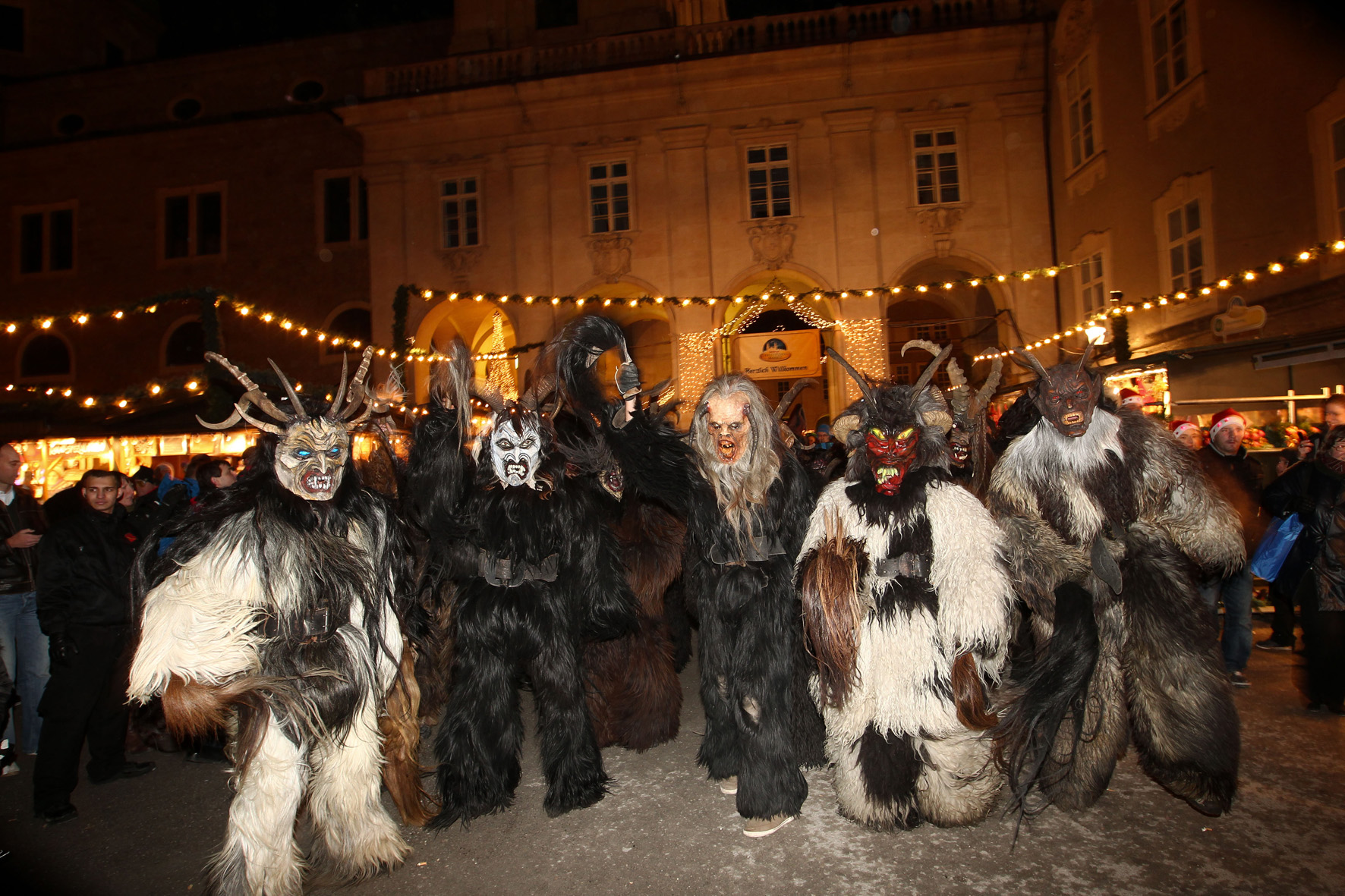
The figure of the Krampus is based on pre-Christian custom. The Krampusse not only punish the bad children but had the function at one time of driving out the winter devils and blizzard sprites. Originally the custom of the Krampus was spread over all of Austria but was forbidden by the Catholic Church during the Inquisition. It was prohibited by death to masquerade as a devil or an evil creature and so this custom only survived in some remote, inaccessible, regions of the Alps from where it slowly spread back across the western parts of Austria again. Today the Krampusse revels are especially popular in Salzburg. As many times as I have been to Salzburg, I have never been there during Krampusse-time; I would dearly love to be there to see the processions and parades of costumed characters in the streets.

St. Nicholas and the Krampus procession in Salzburg (2010); photo by Charlotte Anne Brady.

St. Nicholas and the Krampus procession in Salzburg (2010); photo by Charlotte Anne Brady.

Krampus revels at the Salzburg Christmas Market, 2011; photo by Neumayr/MMV 05.12.2011

Krampus revels at the Salzburg Christmas Market, 2011; photo by Neumayr/MMV 05.12.2011