
Werewolves, Weasels, Ravens—O, My!

Tomatoes were an important ingredient in some potions that would turn someone into a werewolf.

Everyone knows about the connections between werewolf bites, wolfbane, silver bullets, and the full moon. “Thank you, Hollywood!” But the real connections between werewolves, tomatoes, and other legends is actually more interesting although less well known.

The most famous werewolf story in Norse mythology–but almost unknown anywhere else–is the story of father and son, Sigmund and Sinfjotli. Wandering in the woods, Norse heroes Sigmund and Sinfjotli come upon a hut where they find two spellbound wolf pelts. Sigmund and Sinfjotli put on the pelts and then discovered that the pelts could only be removed every 10th day and therefore wander in forest as wolves.

Sinfjotli & Sigmund agree to fight together if attacked by more than 7 men but Sinfjotli the son kills 11 men at one time. Sigmund fatally injures his son. But a raven, the messenger of Odin, brings a healing leaf to place on Sinfjotli’s wound. (Some versions of the story say that a pair of weasels bring the healing leaf.)

Sinfjotli is healed, he and his father take off the wolf pelts as the 10th day comes and burn the pelts to free themselves.

It is not a surprise to meet a raven, associated with Odin and death, around werewolves. Weasels, generally thought sneaks and thieves, are also considered extremely talented physicians in traditional tales. Using a magic wolf pelt to become a werewolf is also common in folklore. But the stipulation that the pelt can only be removed 10 days after it is put on is unusual. Perhaps the ten days, which is approximately 1/3 of a lunar month, is a Norse version of the connection between werewolves and the moon.
Beating the Bounds

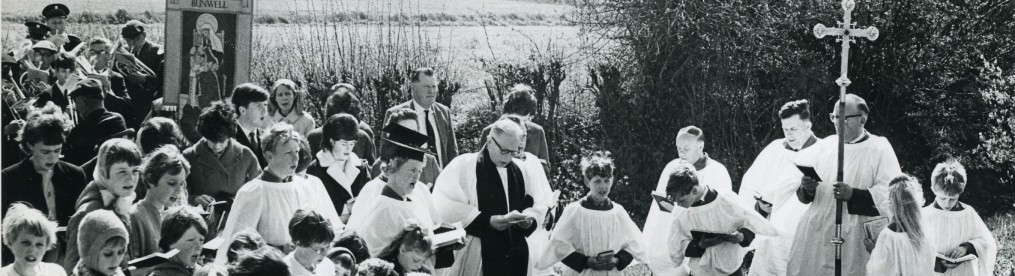
This 1967 Rogation procession in England to pray for the crops would have originally involved “beating the bounds” to mark the boundaries of the parish.

Throughout Europe on Ascension Day (the 40th day after Easter, always a Thursday) there was an ancient custom of “beating the bounds” to mark the limits of each parish (community). There were also processions through the local fields on the 3 days called “Rogation” that same week; sometimes the “beating of the bounds” was combined with the Rogation processions.

In England, the custom of beating the bounds goes back at least as far as the Anglo-Saxon period. In the days before maps and written title deeds a knowledge of the physical boundaries of property was very important. So the custom grew up of walking the boundaries, stopping at intervals to strike boundary stones to ‘mark’ the bounds. (Originally, probably it was the boys and young men that were beaten so that they would remember where the boundaries of the parish were located.) The practice was often linked to Rogation Days, the Monday-Tuesday-Wednesday before Ascension set aside by the Church for prayers for the crops; walking the boundaries of the parish was an obvious opportunity to “beat the bounds” and pray for the crops at the same time.

In England, between 1598 and 1834, the care of the poor was the responsibility of each parish church. It was the local parish (community) that had to relieve the needy, apprentice children and care for the destitute. The responsibility was for all those settled in the parish; this included illegitimate children, which sometimes led to parish officials trying desperately to remove pregnant unmarried women to another parish so that they would not be responsible for the baby! The Poor Laws provided another reason for ensuring that everyone knew the boundaries of the parish. The inhabitants needed to know which authorities to apply to for help, and the authorities to know which inhabitants were entitled to that help.

There are still processions to “beat the bounds” in Oxford as well as in London!

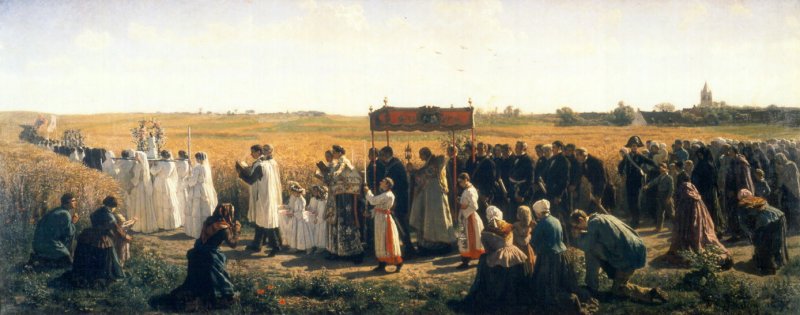
Breton Blessing of the Wheat at Artois (1857)

“May Day 2018!”

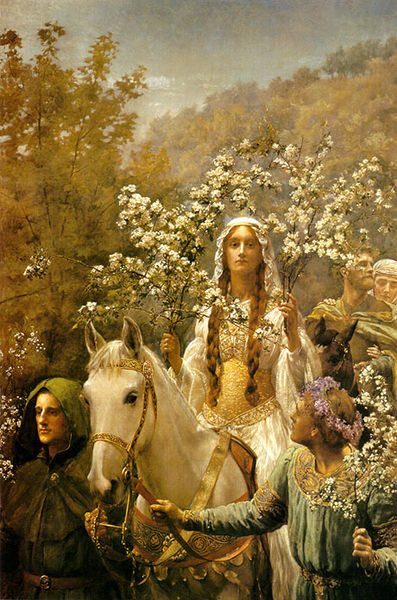
Queen Guinevere, as the May Queen, leads the May Day celebrations in Camelot.

Queen Guinevere, as the May Queen, leads the May Day celebrations in Camelot.

Considered the first day of the summer season in traditional European societies, the first day of May has been celebrated in many ways over many centuries. May Day is related to the Celtic festival of Beltane and the Germanic festival of Walpurgis Night. May Day falls half a year from November 1 (Samhain, Hallowe’en, and All Saints’ Day) and it has traditionally been an occasion for popular and often raucous celebrations.

The earliest May Day celebrations appeared in pre-Christian times, with the festival of Flora, the Roman goddess of flowers, and the Walpurgis Night celebrations of the Germanic countries. It is also associated with the Gaelic Beltane. Many pagan celebrations were abandoned or Christianized during the process of conversion in Europe. A more secular version of May Day continues to be observed in Europe and America. In this form, May Day may be best known for its tradition of dancing the maypole dance and crowning of the Queen of the May. Fading in popularity since the late 20th century is the giving of “May baskets”, small baskets of sweets and/or flowers, usually left anonymously on neighbors’ doorsteps. (I remember making May Baskets in school and field day Maypoles on the playground.)

The day was a traditional summer holiday in many pre-Christian European pagan cultures. While February 1 was the first day of Spring, May 1 was the first day of summer; hence, the summer solstice on June 25 (now June 21) was Midsummer.

In Oxford, it is traditional for May Morning revellers to gather below the Great Tower of Magdalen College at 6:00 a.m. to listen to the college choir sing traditional madrigals as a conclusion to the previous night’s celebrations.

On May Day, the Romanians celebrate the arminden (or armindeni), the beginning of summer, symbolically tied with the protection of crops and farm animals. The name comes from Slavonic Jeremiinŭ dĭnĭ, meaning the prophet Jeremiah’s feast day, but the celebration rites and habits of this day are apotropaic and pagan, possibly originating in the cult of the god Pan.

The day is also called ziua pelinului (mugwort day) or ziua bețivilor (drunkards’ day) and it is celebrated to insure good wine in autumn and, for people and farm animals alike, good health and protection from the elements of nature (storms, hail, illness, pests). People would have parties outdoors with fiddlers and it was customary to eat roast lamb, as well as new mutton cheese and drink mugwort-flavoured wine to refresh the blood and get protection from diseases. On the way back from the parties, the men wear lilac or mugwort flowers on their hats.

Other May Day practices in many places include people washing their faces with the morning dew (for good health) and adorning the gates for good luck and abundance with green branches or with birch saplings (for the houses with maiden girls). The entries to the animals’ shelters are also adorned with green branches. All branches are left in place until the wheat harvest when they are used in the fire which will bake the first bread from the new wheat.