
Bloodstone or Aquamarine? The Birthstone of March

Bloodstone, the birthstone for March, is used as a medicine and an aphrodisiac.

Bloodstone, the birthstone for March, is used as a medicine and an aphrodisiac.

Bloodstone, long considered the birthstone of March, is jasper speckled with iron oxide. (Months were assigned stones and gems from the high-priest’s breastplate of Aaron in the Old Testament or the gems described as the foundations of the New Jerusalem in the Apocalypse, the “Revelation of St. John.”)

Bloodstone was used to heal blood disorders and stop bleeding noses and wounds in Babylon and was carved into amulets to protect against the Evil Eye. Ancient Greeks thought using it in ritual would hasten changes in fortune. Western European Christians in the Middle Ages thought all bloodstones had been splashed with Christ’s blood at the Crucifixion and used the stones to carve images of either the Crucifixion or scenes of martyrs’ deaths.

These gems would be pulverized and mixed into egg whites with honey and used to remove poison from snakebites. Knights and soldiers would bring bloodstones with them into battle not only to staunch bleeding but to increase courage and physical strength as well. It was also thought to confer invisibility, a useful skill in battle. It was also used as an aphrodisiac (useful after battle).

Some also associate aquamarine gems with March. This gemstone was believed to protect sailors, as well as to guarantee a safe voyage. The serene blue or blue-green color of aquamarine is said to cool the temper, allowing the wearer to remain calm and levelheaded.

In the Middle Ages, many believed that the simple act of wearing aquamarine was a literal antidote to poisoning. The Romans believed that if you carved a frog into a piece of aquamarine jewelry, it would help to reconcile differences between enemies and make new friends.

In some times and places, an aquamarine was given to the bride at her wedding in order to symbolize long unity and love. Some believed it could re-awaken love between two people; maybe that’s why it is also associated with a couple’s 19th anniversary?

The Sumerians, Egyptians, and Hebrews all admired aquamarine, and many warriors would wear it into battle to bring about victory. Many ancient medicines used powder from aquamarine to help cure all manner of infection, but it was said to be particularly good for eye ailments.

Since early times, aquamarine has been believed to endow the wearer with foresight, courage, and happiness. It is said to increase intelligence and make one youthful. As a healing stone, it is said to be effective as a treatment for anxiety and in the Middle Ages it was thought that aquamarine would reduce the effect of poisons.
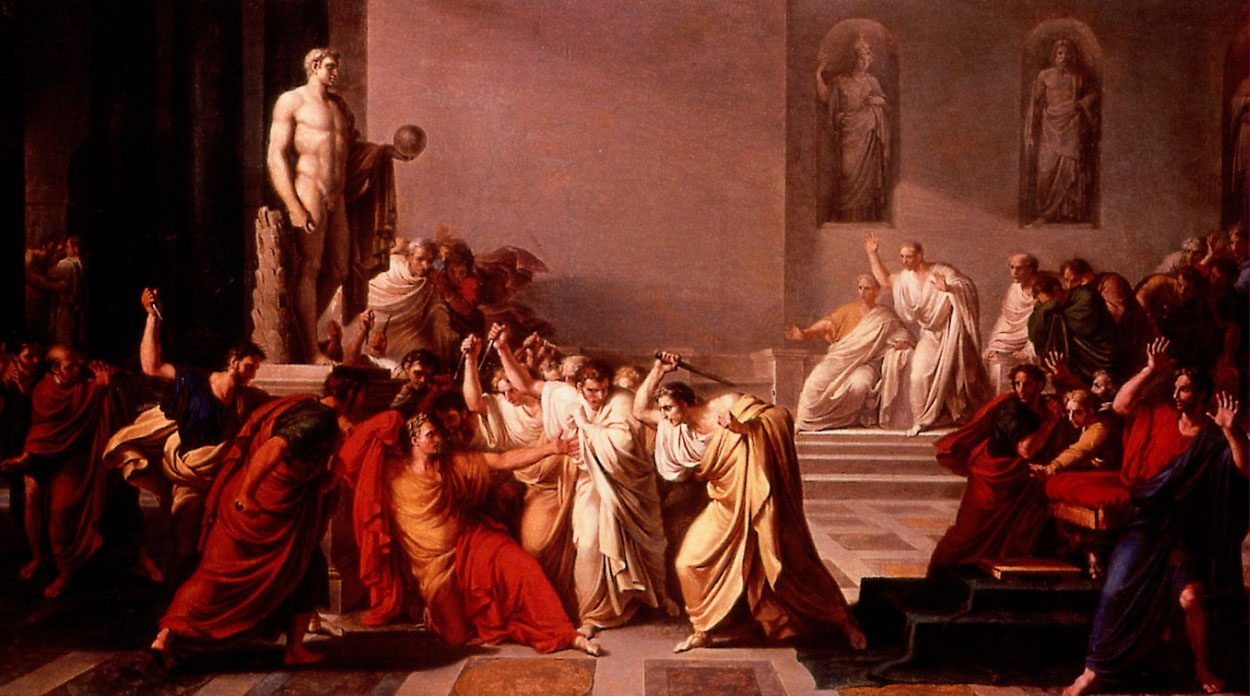

“Beware the Ides of March 2019!”

Vincenzo Camuccini, "Morte di Cesare", 1798,

Vincenzo Camuccini, “Morte di Cesare”, 1798,

“Beware the ides of March!” the prophet warned Julius Caesar in 44 B.C. and Caesar was assassinated shortly thereafter, on the ides. Ever since, the Ides of March has been a day associated with doom, disaster, or failure in some form. But what is the “ides”?

Unlike currently used dates, which are numbered sequentially from the beginning of the month, the Romans and medieval Europeans counted backwards from three fixed points: they designated the “kalends,” the “nones,” and the “ides” and all other dates were based on these. (ex. the kalends = the 1st, the nones = the 5-7th, and the ides = the 13-15th days of the month). For instance, rather than saying, “Today is March 3” they would say, “Today is three days before the nones of March.” The kalends marked the new moon, the nones was the half-moon and the ides was the full moon.

The ides of the month marked the full moon and thus the following days of each month were governed by the waning moon, a good time for curses as dark magic grew more powerful as the nights grew darker. Not only would dark magic grow stronger but the darker nights also made crime in general more likely. That the last half of each month was steeped in evil and disaster was underscored by its association with the assassination of Caesar.

Even before the assassination of Caesar, the Ides of March had been important in Roman religion. The Ides of each month were sacred to Jupiter and the Flamen Dialis, Jupiter’s high priest, led the “Ides sheep” in procession along the Via Sacra to the place where it would be sacrificed.

In addition to the usual Ides monthly sacrifice, the Ides of March was also the occasion of the Feast of Anna Perenna, a goddess of the year (Latin annus, hence words like “annual” in English) whose festival originally concluded the ceremonies of the New Year. The day was enthusiastically celebrated among the common people with picnics, drinking, and revelry. One source from late antiquity also places the Mamuralia on the Ides of March. This observance, which has aspects of a scapegoat ritual, involved beating an old man dressed in animal skins and perhaps driving him from the city. The ritual may have been a new year festival representing the expulsion of the old year.

In the later Imperial period, the Ides of March began a “holy week” of festivals celebrating Cybele and Attis, marking first the day when Attis was born and found among the reeds of a Phrygian river. He was discovered by either shepherds or the goddess Cybele (known as the Magna Mater or “Great Mother”). A week later, on March 22nd, the solemn commemoration of Arbor intrat (“The Tree enters”) commemorated the death of Attis under a pine tree. A college of priests, the dendrophoroi (“tree bearers”) annually cut down a tree, hung from it an image of Attis, and carried it to the temple of the Magna Mater with lamentations. The day was formalized as part of the official Roman calendar under Claudius (who died in AD 54). A three-day period of mourning followed, culminating with celebrating the rebirth of Attis on March 25th, the date of the vernal equinox on the Julian calendar.

Daffodil, the Flower of March

Associated with Venus and water, daffodil is used to promote love, fertility, and luck.

Associated with Venus and water, daffodil is used to promote love, fertility, and luck.

Daffodil or “lent lily”, one of the early blooming flowers of spring and the flower most associated with the month of March, is a common name for the blossom which is a variety of those called “Narcissus.” It was said by the ancient Greeks to have bloomed where the youth Narcissus withered and died, having become infatuated with his own reflection in a pool. (The goddess Nemesis had cursed him in retaliation for his already self-obsessed and cruel disdain of the mountain nymph Echo. Echo had already been punished by the goddess Hera who had made it impossible for Echo to say anything other than repeat a word or two that someone else had spoken to her. Greek mythology is one big interconnected soap opera, isn’t it?!)

It is associated with the goddess Venus (because of Echo’s love for Narcisscus and Narcissus’ love for himself) and is therefore a “feminine” plant. The alchemists associated daffodil with the element water (perhaps because of its association with Narcissus’ death by a pool, even though the flower itself grows easily in meadows and woods).

If you carry daffodil, it will attract a lover to you. If you place fresh-cut daffodil in your bedroom, fertility will increase. If the bloom is plucked and carried next to your heart, it will attract good luck to you. Good luck and fertility being exactly what Narcissus was himself in short supply of, perhaps his flower is attempting to make amends for him and his bad behavior toward the nymph who wanted nothing more than to be his lover.

IF YOU LIKED THIS POST ABOUT THE FOLKLORE & OCCULT QUALITIES ASSOCIATED WITH DAFFODILS, CLICK HERE TO SEE MY FANTASY NOVELS IN WHICH ALL THE MAGICAL, FANTASTIC, AND SUPERNATURAL EVENTS ARE BASED ON AUTHENTIC MEDIEVAL-RENAISSANCE OCCULT BELIEFS AND PRACTICES.