“Christ is risen! Indeed, he is risen!”
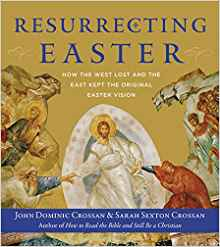
In the iconography of the Eastern Church, the risen Jesus grasps the hands of other figures around him. Unlike the Western image of a solitary Jesus rising from an empty tomb, the authors of Resurrecting Easter saw images of the Resurrection depicting Jesus grasping the hands of Eve and Adam, lifting them to heaven from Hades or hell. They discovered that the standard image for the Resurrection in Eastern Christianity is communal and collective, something unique and distinct from the solitary depiction of the resurrection in Western Christianity.
A popular 7th-century homily on the Resurrection tells us
“The Lord rose, then, after three days… and all the descendants of the nations were saved in Christ. For one was judged and multitudes were saved. The Lord died on behalf of all…. [and] He raised up all humanity to the height of heaven, bearing a gift to the Father, not of gold nor silver nor precious stone, but rather that human race which he made according to his own image and likeness.”
In the Eastern images of the Resurrection, Adam and Eve–often with Kings David and Solomon, St. John the Baptist, and other prophets from the Old Testament–represent all humanity exiting an empty Hades. The whole human race shares in the triumph of the Resurrection of Christ and the earth itself is saved from the desecration of Abel’s blood shed by Cain. This is reflected in the hymnography of the Holy Saturday services as well:
TODAY, HELL CRIES OUT GROANING:
MY DOMINION HAS BEEN SHATTERED.
I RECEIVED A DEAD MAN AS ONE OF THE DEAD,
BUT AGAINST HIM I COULD NOT PREVAIL.
FROM ETERNITY I HAD RULED THE DEAD,
BUT BEHOLD, HE RAISES ALL.
BECAUSE OF HIM DO I PERISH.
GLORY TO THY CROSS AND RESURRECTION, O LORD!
Resurrecting Easter reflects on this divide in how the Western and Eastern churches depict the Resurrection and its implications. The authors argue that the West has gutted the heart of Christianity’s understanding of the Resurrection by rejecting that once-common communal iconography in favor of an individualistic vision. As they examine the ubiquitous Eastern imagery of Jesus freeing Eve from Hades while ascending to heaven, they suggest that this iconography raises profound questions about Christian morality and forgiveness.
A fundamentally different way of understand the story of Jesus’ Resurrection, Resurrecting Easter is illustrated with 130 images and introduces an inclusive, traditional community-based ideal that offers renewed hope and possibility.