Melchizedek, King of Salem

This icon of Melchizedek is one of several that I painted many years ago. You can see the curls of the challah bread in his hand reflected in the curls of his beard. He wears the turban of a high priest and the crown of a king, as he was both priest of God Most High and king of (Jeru-)Salem.

Melchizedek is a mysterious but very important figure in the Bible. He is the king of Salem (later known as Jerusalem) and a priest of God Most High, and he blessed the patriarch Abraham. In the book of Genesis, we read how Abram returns from defeating king Chedorlaomer and meets with Bera the king of Sodom, at which point: “…Melchizedek king of Salem brought out bread and wine: and he was [is] the priest of the most high God. And he blessed Abram, and said, ‘Blessed be Abram to the most high God, possessor of heaven and earth, And blessed be the most high God, which hath delivered thine enemies into thy hand’. And Abram gave him tithe from all.” (Genesis 14:18–20)

Melchizedek is also mentioned in Psalm 110 as an example of one man acting as both priest and king (a new development in Jewish practice, dating from the time of the Maccabees about 200 BC) and Christ is compared to Melchizedek in the Epistle to the Hebrews in the New Testament. Melchizedek is the only non-Jewish priest in the Old Testament who is considered legitimate; his priesthood is also greater than the Jewish priesthood because he blesses Abram [Abraham], the father of all Jews and thus all of Abraham’s descendants–including the Jewish priests! Abraham also offers Melchizedek a tithe (10%) of all he has, indicating that he considers Melchizedek more important than himself. Melchizedek, king of Salem [i.e. “righteousness” and “peace”], sacrifices bread and wine to God; this is considered by Christian readers as a clear allusion to the Eucharist. Because he is king of righteousness and seems to be a priest for all eternity (as there is no record of his birth or death or his ancestors), he is considered by Christians to be an archetype of Christ Himself.

Some Jewish legends also notice his apparent eternity and say that he presided at the funeral of Abel and was hidden by God in Eden during the Flood to protect him. He was also important to Jews who rejected the legitimacy of the Temple, such as the Essenes and the Qumran community who compiled the Dead Sea Scrolls.

Melchizedek is commemorated by the Eastern churches on May 22.
“Happy Birthday, Stock Market!”

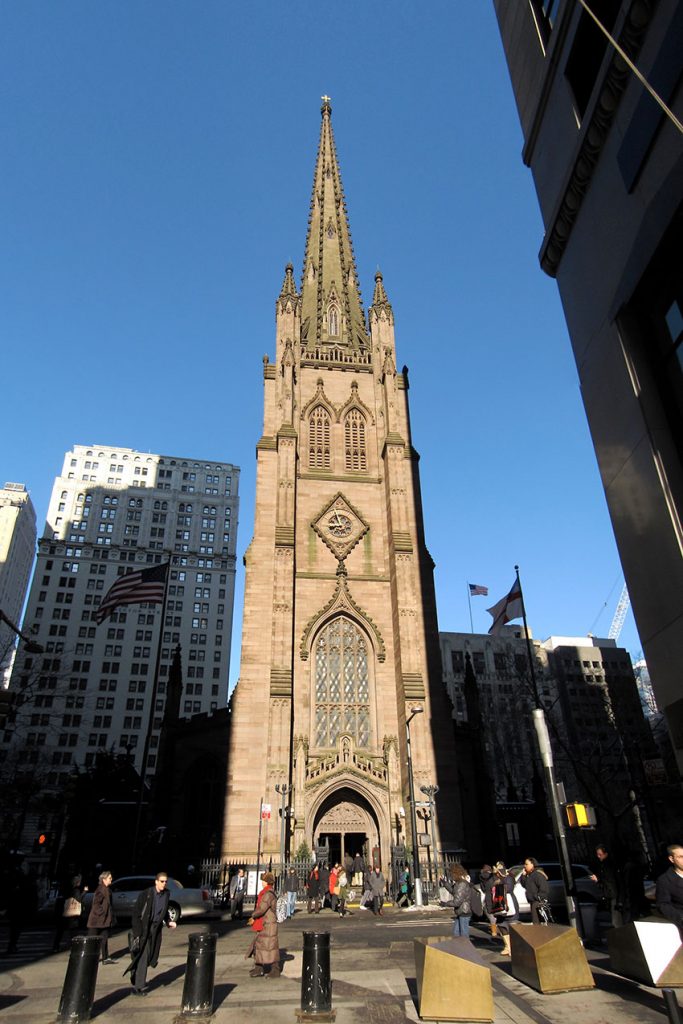
Wall Street leads directly to the front door of Trinity Church in New York City. Trinity Church is an Episcopal church that was founded by royal charter in 1697. The first church was on Wall Street facing the Hudson River.
When Trinity Church was destroyed by the Great New York City Fire of 1776, services moved over to St. Paul’s Chapel until the new church was finished in 1790.
The rebuilt Trinity Church was destroyed by the snowstorms of 1838 – 1839.
The current Trinity Church was completed in 1846. It was the tallest building in the United States until 1869 when a church in Chicago took the title. Trinity Church remained the tallest structure in New York City until it was surpassed by the Brooklyn Bridge towers in 1883.

Two dozen merchants and brokers established the New York Stock Exchange on May 17, 1792. In good weather they operated under a buttonwood tree on Wall Street. In bad weather they moved inside to a coffeehouse to conduct business.

Previously securities exchange had been intermediated by the auctioneers who also conducted more mundane auctions of commodities such as wheat and tobacco. On May 17, 1792 twenty four brokers signed the Buttonwood Agreement; the agreement had two provisions:

1) the brokers were to deal only with each other, thereby eliminating the auctioneers, and

2) the commissions were to be 0.25%.

The earliest securities traded were mostly governmental securities such as War Bonds from the Revolutionary War and First Bank of the United States stock. In 1817 the stockbrokers of New York operating under the Buttonwood Agreement instituted new reforms and reorganized. After re-forming as the New York Stock and Exchange Board the broker organization began renting out space exclusively for securities trading, which previously had been taking place at the Tontine Coffee House. Several locations were used between 1817 and 1865, when the present location was adopted.

The location of the stock market, a building on Wall Street, is shorthand for referring to the entire financial system. There are varying accounts about how the Dutch-named “de Waalstraat” got its name. A generally accepted version is that the name of the street was derived from a wall (actually a wooden palisade) on the northern boundary of the New Amsterdam settlement, built to protect against Native Americans, pirates, and the British. When the British did take control of New Amsterdam and it became New York, the New York City Common Council made Wall Street the city’s first official slave market for the sale and rental of enslaved Africans and Indians in 1711. The slave market operated from 1711 to 1762 at the corner of Wall and Pearl Streets. It was a wooden structure with a roof and open sides, although walls may have been added over the years and could hold approximately 50 men. The city directly benefited from the sale of slaves by implementing taxes on every person who was bought and sold there.

Much of Wall Street itself is owned by Trinity Church; the land along the northern wall of the fort was a gift from Queen Anne to the parish.

Visiting the Departed

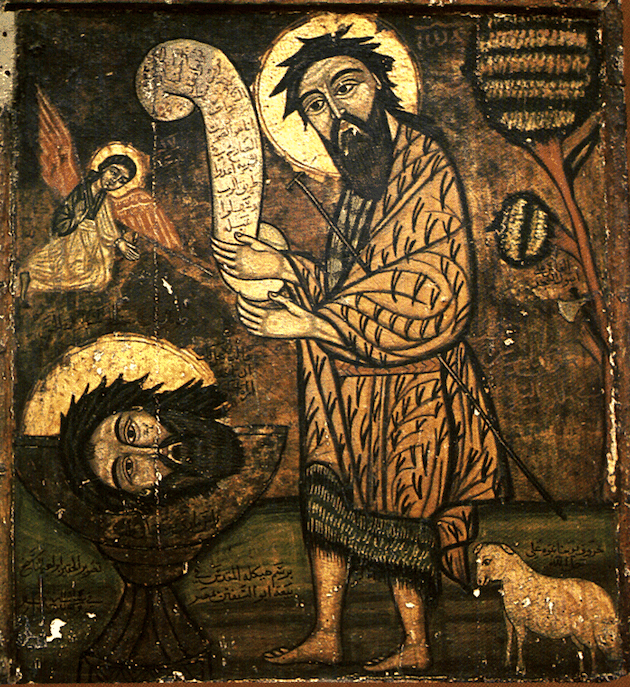
This Coptic icon for the Beheading of St. John the Baptist, shows St. John ‘in clothing of camel’s hair’, with a cross (here in the Coptic Tau (T) form), beholding his own head. The axe at right refers to this line from his own preaching: “And even now the axe is laid to the root of the trees. Therefore every tree which does not bear good fruit is cut down and thrown into the fire.” [Mt 3.10; Lk 3.9]

Decoration Day was first observed on May 5 in the U.S., with the tradition of decorating soldiers’ graves from the Civil War with flowers. On May 5, 1868, General John A. Logan issued a proclamation calling for “Decoration Day” to be observed annually and nationwide; he was commander-in-chief of the Grand Army of the Republic, an organization of and for Union Civil War veterans. With his proclamation, Logan adopted the Memorial Day practice that had begun in the Southern states three years earlier. The observance date was later moved to May 30th and included American graves from World War I and World War II, and became better known as Memorial Day. In 1971, Congress moved Memorial Day to the last Monday in May, thus creating a three-day holiday weekend.

In much of Central and Eastern Europe, the Orthodox Church celebrates the Tuesday after Thomas Sunday as the “Day of Rejoicing” (Radonitsa) by visiting graves and celebrating memorial services for the departed for the first time since before Palm Sunday. (Many monasteries depended on donations in exchange for their prayers for the departed; resuming these services was important for the financial survival of many small monastic communities.) The Day of Rejoicing also begins the marriage season. Since weddings are forbidden during the Great Lenten Fast (because that time should be devoted to penance and self-examination, rather than merrymaking), as well as during Bright Week (because at that time the Church celebrates nothing else except the Resurrection), with Radonitsa comes the time for weddings.

Among Eastern Christians, the Beheading of St. John the Baptist on August 29 is the day to pray for soldiers slain in battle and to visit their graves as established in 1769 at the time of Russia’s war with the Turks and the Poles. The day is always observed with strict fasting, and in some places the pious will not eat food from a flat plate, use a knife, or eat round food on this day because of the association of these things with the Gospel account of St. John’s beheading.