Protection of the Mother of God (Part 2)

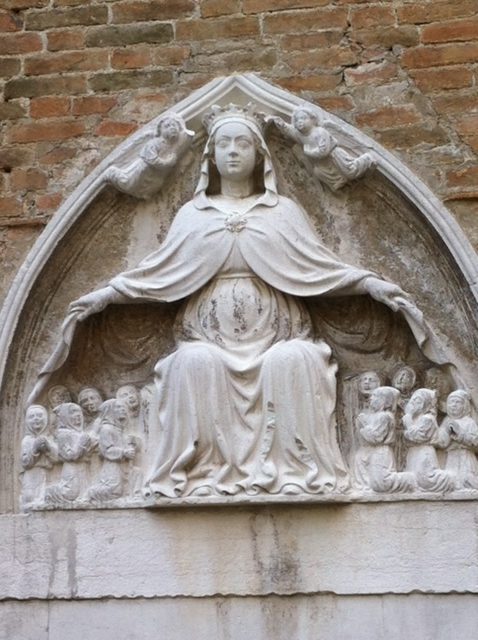
A medieval bas relief in Venice of the Mother of God protecting the faithful gathered under her veil.
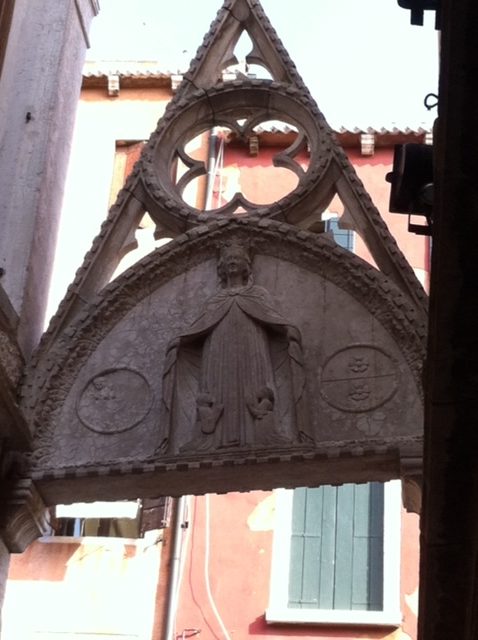
An archway atop a small pedestrian bridge in Venice depicts the Mother of God protecting the faithful with her veil.

Western Christian depictions of the Protecting Veil of the Mother of God are often called “the Virgin of Mercy” and are sometimes associated with Christ’s remarks that He “longed to gather your children [the people of Jerusalem] together, as a hen gathers her chicks under her wings….” (Matthew 23:37) The Mother of God is shown with the faithful of many social ranks and classes gathered on their knees beneath her outstretched cloak. As she is the bridge that unites earth to heaven, having nurtured Christ in her womb and giving birth to God-made-man, her image is frequently seen near bridges. (The Latin word for “priest” (pontifex) comes from the Latin for bridge-builder because priests also act as bridges between Heaven and earth, divinity and humanity.

Probably the oldest Western version of this image is a small panel by Duccio of c. 1280, with three Franciscan friars under the cloak, in Siena. The Franciscans seem to have been devoted to the idea of the Virgin’s protecting veil and were important in spreading this form of iconography, which remains important in much of Latin America.

The image of Our Lady in Walsingham was not the Virgin of Mercy with her protecting veil but the shrine of Walsingham did celebrate the feast of Our Lady of Mercy as its patronal feast day. The popularity of the Walsingham shrine led many to call England “the dowry of the Virgin” and thus celebrate the Virgin of the Dowry on the same day as well.

The importance of the Virgin’s mercy and protection underlines the communal nature of Christianity and the dependence of the faithful on each other–as well as on particular saints–in times of adversity. In the gospel, it is rare that a sick person is healed because of their own faith; usually the sick are healed because their friends had the faith to approach Christ and ask that He heal the sick or cast out the demon(s) from the possessed. It is the faith of their friends which heals and saves those most in need.
Protection of the Mother of God (Part 1)

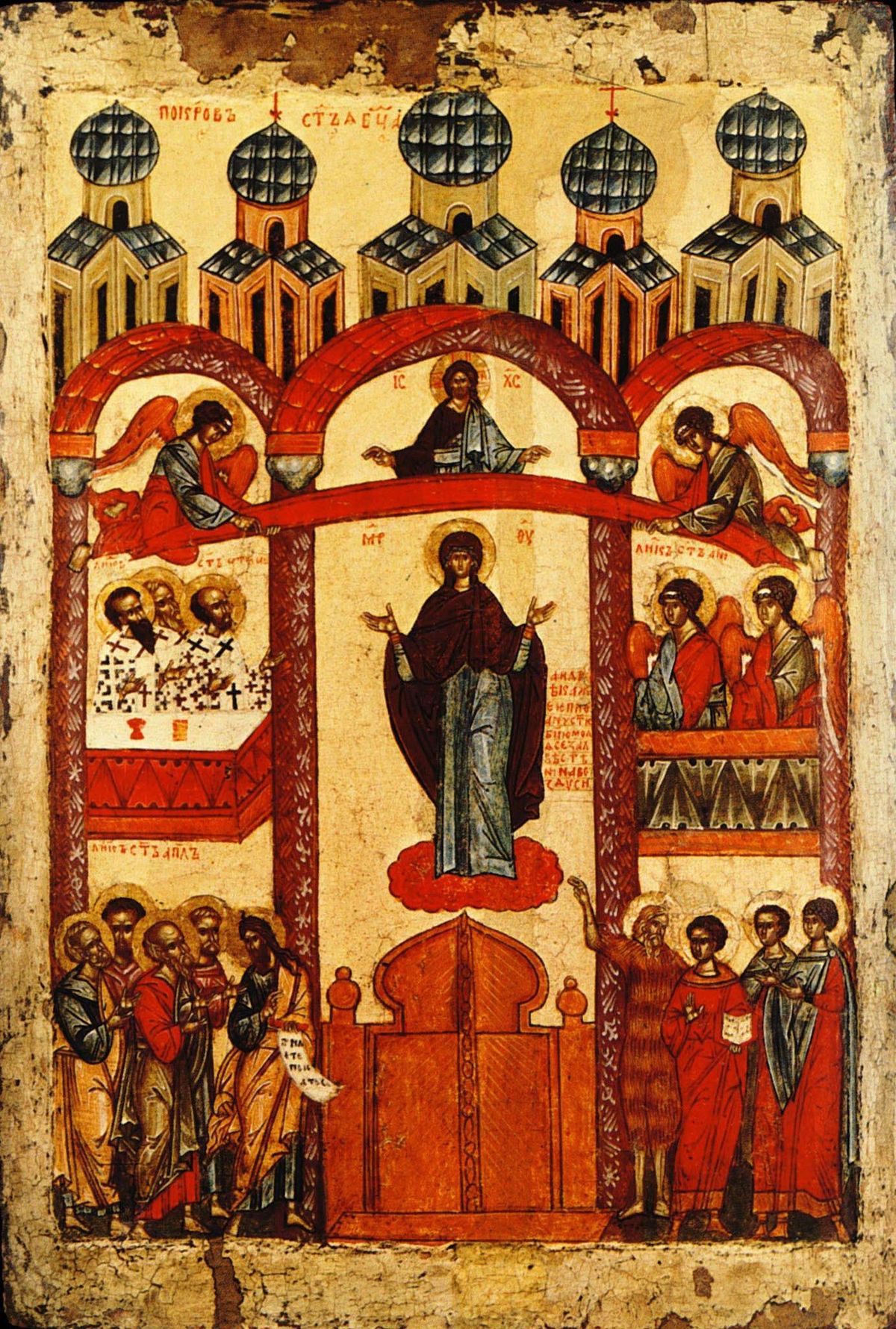
A medieval icon of the Protecting Veil of the Mother of God from Novgorod, currently in Moscow.

The Protecting Veil (or more simply, the Protection) of the Mother of God is one of the most popular festivals of the Slavic churches. Known as “Pokrov,” is celebrated on October 1. It commemorates a 10th century vision at the Blachernae church in Constantinople where several of her relics (her robe, veil, and part of her belt) were kept. On Sunday, October 1 at four in the morning, St. Andrew the Blessed Fool-for-Christ, who was a Slav by birth, saw the dome of the church open and the Virgin Mary enter, moving in the air above him, glowing and surrounded by angels and saints. She knelt and prayed with tears for all faithful Christians in the world. The Virgin Mary asked Her Son, Jesus Christ, to accept the prayers of all the people entreating Him and looking for Her protection. Once Her prayer was completed, she walked to the altar and continued to pray. Afterwards, she spread Her veil over all the people in the church as a protection.

St. Andrew turned to his disciple, St. Epiphanius, who was standing near him, and asked, “Do you see, brother, the Holy Theotokos, praying for all the world?” Epiphanius answered, “Yes, Holy Father, I see it and am amazed!” In the icon of this event, we see the Mother of God standing in the midst of the church with her arms reaching out in prayer and her veil stretching out between her hands. The angels and saints surround her. Below, St. Andrew the Fool for Christ is depicted, pointing up at the Virgin Mary and turning to his disciple Epiphanius.

According to the Primary Chronicle of St. Nestor the Chronicler, the inhabitants of Constantinople called upon the intercession of the Mother of God to protect them from an attack by a large Rus’ army (Rus’ was still pagan at the time).

The Pokrov icon may be related to the Western Virgin of Mercy image, in which the Virgin spreads wide her cloak to cover and protect a group of kneeling supplicants (first known from Italy at about 1280).

Tracts for the Times: “Remember your calling!”

The series Tracts for the Times urged the English clergy to remember that they were priests of God rather than minor functionaries of the British government.

I have always been a firm believer in the power of tracts to educate people and that such education can produce results in changed lives. In my parish, I wrote several tracts that were available in the back of the church; many of these proved to be extremely popular and were reprinted several times. Another series of church tracts, the Tracts for the Times, were even more popular and led to significant changes in the Church of England.

The first of the Tracts for the Times, a series of 90 pamphlets to educate English Christians about Church history as well as classic Christian belief and practice, appeared on September 9, 1833. The tracts were widely available and very inexpensive; the popularity of the tracts, produced by the leaders of the Oxford Movement who wanted the Church of England to reclaim her status as a Church and not simply the “Religious Department” of the British government, resulted in many people using the name “Tractarian” to refer to this movement to restore pre-Reformation thought and practice.

The first 20 tracts appeared in 1833, with 30 more in 1834; the series concluded with Tract 90 in 1841. After that the pace slowed, but the later contributions were more substantive on doctrinal matters. Initially these publications were anonymous, pseudonymous, or reprints from theologians of previous centuries. The authorship details of the tracts were recovered by later scholars of the Oxford Movement. The tracts also provoked a secondary literature from opponents. Significant replies came from evangelicals, including that of William Goode in “Tract 90 Historically Refuted” (in 1845) and others.

Tract 1, by John Henry Newman, was primarily addressed to English clergy and urged them to remember that they were priests of God and not simply functionaries of the British government. The tract mourned that too many clergy were more concerned about social status and privilege than with preaching the Gospel, teaching their people, and celebrating the services of the Church. The tract urged the clergy to remember that they were ordained in the Apostolic Succession and that this gift was not to be taken lightly.

“Therefore, my dear Brethren, act up to your professions. Let it not be said that you have neglected a gift; for if you have the Spirit of the Apostles on you, surely this is a great gift: “Stir up the gift of God which is in you.” Make much of it. Show your value of it. Keep it before your minds as an honorable badge, far higher than that secular respectability, or cultivation, or polish, or learning, or rank, which gives you a hearing with the many. Tell them of your gift…. Speak out now, before you are forced, both as glorying in your privilege, and to ensure your rightful honor from your people. A notion has gone abroad, that they [British politicians] can take away your power. They think they have given and can take it away. They think it lies in the Church property, and they know that they have politically the power to confiscate that property. They have been deluded into a notion that present palpable usefulness, [measurable] results, acceptableness to your flocks, that these and such like are the tests of your Divine commission. Enlighten them in this matter. Exalt our Holy Fathers the Bishops, as the Representatives of the Apostles, and the Angels of the Churches; and magnify your office, as being ordained by them to take part in their Ministry.”

The tract warned that there was a coming conflict. The conflict would be between those who considered the Church of England to be the Body or Bride of Christ and those who thought the church was simply a convenient institution to be amended however they saw fit. These two radically opposed viewpoints would force clergy to take a stand and the tract warned clergy that they would face the consequences of their choice align with one side or the other on Judgement Day.