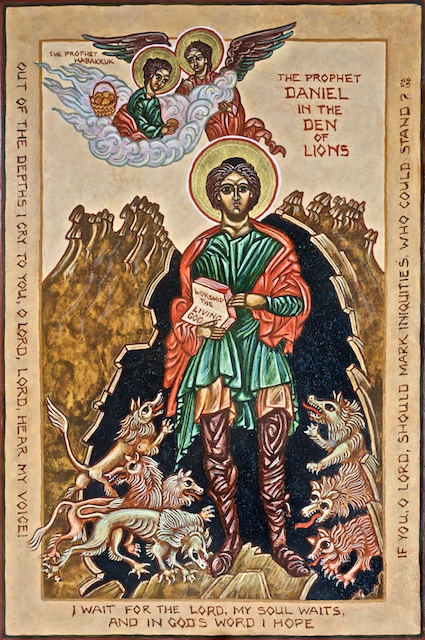
Prophet Daniel: Shepherd to the Lions

Daniel in the Lion’s Den has been portrayed since the beginning of Christian art. See many more examples here.

Daniel in the lions’ den (chapter 6 of the Book of Daniel) tells of how the prophet Daniel is saved from lions “because I was found blameless before God” (Daniel 6:22). It parallels and complements chapter 3, the story of Shadrach, Meshach, and Abednego in the burning fiery furnace: each story begins with the jealousy of non-Jews towards successful Jews and an imperial edict requiring them to compromise their religion, and concludes with divine deliverance and a king who confesses the greatness of the God of the Jews and issues an edict of royal protection. Both stories are understood by Christians to foreshadow the Resurrection of Christ.
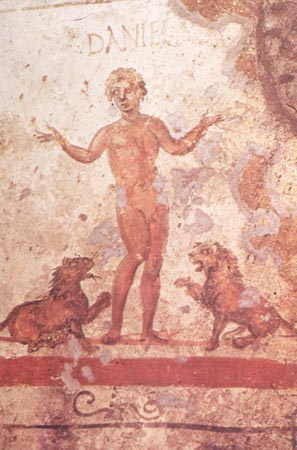
Daniel in the Lion’s Den from the walls of an early Christian catacomb.

The king of Babylon orders that no one should pray to any god but himself and that no one should practice any foreign religion. (Christians understood this to be similar to the Roman law insisting that they worship the emperor rather than Christ.) Daniel, a Jewish man promoted to an important government position in Babylon, is accused by his Babylonian enemies of prying to the God of Israel and practicing the Jewish religion. The king is forced to obey his own law although he does not want Daniel to be killed. The king orders Daniel to be thrown into the den of hungry lions and a heavy stone is used to shut the den. When the stone is rolled away, Daniel is found unharmed (“a shepherd to the lions as though they were sheep,” as one Christian hymn says) and the lions attack his enemies instead.
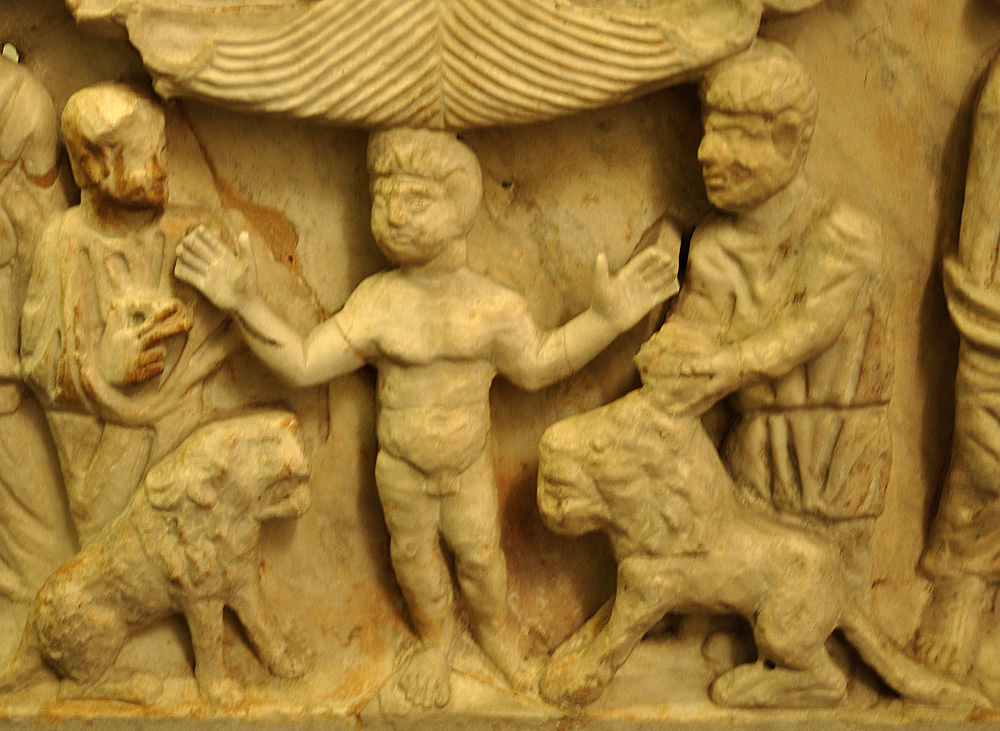
Daniel in the lions’ den: Middle of a sarcophagus frontal, AD 300-325

Ancient Christian preachers–such as St. Jerome–have always pointed out that the den of lion’s was a cave sealed by a large stone, just as Jesus’ tomb was a cave sealed by a stone. Daniel was as good as dead when the stone was sealed shut by the king but emerged alive–as if resurrected!–the next morning when the stone was rolled away at dawn. (The lion’s den is sometimes identified as a dry pit, much like the dry pit that Joseph was thrown into by his brothers before they sold him into slavery in Egypt. That pit is also sometimes seen as an anticipation of Christ’s tomb, just as Joseph is seen as a type or anticipation of Christ. The lions–the powers of Death–are tamed by Daniel just as Christ tamed Death by his own death and burial.

An early (2nd century) commentary attributed to Hippolytus of Rome tells us that “… when the angel appeared in the den, the wild beasts were tamed and the lions, wagging their tails at [Daniel], rejoiced as being subjected by a new Adam. They, licking the holy feet of Daniel, rolled around to taste the soles of his feet and they longed to accompany him. For if we believe that, after Paul was condemned to beasts and that a lion was set upon him, it reclined at his feet and licked him all around, how do we not also believe what happened to Daniel…?”

Hippolytus goes on to tell us, “You see, Babylon is the world today, the satraps are its authorities, Darius is their king, the den is Hades, the lions are punishing angels. And so imitate the blessed Daniel who did not fear the satraps and do not obey a human decree, so that after being cast into the den of lions you may be guarded by the angel, and you may tame beasts, and you may be worshipped by them as a slave of God and no destruction may be found in you, but being alive you may be brought up from the den and may be found as a sharer of the resurrection and you may rule over your enemies and you may always give thanks to the living God. For to him be glory and might unto the endless ages of ages. Amen.”

You can read more of the commentary on Daniel by Hippolytus of Rome here.
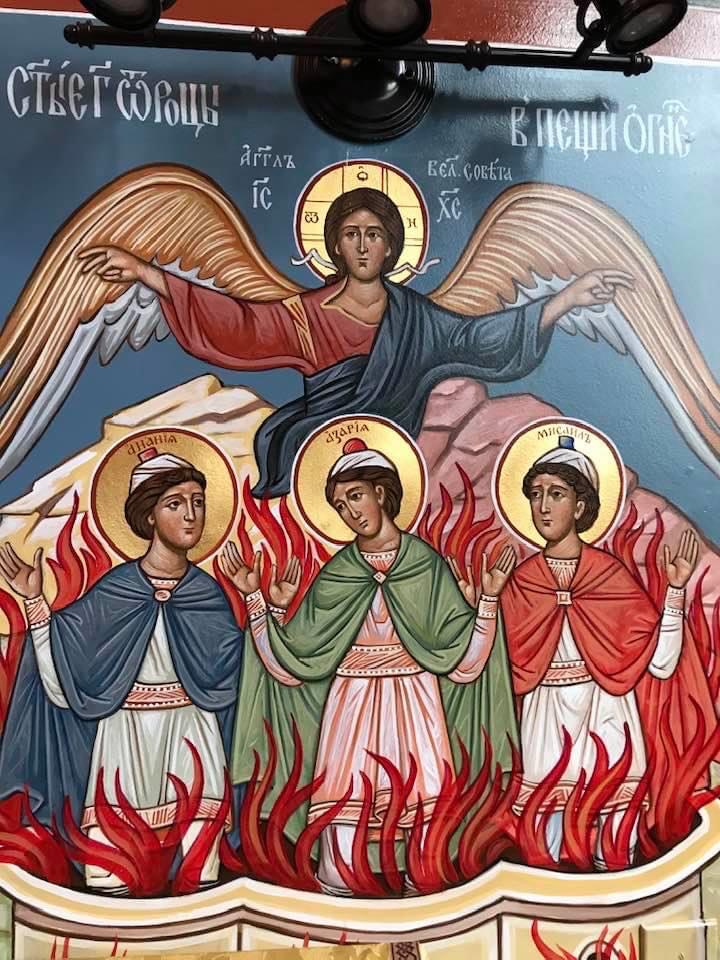
Three Young Men in the Burning Fiery Furnace

He who saved the three young men in the furnace became incarnate and suffered as a mortal man. Through his sufferings he clothed what is mortal in the robe of immortality. He alone is blessed and most glorious: the God of our fathers. (Paschal Matins)

The story of the three young men in the burning, fiery furnace found in Daniel 3 was traditionally the last Old Testament reading of the Easter Vigil, the “hinge reading” connecting the Old Testament prophecies to the blessing of the font and the celebration of Holy Baptism. (It is still the last of the Old Testament readings in the Orthodox Church.) The great canticle of the men in the furnace–with its tremendous refrain, “Praise the Lord! Sing and exult him forever!”–would follow, with a prayer and the procession to the font. In ancient practice, when baptisms were celebrated in a separate baptistry chapel because the adults to be baptized were all nude, the baptisms were conducted while the last of the Old Testament lessons were being read and the newly-baptized would come back to the church during the singing of this canticle.

How does this story of the three young men in the burning fiery furnace connect to Holy Baptism and the celebration of the Resurrection? In the book of Daniel, we read that the three young men were thrown into the great furnace because they refused to worship a giant idol the king of Babylon had set up. (The fire in the furnace was so terrible that the soldiers that threw the young men into the falmes were killed as well.) But the witnesses of the execution saw that the three young men were not burned in the fire but instead could be seen walking and singing in the midst of the flames and that a fourth man–who looked like “the Son of God,” the text reports– could be seen in the furnance as well. That “Son of God,” a fearful, beautiful Angel of the Lord was understood to be a divine reflection of God himself and he protected the three men from the flames. When the three men were finally extracted from the fire, they were found to be unharmed–not even their clothers or hair was singed and there was no smell of smoke on them! Christians have always understood that Angel of the Lord, the fourth angelic Son of God in the furnace to be a revelation of the Word of God who would later be incarnate of the Virgin Mary and who would descend through the Cross into Hell itself to smash the gates of death.

These young men in the furnace are understood to prefigure both the Incarnation and the Resurrrection. They prefigure the Virgin’s birthgiving because she, on receiving the Fire of the Godhead within her womb, was not burned, but remained virgin, even as she was before giving birth. But more specifically in terms of the Resurrection, the early Christian preachers and hymnographers tell us:

 “According to the story of the Three Children in Babylon [Dan. 3], the flame of fire was divided; for when the furnace poured forth fire forty-nine cubits high it burned up all those around [Dan. 3:22], but by the command of God, it admitted the wind within itself, providing for the boys a most pleasant breeze and coolness as in the shade of plants in a tranquil spot; for it was as the blowing of a wind bringing dew. It is far more wonderful for the element of fire to be divided than for the Red Sea to be separated into parts, Nevertheless, the voice of the Lord divides the continuity and unity in the nature of fire. Although fire seems to human intelligence to be incapable of being cut or divided, yet by the command of the Lord it is cut through and divided. I believe that the fire prepared in punishment for the devil and his angels [Mt. 25:41] is divided by the voice of the Lord, in order that, since there are two capacities in fire, the burning and illuminating, the fierce and punitive part of the fire may wait for those who deserve to burn, while its illuminating and radiant part may be allotted for the enjoyment of those who are rejoicing. Therefore, the voice of the Lord divides the fire and allots it; so that the fire of punishment is darksome, but the light of the state of rest remains incapable of burning.” (extract from St. Basil the Great, in his Homily on Psalm 28, which says “The voice of the Lord Who divides the flame” [Ps. 28:7])

St. Jerome, in his commentary on the Book of Daniel, tells us that this experience can be shared by all the baptized: “When the soul is oppressed with tribulation and taken up with various vexations, having lost hope of human aid and turned with its whole heart to God, an Angel of the Lord descends to it. That is to say, the supernatural being descends to the aid of the servant and dashes aside the fierce heat of the violent flames, that the fiery shafts of the enemy utterly fail to pierce the inner citadel of our heart and we escape being shut up in his fiery furnace.”

How many, during these weeks of quarentine and lockdown, have experienced tribulation and various vexations How many have perhaps lost hope of human aid? It is at times such as these that we look for the Angel to protect the inner citadel of our hearts from the fiery attacks of our Enemy.

“Almighty and everlasting God, the only hope of the world, who by the preaching of thy holy prophets hast prefigured the mysteries of this present time: mercifully increase the devotion of thy people, since none can grow in any virtue without thy inspiration ….” (traditional collect after the reading from Daniel 3 at the Easter Vigil)

“Go, Tell My Brethren”

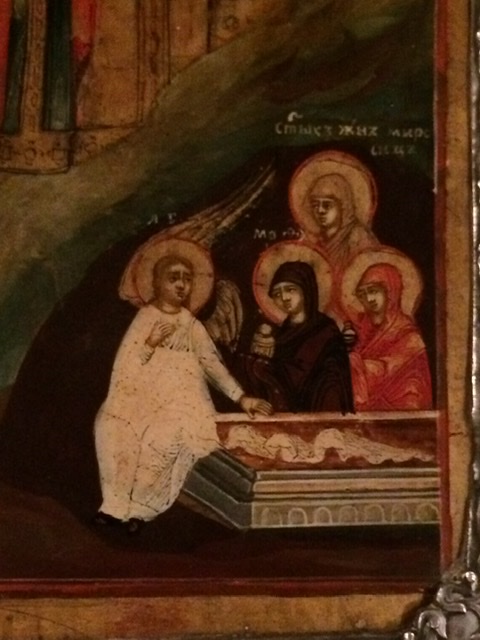
“The myrrhbearing women, at the break of dawn, drew near to the tomb of the Life-giver. There they found an angel sitting upon the stone. He greeted them with these words: ‘Why do you seek the living among the dead? Why do you mourn the incorrupt amid corruption? Go, proclaim the GOSPEL to his disciples.” (Paschal Matins) (Detail from a larger 18th cent. Resurrection icon; photo by S. Morris)

“How filled with bliss were these women who, taught by the angel’s account, were found worthy to announce the triumph of the resurrection to the world and to proclaim that the sovereignty of death, to which Eve became subject when she was seduced by the serpent’s speech, had been utterly destroyed! How much more blissful will be the souls of both men and women equally, when, aided by heavenly grace, they have merited to triumph over death and enter into the joy of a blessed resurrection, while the condemned have been struck with trepidation and well-deserved punishment on the day of judgment!” (excerpt from Homily II.7, St. Bede, Homilies on the Gospels, vol. 2, translated by Martin and Hurst)

The knowledge of the gospel, the “good news,” depends on the preaching of the women who came to the tomb and discovered that Christ had risen. The angel at the tomb sent them back to preach the good news to the male apostles who were still hiding after the Crucifixion, frightened and alone. If the women had said nothing, no one would have ever heard that Christ had destroyed Death. Their participation in the divine plan of salvation was critical. All subsequent Christian experience depends on them having gone to the tomb and then telling everyone what had happened there.

We see a contrast between Eve and the Virgin Mary, the second Eve–just as Christ is the Second Adam–insofar that Eve was confronted by a (fallen) angel and chose to defy God, bringing Death into the world while the Virgin Mary was confronted by an angel (Gabriel) and chose to cooperate with God to bring true Life into the world. (Read more about this in St. Irenaeus of Lyons.) We can also see a contrast between the Myrrhbearing Women and Eve insofar that Eve hid from God in a garden and was given an apron of fig leaves to hide her nakedness while the Myrrhbearing Women stepped forward to meet the Risen Christ in a garden and were able to “put on Christ” (Galations 3:27) to remove their sinfulness.

St. Bede says something similar in another homily, where he contrasts the several Myrrhbearing Women to the one woman (Eve): “You see that several [women], instructed by the angels, proclaim that the death which one woman, seduced by the devil, had brought upon the world was now destroyed. One woman, coming [out of the garden] opened a path [that led away] from heavenly joys; many, coming back from their present exile, gave the information that the gate had now been unbarred for regaining the heavenly fatherland.” (Homily II/10, p. 94)

The stars of Orion’s belt in the night sky are sometimes called “the Three Marys” or “the Myrrhbearing Women;” these same stars are sometimes called “the Magi,” and identified with the Wise Men who came to visit the Christ Child. This association demonstrates the similar roles of the Myrrhbearing Women and the Magi in the Easter/Christmas stories as they were Outsiders (women and pagan philosophers) who were responsible for proclaiming the good news, the gospel, of Christ to the world.