Mary, Pentecostal Teacher of the Church

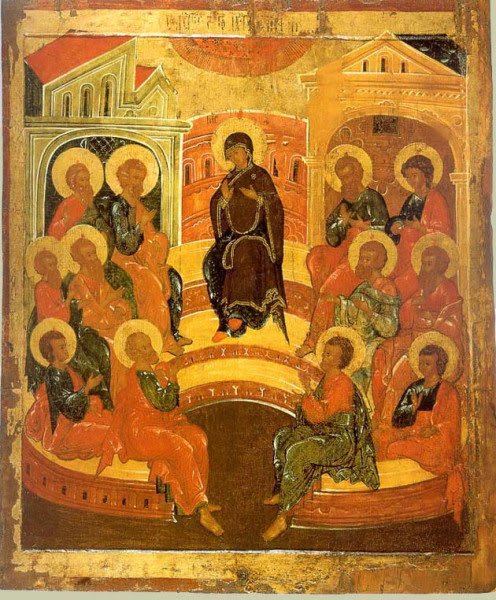
17th century Icon of Pentecost (from the border of Russia and Finland)

Some icons of Pentecost show Mary the Mother of God in the centre, occupying the “Teacher’s Seat.” Mary was present at Pentecost; she is the ultimate exemplar of a Christian. With Jesus Christ ascended into Heaven, the Holy Spirit acts within people, and through the saints, Christ is manifest in the world. Mary is therefore shown in the “teacher’s seat” as the best example we have, and the person on earth who most resembled Jesus Christ (both physically, as His mother, and spiritually as His disciple).

By the 9th century the Church came to recognize Mary as the Stella Maris, the Star of the Sea, an image reminiscent of sailors who would chart their course by the stars. Mary points the way to Christ.

The presence of the Apostle Paul in the icon, even though at that time he had not yet converted on the road to Damascus, hints that this icon is more than a purely historical picture. Sometimes, the evangelists Luke and Mark are also shown, despite also not having been present in the upper chamber at Pentecost. The gathering, then, is a representation of the Church. The Apostles are shown as equals, with no individual among them taking the central seat of authority. They are seated in a semi-circle, representing a unity and harmony similar to that found in Icons of the Holy Trinity. As in icons of the Holy Trinity, a semi-circle, rather than a full circle, is used so that we as observers are drawn into the unity.

See a Pentecost sermon that includes the role of the Mother of God here, preached at St. Matthew’s, Sheffield (a Church of England parish).
When the Mother of God Went to Hell

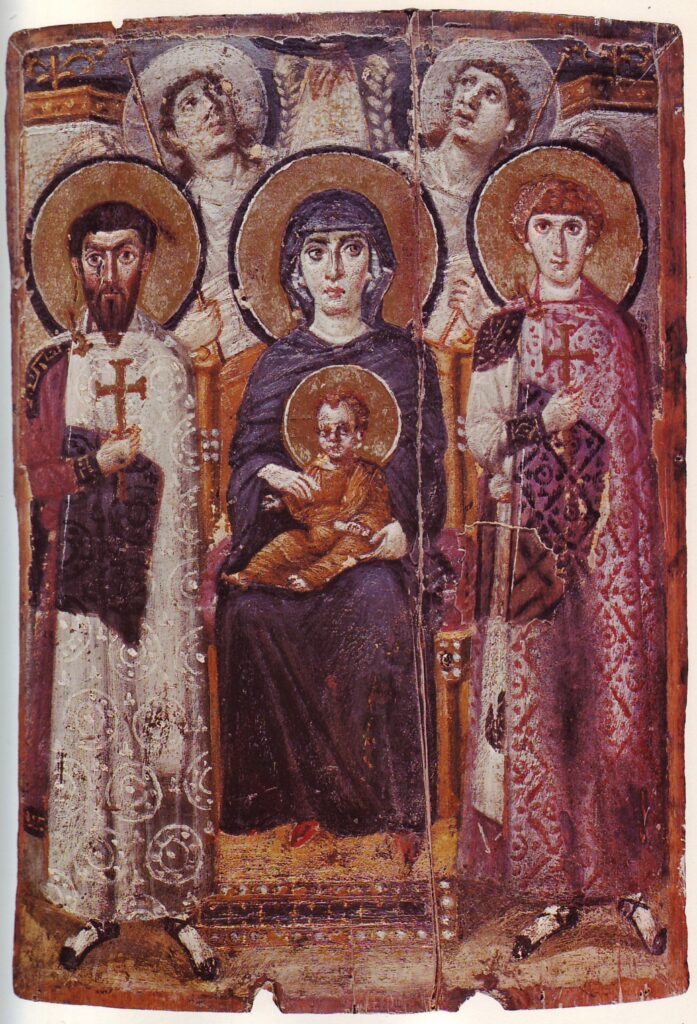
Icon of the enthroned Virgin and Child with SS. George, Theodore and angels, 6th century, Saint Catherine’s Monastery. An antiphon from the Saltair Mhuire, attributed to Domhnall Albannach Ó Troighthigh, in a manuscript dated 1477, reads, “Ave Marie mater Domini nostri Iesus Christi regina celi domina mundi imperatrix inferni misere mei & totius populi Christiani Amen.” (“Hail, Mary — mother of our Lord Jesus Christ, Queen of heaven and Lady of the world, Empress of hell: have mercy on me and on all Christian people. Amen.”)
.

There was an early Christian folktale that the damned in Hell got a short reprieve every year: their suffering was reduced–or stopped altogether–for the fifty days between Easter and Whitsunday (Pentecost) or Trinity Sunday. Around the year AD 1000, this reprieve was said to be the result of the prayer of the Mother of God who was said to have gone to Hell to see the suffering of the damned. Escorted by St. Michael the Archangel, she went on a tour of the Underworld and was moved to tears at what she saw. She pleaded with her Son to spare the damned as much of their suffering as possible. So it became common practice in the Middle Ages to offer special prayers for the dead at Pentecost as the punishment of the damned began again.

In one story, a man makes a deal with the devil and sells his soul in exchange for special favors from the devil during life. As the man was dying, he is sorry about his decision and begs the Mother of God to help him. Mary is infinitely merciful, so she does. She girds her loins for battle, descends into hell, and steals back the contract giving the man’s soul to the devil!

In this story, Mary’s mission to hell is portrayed as warfare. The tale evokes the devil’s anger, and uses the language of violence and theft to describe Mary’s actions. In her guise as empress of hell–that is, more powerful even than Satan–she is not the mother of mercy, she is the “queen of vengeance” against the devil and the powers of Hell.

I think these stories are all trying to express an intuition about the power of the Mother of God to save us from ourselves and our own worst choices and behavior. They also show the inability of Hell to confine anyone who really wants to escape, underlining the original understanding that when Christ smashed down the gates of Death and Hell, everyone who wanted to escape did and now only those who choose to remain in Hell–unable to accept responsibility for their actions and thus unable to accept forgiveness–are there.

Curious about these stories? Read more here and here. This is another good one to read. See how many of them there are?

Witnesses of the Resurrection

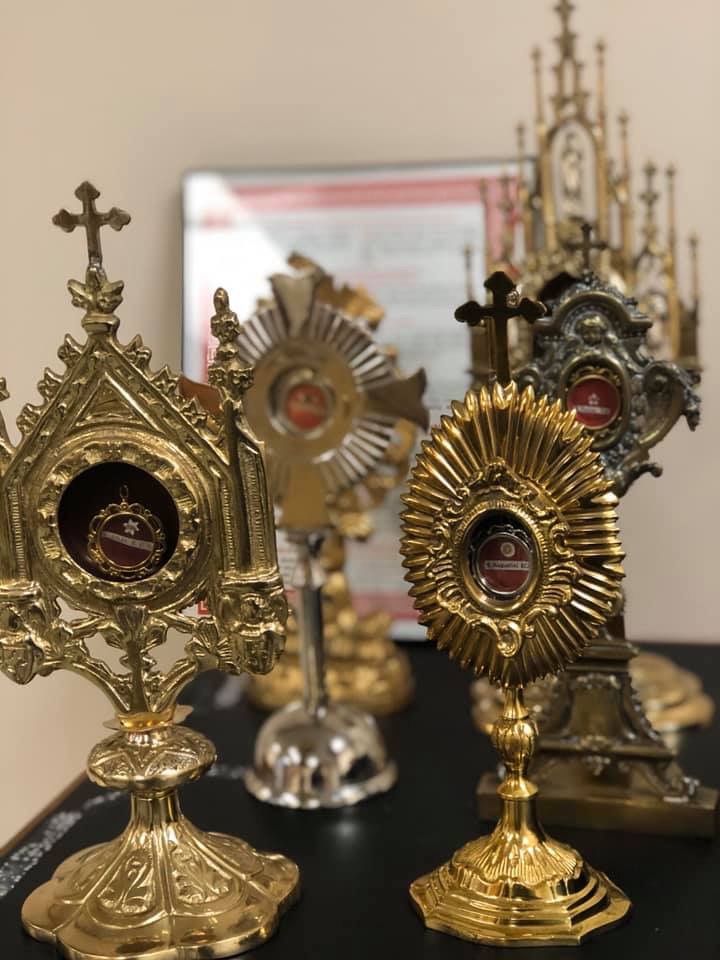
Relics of the martyrs (lit. “witnesses”) whose lives and deaths testify to the power of Christ’s Resurrection, even in the midst of affliction and death. “You let people ride over our heads; we went through fire and water, but you brought us to a place of abundance.” (Psalm 66:12)

In ancient Greece, a martyr was a witness who testified in court. When Christians were arrested and asked to testify in court about their religious beliefs, they were therefore called “martyrs.” But that testimony would usually result in their execution for refusing to practice one of the legitimate religions of the Greco-Roman world; the Church has continued to call those who were executed for their testimony martyrs; their faith, even as they were tortured and killed, was a testimony to the power of Christ’s Resurrection.

After the martyrs were executed, other members of the Church would come collect the corpses or fragments of their tortured bodies for burial. They would gather at the tombs and burial places of the martyrs to celebrate the Eucharist. The bodies were treated with great care and devotion because they had been washed with the waters of baptism, anointed with holy oil, had tasted Holy Communion, and were simply one aspect of the deceased’s existence: a person is made of a body and soul together. Often, portions of the bodies–called “relics,” from the Latin for “remains”–would be placed in new altars, as described in the New Testament, “When the Lamb broke the fifth seal, I saw under the altar the souls of all who had been martyred for the word of God and for being faithful in their testimony.” (Rev. 6:9)

One of the earliest sources that describes the power of relics is found in 2 Kings 13:20–21:

20 Elisha died and was buried. Now Moabite raiders used to enter the country every spring. 21 Once while some Israelites were burying a man, suddenly they saw a band of raiders; so they threw the man’s body into Elisha’s tomb. When the body touched Elisha’s bones, the man came to life and stood up on his feet.

Another often cited passage is Acts 19:11–12, which says that Paul’s handkerchiefs were imbued with healing power by God.

Relics are typically divided into three categories:

First-Class Relics: items directly associated with the events of Christ’s life (manger, cross, etc.) or the physical remains of a saint (a bone, a hair, skull, a limb, etc.). Traditionally, a martyr’s relics are often more prized than the relics of other saints. Parts of the saint that were significant to that saint’s life are more prized relics.

Second-Class Relics: items that the saint owned or frequently used, for example, a crucifix, rosary, book, etc. Again, an item more important in the saint’s life is thus a more important relic. Sometimes a second-class relic is a part of an item that the saint wore (a shirt, a glove, etc.).

Third-Class Relics: any object that has been in contact with a first- or second-class relic. Pilgrims would often bring home these Third-class relics as a remembrance of a pilgrimage to a shrine.

For a post about the blood relic of St. Januarius (San Gennaro), first published in 2015, click here.