“I am wounded with love”

Painter: Greek School 17/18th Century Medium: Tempera on panel Location: National Museum of Fine Arts, Valletta, Malta

The bride says: “I am wounded with love.” (Song of Songs 2:5) She explains that the dart has gone right through her heart and the Bowman is love. We know that God is love (1 John 4:8) and that he sends forth his only begotten Son as his chosen arrow (Isaiah 49:2) to the elect, dipping … its tip in the Spirit of life. The arrow’s tip is faith and unites to the Bowman whomsoever it strikes. (St. Gregory of Nyssa, On the Song of Songs)

The bride in the Song is wounded by the arrow shot by the divine Bowman. The arrow, whose tip is dipped in the Spirit of life rather than the venom or poison common in the ancient world, binds her to the one who shot the arrow: God, the Father. Christ is the arrow and—unlike most arrows we are familiar with—this arrow’s wound does not kill; it causes the bride to live. Forever. Bound by faith and love to the Bowman who shot the arrow into the world, she shares the divine life of the Bowman (the Father), the arrow (Christ), and the Spirit.

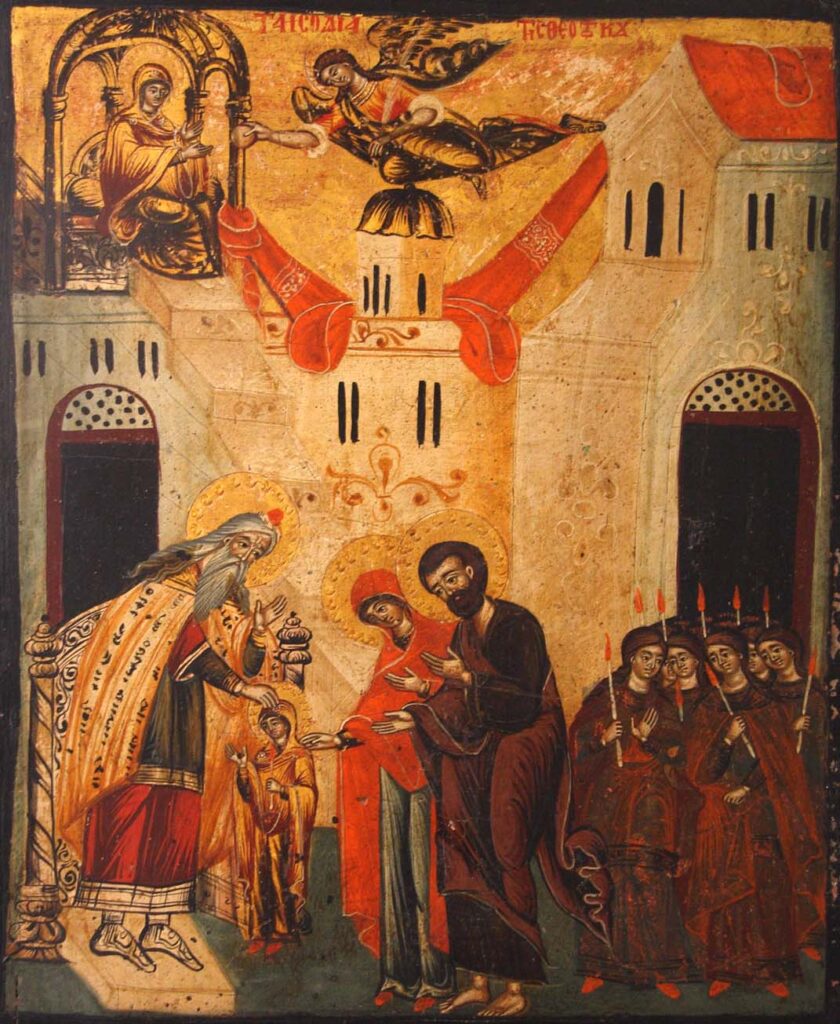
The Mother of God, brought to the Temple when she was three years old, is presented by her parents to be brought up serving the Lord in his house. We see in the upper left hand corner of the icon the angel that brought her bread from heaven each day; this is a pictorial way of saying that she trusted in the Lord for her sustenance and support and so was capable of conceiving the one who is the true bread come down from heaven. This bread that she received from the angel united her in love to the giver of the Living Bread just as the arrow united the bride to the Bowman. The bread brought by the angel is spiritual sustenance just as the arrow’s point was said to be anointed with the Spirit.

Annunciation is the only time we read of in the Bible when the first words out an angel’s mouth were not “Don’t be afraid! Fear not!” The daily visitation of the angel to bring bread to the Mother of God is also a way to explain why she was not shocked to see the angel Gabriel although she was shocked at the angel’s announcement.
Mother of God as Fortress and Incense

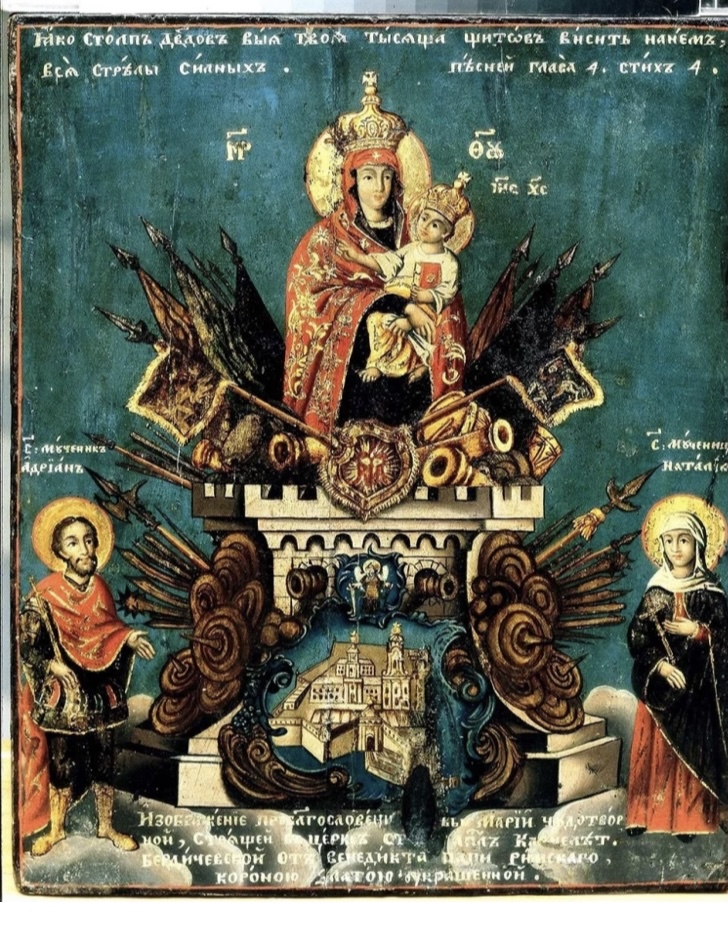
This icon, similar to the icon in Rome of the Mother of God known as “Health/Salvation of the Roman People,” illustrates the Song of Songs 4:4, which reads, “Like the Tower of David is your neck … a thousand shields hang upon it, all arrows of the mighty.”

“Who is she that goes up from the desert, as a pillar of smoke of aromatic spices–of myrrh and frankincense and all the perfumer’s powders?” (Song of Songs 3:6)

The friends of the groom are surprised by what they see, St. Gregory of Nyssa tells us. They know she is beautiful more splendid than gold or silver. But now they see her ascending and are struck with amazement and compare her beauty and virtue to not just a simple, single variety of incense but to a mixture of frankincense and myrrh together.

“One aspect of their praise is derived from the association of these two perfumes: myrrh is used for burying the dead and frankincense is used in divine worship…. a person must first become myrrh before being dedicated to the worship of God. That is, a person must be buried with Christ who assumed death for our sake and must mortify themselves with the myrrh–understood as repentance–which was used in the Lord’s burial.” (St. Gregory of Nyssa, On the Song of Songs)

A person must embrace ongoing self-examination and repentance; only then is it possible to then possible to enter the presence of God as the frankincense which is offered by the angels before the throne of God (Rev. 8:4).

Another of the spices used by perfumers was cinnamon. It was thought to have several remarkable properties, such as stopping putrefaction or infection and would cause a sleeping person to answer questions truthfully. So the application of “spiritual cinnamon” would stop anger, induce honest/truthful self-examination, and calm the anxious.

Myrrh and cinnamon were therefore metaphors for attitudes and practices that would protect a person from sin. In the Song, the bride–who was a type of the Mother of God–was not only myrrh and cinnamon but a protective fortress as well. The bride–in patristic sermons, the Mother of God–is a fortress with shields hanging from the battlements. The walls of the fortress are impervious to spears. The early fathers took this to mean that the prayers of the Mother of God could protect Christians from the darts and arrows of temptation. The fortress could also be seen as the Church herself, steadfast and immoveable on the rock of faith.

There were 18th century icons to illustrate this idea of the Mother of God as fortress; the inscription at the top of these icons was commonly:

“Like the Tower of David is your neck, built on courses of stone; a thousand shields hang upon it, all arrows of the mighty.” (Song of Songs 4:4)

In the example of this kind of icon seen above, the two saints appearing at the sides are additions generally not found in other versions.  They are the Martyr Adrian and the Martyr Natalia.  Some examples have instead the military saints such Alexander Nevsky at left, and George at right, but many have no saints added to the main image.

Much thanks to the Icons and Their Interpretation blog for information about this icon.

“Peace Shall be a Pathway for His Feet.”

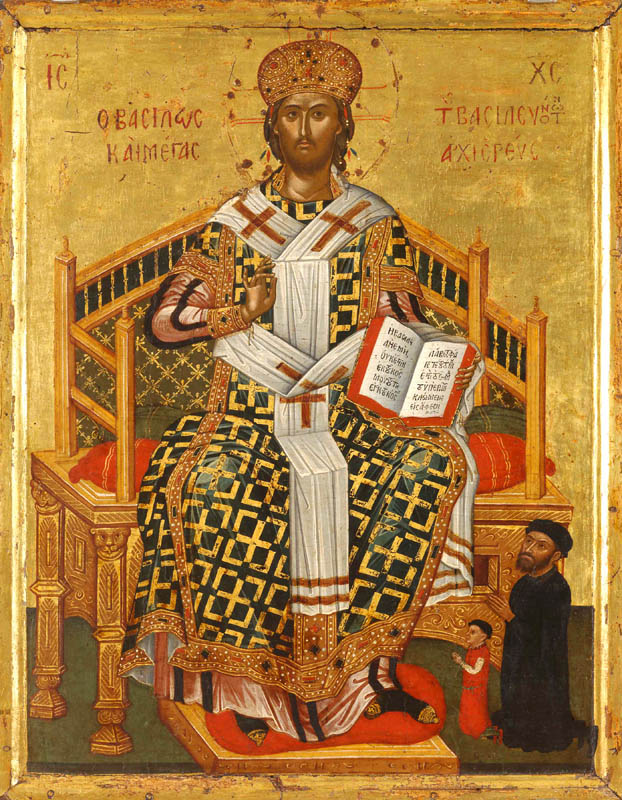
A Byzantine icon of Christ as the Great High Priest, seated on a bishop’s throne (cathedra), as the donor and his son kneel in supplication. Christ’s hand is raised in blessing, typically accompanied by the greeting, “Peace be unto all.”
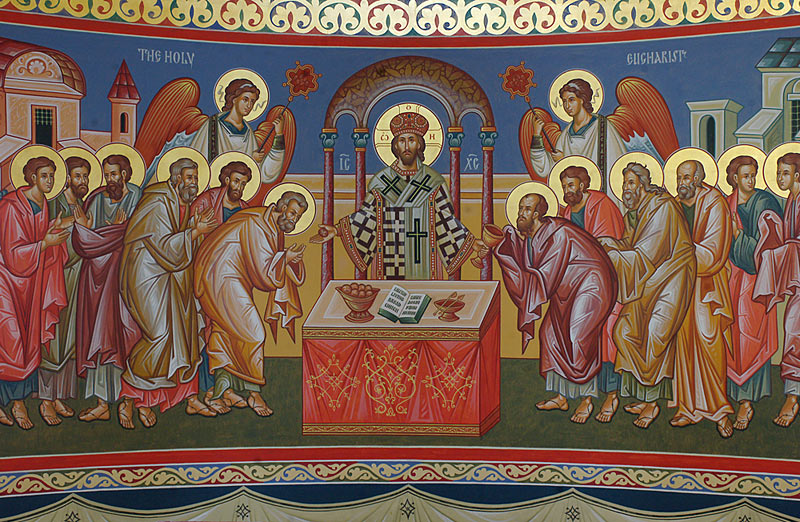
Christ depicted as a bishop at the Eucharist, giving Holy Communion to the apostles; St. Paul leads those approaching the chalice while St. Peter leads those approaching from the other side. The assembly of the apostles is typically a depiction of the Church assembled in peace as the Body of Christ, in which all peoples can be reconciled.

“Righteousness shall go before him, and peace shall be a pathway for his feet.” (Psalm 85:13)

On the most straightforward, historical level, peace was the pathway for the Gospel insofar as the pax Romana made it possible to preach the Gospel from Syria to Great Britain, from Egypt to the North Sea. Apostles and missionaries were able to travel the system of Roman roads–many of which still exist–which were kept safe by the Roman soldiers and the sheer number of people travelling on the roadways. Although it was safe to travel from one end of the empire to the other, it was expensive. Apostles and missionaries needed financial support from their home parish or would stop and work to support themselves as they made their journey.

The peace and stability of the Roman empire not only enabled the growth of the Church but made it possible for letters and communication to be shared. It was the re-establishment of the “Roman peace” that the many kingdoms of western Europe during the Middle Ages aspired to.

Peace is also understood to be the pathway for Christ to meet the worshipper at the celebration of the Eucharist. Each person who approaches the altar, walking towards encountering Christ in the Holy Gifts of the Eucharist, must first make peace with their neighbors either by exchanging the Kiss of Peace or by heeding Christ’s admonition to “leave your gift at the altar, if you remember that your brother has anything against you; go, be reconciled and then come to offer your gift” (Matthew 5:23-24). Peace and reconciliation between Christians was the road that had to be built or repaired to make Christ’s arrival possible.

Christ himself was also understood to be the peace of God; in Constantinople, the church of the Holy Peace is nowadays sometimes called St. Irene’s but which was always understood previously to be dedicated to Christ, the Peace of God.

“For he himself is our peace, who has made the two one and has destroyed the barrier, the dividing wall of hostility, by abolishing in his flesh the law with its commandments and regulations. His purpose was to create in himself one new man out of two, thus making peace.” (Ephesians 2:14-15 )

(The great cathedral of Hagia Sophia was also understood to be dedicated to Christ, the Wisdom of God, rather than the woman-martyr St. Sophia.)