Wormwood

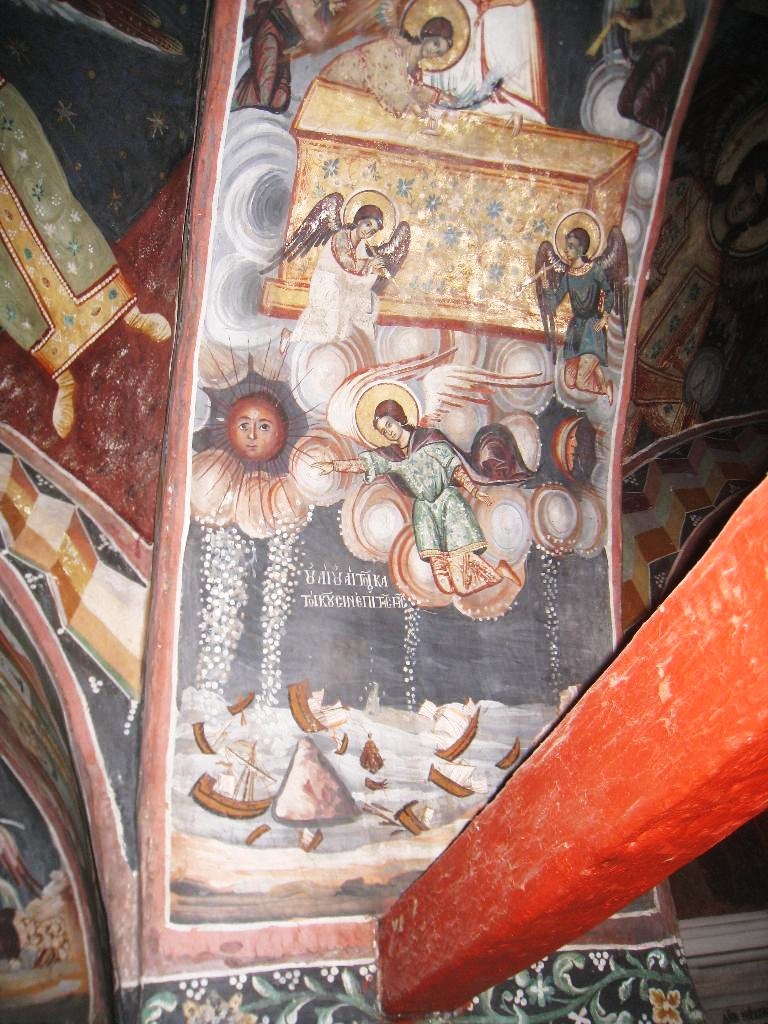
Monastic fresco on Mt. Athos illustrating chapter 8 of the Apocalypse: the angels at the heavenly altar cast judgement/ hail onto the earth and sea.

The first angel blew his trumpet; there came hail… cast upon the earth…. The third angel blew his trumpet and a great star fell from the sky…. The name of the star was Wormwood. (Apocalypse 8:7, 10-11)

The angels begin to blow their seven trumpets and unleash a series of destructive judgements: hail with fire, a flaming mountain thrown into the sea, a falling star. Repeatedly, a third of everything is destroyed: a third of the earth is burnt up, a third of the trees are burnt up, a third of the sea is turned to blood, a third of the sea creatures die, a third of the sun-moon-stars are wiped out, a third of the ships are destroyed (see illustration above). This repetition of the destruction of one-third of everything suggests to many Early Church readers that one-third of the angels rebelled against God and became the demons of hell.

The destructive plagues released by the trumpet blasts mimic the plagues that God sent to destroy Egypt in the book of Exodus. In both cases, creation is undone and refashioned. Many of the prophets in the Old Testament describe similar plague-judgements that God will unleash at the End of Days: the sun and moon and stars will go dark, the sea will be consumed by fire, darkness will envelop the earth. Jeremiah describes a mountain that will be reduced to a burning, smoldering ruin and 1 Enoch describes 7 stars that are like 7 fiery mountains. These are not the acts of a vindictive God; these are the descriptions of what happens when creation rises up in rebellion and goes-against-the-stream that is cooperation (synergy) with God.

One of the most interesting images of judgement-destruction is the star called Wormwood. This name, which in Slavonic is Chernobyl, was often mentioned by evangelical Christians when the Chernobyl nuclear accident happened. It was popular to muse in the United States if the nuclear accident was the great portent of the End described in the Apocalypse; timelines for the coming judgement were eagerly discussed.

Wormwood is a plant with a bitter taste and is a metaphor for divine judgement (Jeremiah, Lamentations, Amos, Proverbs). This plague is the reverse of the miracle at Mara in the desert: there, poison water was made fresh but the star Wormwood makes fresh water poison. “Wormwood” is the perversion of justice in Amos: the blazing star that falls from the sky in the Apocalypse can be viewed as the downfall of the Devil himself, the father of lies and deception (John 8:44).
The Seventh Seal

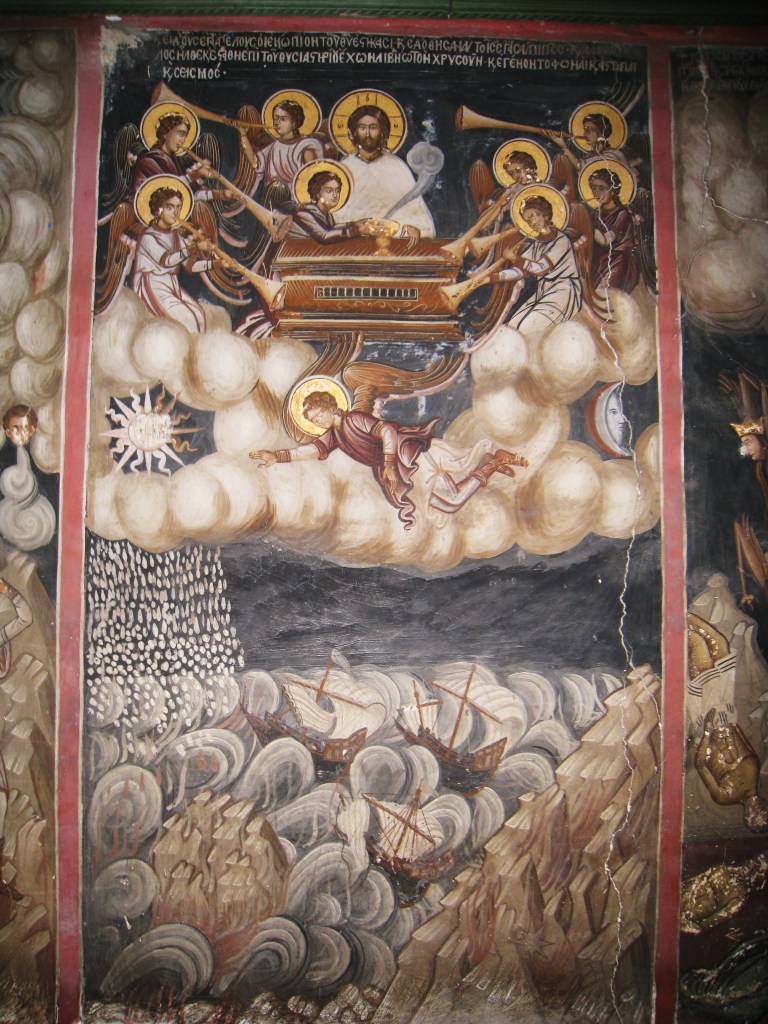
Dionysiou Monastery on Mt. Athos was founded in 1374. In its refectory (dining hall) is a magnificent series of frescoes that illustrate the Apocalypse. In this illustration of chapter 8, we see the seven angels with trumpets, the censer with smoke, a mountain in the sea, the bloody sea water, destroyed ships, the fountain of water, the star Wormwood (in the rocks in the right corner), a darkened sun, etc.

When the Lamb broke the seventh seal, there was silence in heaven for about half an hour. I saw the seven angels who stand before God and they were given seven trumpets. (Apoc. 8:1)

The silence in heaven is momentous. It grabs the attention. It is louder than the thunder and commotion that either precede or follow it. Silence is not simply the absence of noise or the lull between events, one thing having finished and the other not yet having started as sometimes happens when a reader or performer is not ready to begin. Silence is a living presence.

I read many years ago that the most brilliant moment in music is the silence before the Et incarnatus of Bach’s “B Minor Mass.” The silence in heaven is like that. It is the sudden silence that follows Dorothy’s house crashing into Munchkinland as it drops from the cyclone in which she has seen Miss Gulch become the Wicked Witch.

This silence in heaven is an echo of the silence in heaven that preceded God’s first utterance: “Let there be light.” (see 4 Ezra 7:30-33) The apocalyptic silence in heaven is liturgical silence, the moment when all creation holds its breath seeing the Word of God crucified. It is the silence of the Great Entrance on Holy Saturday: God the Word has died and descended into Hades. It is the moment before all creation is turned topsy-turvy by Life himself tearing Death to shreds from the inside out.

Before the angels blow their trumpets, another angel-deacon comes to offer incense at the heavenly altar. There is “much incense” offered. The smoke creates an impenetrable cloud, much like the cloud of incense that the prophet Isaiah also saw (Isaiah 6). It was said that when the High Priest offered incense in the Holy of Holies on Yom Kippur that there was not enough smoke if he could still see his hand in front of his face. The smoke creates a buffer that serves to protect the human from the brilliant glory of God that would annihilate anything or anyone that dared stand unprotected in the terrible light.

In the Our Father, we pray, “Thy kingdom come.” Before the kingdom comes, all creation holds its breath and peers through the smoky clouds of incense, waiting to see what will happen when God reveals himself.

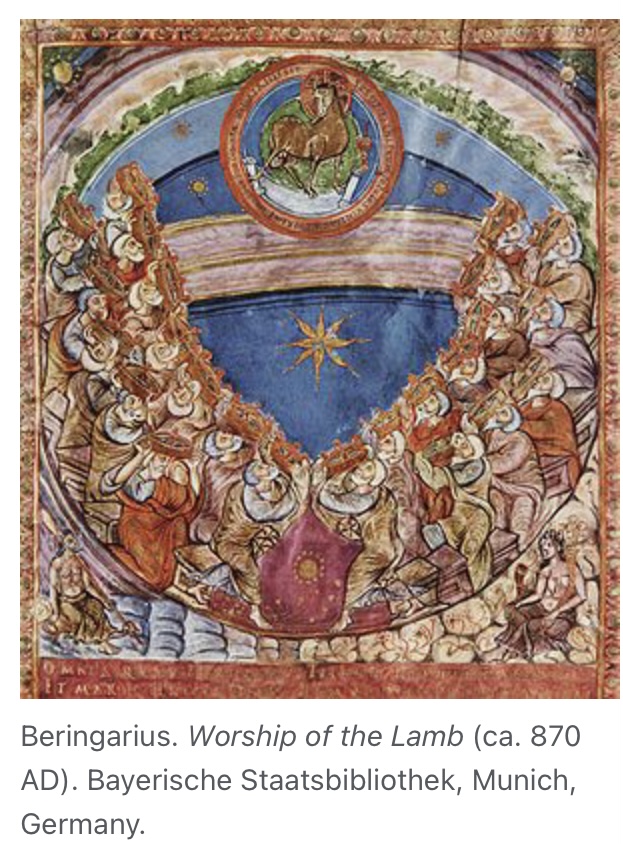
“A great multitude, which no one could number….”

After these things I looked, and behold, a great multitude which no one could number, of all nations, tribes, peoples, and tongues, standing before the throne and before the Lamb, clothed with white robes, with palm branches in their hands…. (Apocalypse 7:9)

The book of the Apocalypse is built on a series of sevens–seven letters, seven seals, seven bowls, seven trumpets, etc. Often there is a pause or intermission between the sixth and seventh event in each series and the seer describes another vision or event that interrupts the series-of-seven. This vision of the great multitude comes as such a pause between the sixth and the seventh seals which the Lamb is opening. This vision of the multitude has two aspects: the seer beholds the 144,000 redeemed from the tribes of Israel and then he beholds the great multitude from all the nations and languages.

The 144,000 is symbolic of all Israel; it is the 12 tribes x 12 apostles x 1,000. It is complete. Full. It is a vast throng of believers, too many to actually count. Modern readers often see the 144,000 as the Jewish-Christian version of the “great multitude” of Gentile-Christians which the seer also beholds. But the original intent of the author was unlikely to distinguish Jewish and Gentile believers. One of the important concerns of the Gospel-Epistles-Apocalypse of St. John is who the authentic heirs of Abraham are; who are the “real Jews” is an issue in all the texts attributed to St. John and the answer is always, “Those who accept Jesus as the Messiah, whether they are biological descendants of Abraham or not, are the true Israel.”

The 144,000 have been marked with the seal of the Lamb–a common description of the anointing with oil/chrism following baptism. Having been sealed with chrism, the 144,000 make their confession, i.e. are slain because they acclaim Jesus as the Messiah. Martyrs for the true faith much as the Maccabees were martyred for refusing to compromise the faith to accommodate with the Greco-Syrian culture prevalent in their society.

The great multitude robed in white with palm branches are also martyrs. (Some readers suggest the 144,000 are the saints on earth and the great multitude are those same saints in heaven.) The palm branches, always indications of victory (1 Maccabees 13:51, 2 Maccabees 10:7), also suggest the feast of Tabernacles (Succoth), which is celebrated in the autumn. Succoth involved processions with palm branches and the building of booths for the people to live in for 8 days (Leviticus 23:33-36, Nehemiah 8:13-18). It was the celebration of God’s care for Israel in the wilderness after the exodus; it was also understood as a celebration which anticipated the Messiah (Zechariah 14:16-19). In both cases, it is God dwelling with his people which is the focus of the celebration.

There are Christian celebrations of Passover-Easter and Shavuot-Pentecost but no Christian equivalent of Succoth; the Church herself is the ongoing feast of Succoth. The Church is the company of those “who shall not hunger or thirst, neither scorching wind nor sun shall smite them, for he who has pity on them will lead them, and by springs of water [he] will guide them” (Isaiah 49:10). It is in the New Jerusalem that Tabernacles is fulfilled, when God will provide “water from the spring of the water of life” (Apoc. 21:6) and wipe away all tears (Apoc. 21:4).