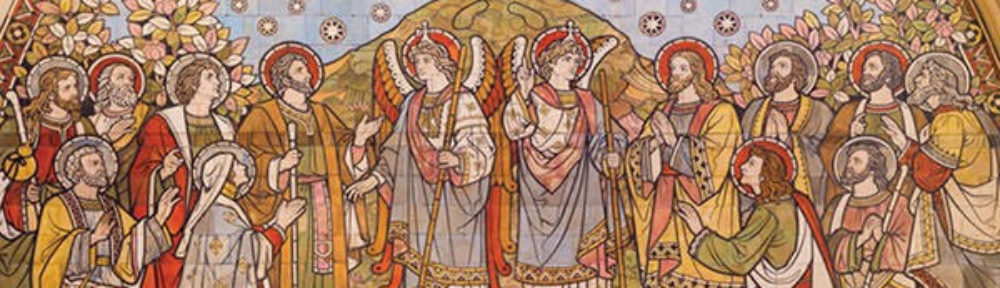
Two Witnesses

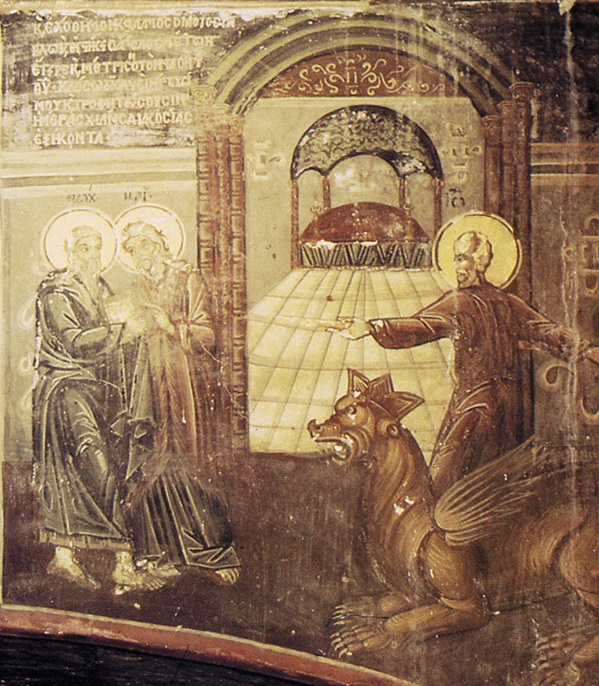
The two witnesses of Apocalypse 11, about to be attacked by the beast from the abyss. They are standing before the Temple, described earlier in chapter 11; the witnesses are identified by the names “Enoch” and “Moses” above their heads.

I will commission my two witnesses to prophesy for those 1,260 days, dressed in sackcloth. These are the two olive-trees and the two lamps that stand before the Lord of the earth…. But when they have completed their testimony, the beast that comes up from the abyss will wage war on them and overcome them and kill them. (Apocalypse 11:3-4, 7)

The two witnesses–lit. martyrs–are spokesmen for God that are killed by the powers that oppose God. Their corpses will remain in the streets to be mocked and defiled but they will be raised from the dead and ascend into heaven. The murder of the two witnesses is the second of the “three woes” that are expected (Apoc. 9).

The witnesses are dressed as prophets, in sackcloth, and preach for more than a thousand days (the symbolic length of history). They are compared to the king Zerubbabel and the high priest Joshua (Zech. 2 and 4). Some authors thought the two witnesses would be Moses and Elijah (who was taken into heaven without dying), come to proclaim the judgement of God; frequently others think the two witnesses will be Moses and Enoch (who was also taken into heaven without dying).

The beast from the abyss slays the witnesses after they have been preaching for 1,000+ days. Later in the Apocalypse, we read the same story from another perspective: “When the 1,000 years are ended, Satan will be let loose from his prison and he will come out to deceive the nations” (Apoc. 20:7-8). We also read the same story from another perspective in the next chapter of the Apocalypse when the dragon attacks the woman clothed with the sun–one of my favorite episodes in the New Testament!

Repeatedly in the Gospel and throughout the history of the Church, the devil and the powers of Death that rebel against God attack and seem to triumph but are finally overthrown and defeated. This is the most basic message of the Apocalypse: the Enemy will seem to triumph but–take heart!–can never win the final victory.
A Little Scroll

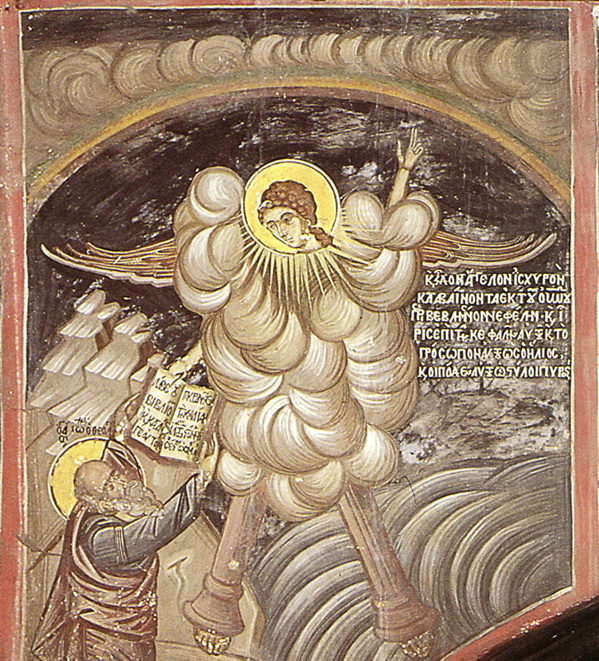
This fresco on Mt. Athos from the 17th century depicts the opening of chapter 10 of the Apocalypse: St. John sees the massive angel, standing with a foot in the sea and a foot on land, who gives him a little scroll to eat.

Then I saw another mighty angel coming down from heaven, wrapped in a cloud, with a rainbow over his head: his face was like the sun and his legs like pillars of fire. He held in his hand a little scroll which was open…. He said to me, “take it and eat it.” (Apocalypse 10:1-2, 9)

St. John takes the small, open scroll and eats it although the angel warns that it will taste sweet in his mouth and then turn his stomach sour. “You must prophesy over many peoples and nations and tongues and kings,” St. John is told after eating the scroll.

Eating a scroll is often the first thing a prophet is told to do (Ezekiel 3). The prophet ingests the message he is to deliver and integrates it into himself. It becomes his message as well as the message of God. (The scroll that Ezekiel eats is also sweet to taste but produces “laments and words of woe.” Both Ezekiel and the Apocalypse are associated with the liturgical season of Eastertide; the Death and Resurrection of Christ are simultaneously blessing and judgement which are described in terms of the Last Days by the prophet and the apostle.)

Given that the Apocalypse is a liturgical commentary, what does this episode correspond to in the Eucharist? Consuming the little scroll can also correspond with receiving Holy Communion, as does Isaiah’s lips being touched by a heavenly coal. Each communicant is called to the same vocation as the seer although details of how that vocation is exercised may differ.

Although this scroll is small, unlike the others mentioned in the Apocalypse, its most important distinguishing feature is that it is open rather than closed. An open message is one that will be fulfilled shortly after it is proclaimed; a closed message is about an event that will happen long after the proclamation is made. The message that will be accomplished soon is the preaching of the Gospel to “many peoples and nations and tongues and kings.” Prophets like Ezekiel were sent only to the Israelites; John–and the Church as a whole–are sent to the whole world. The ingathering of the nations to join Israel in receiving the blessings of God was proclaimed by the prophets as one of the signs that the Last Days had finally come; the nations responding to the preaching of the Gospel is a sign that the Last Days have now arrived.

The Apocalypse is, in many ways, the proclamation of the same message that the prophets proclaimed but that message has now been fulfilled-accomplished. The Last Judgement–while still a distant event in linear time–has begun and is already present in the spiritual-liturgical life of the Church. Eternity has begun to erupt into the world of space-time. The Apocalypse is not a blueprint or a timeline for something to happen in the future; it describes the life of the Church now.

The fancy theological way to refer to this is “realized eschatology.” Eschatology is the Greek word for “last things.” The last things have been realized/accomplished in the life-ministry-Passion of Christ and are now playing out in the life of the Church. Sometimes “realized eschatology” is contrasted with consistent eschatology, which insists that the Last Days are still entirely in the future. The two concepts are combined by some modern authors in inaugurated eschatology.

Shaft of the Abyss

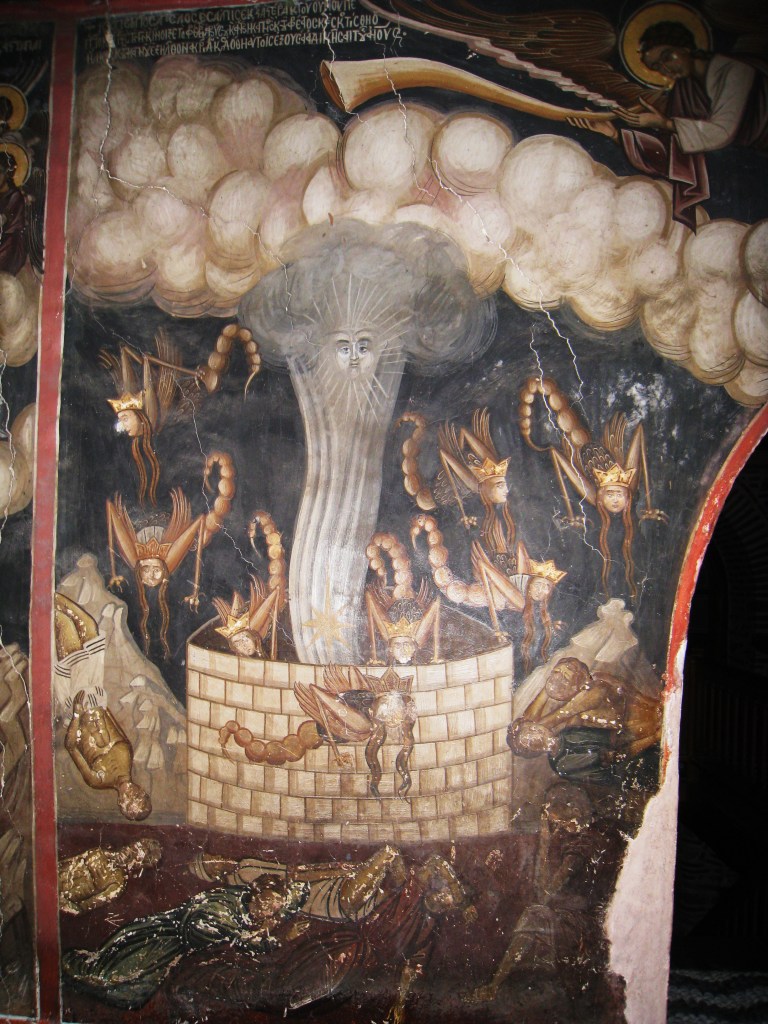
Another fresco from Mt. Athos that illustrates the Apocalypse. Here we see the attack of the demonic locusts described in chapter 9, the “first woe” of three to be unleashed by the angels faithful to God. These locusts, an allusion to the 8th plague that struck Egypt at the Exodus, are allowed to torment–but not kill–the people of the earth.

I saw a star fallen from heaven to earth, and he was given a key to the shaft of the abyss. He opened the shaft of the abyss, and smoke came up from the shaft like smoke from a great furnace, and the sun and the air were darkened by the smoke from the shaft. Out of the smoke came locusts… (Apoc. 9:1-3)

A fallen star is a fallen angel. Hence, the star is “he” and given a key to the abyss. Stars–in apocalyptic writing–are always angels, whether good or bad, faithful to God or not. The tradition of fallen angels is ancient though it does not appear in the oldest layer of biblical writing; the story of the angelic fall is told in 1 Enoch 6-13, an expansion of Genesis 6:1-4. Jesus also refers to the fall of the angels: “I saw Satan fall like lightning from heaven” (Luke 10:18).

The “abyss” is the usual Greek translation of “the deep” (ex. Gen. 1:2, Psalm 105:9, 107:26); it is also used to refer to Sheol (Job 41, Romans 10). In the Apocalypse, the abyss-the deep-sheol is the provisional prison of Satan and the fallen angels. In the gospel, the demons beg Jesus not to send them there (Luke 8:31). In this chapter of the Apocalypse, a shaft leads to the abyss-the deep-sheol and a fallen angel is allowed to unlock it.

Out of the abyss comes a great cloud of smoke and ash; from the smoke and ash come the monstrous locusts that attack people but are not allowed to attack the earth itself, unlike natural locusts. These supernatural locusts attack and torture but cannot kill; they can sting like scorpions and have a king (the word is more usually translated as “emperor”), unlike natural locusts (Proverbs 30:27).

Is the Apocalypse comparing the locusts to the imperial Roman system by using the Greek word for “emperor” rather than “king” to describe their organization? If so, then the Roman state–and any political system that is in opposition to God–can attack and torment the faithful but cannot destroy or overwhelm the Kingdom of God. I have recently discovered the work of Walter Wink, who writes about the demonic aspect of human political systems. As my friend Daniel says, “Phenomena like The Exorcist and The Amityville Horror do occur, but the real danger is from beings that assume power over humanity in the form of nations, corporations, political ideologies, and economic systems.”