The Whore of Babylon

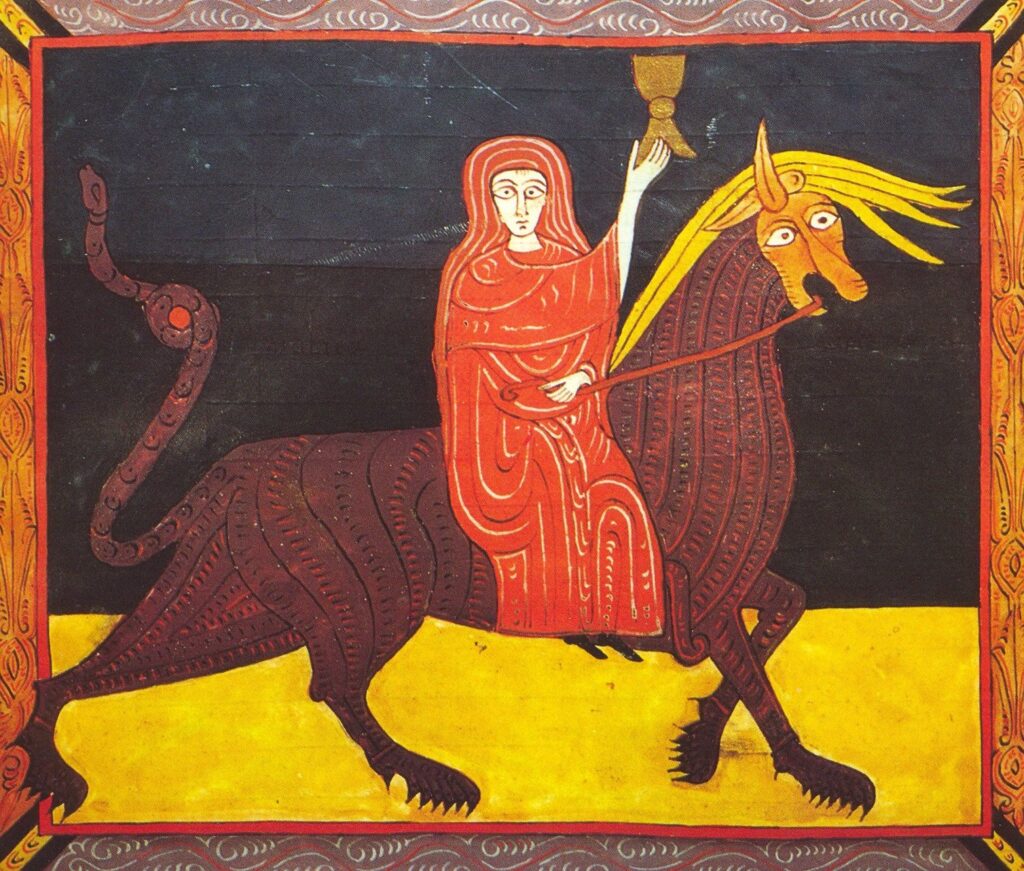
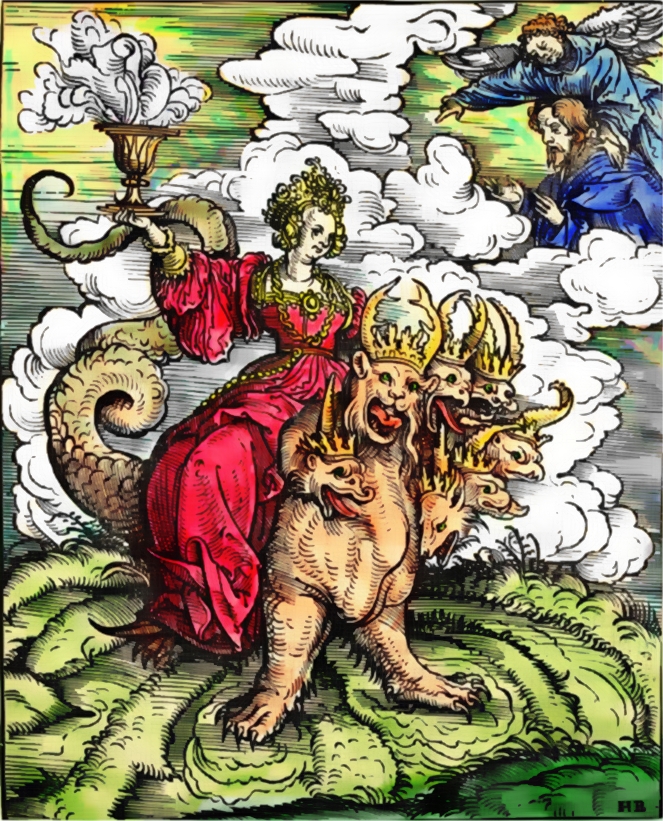
I saw a woman mounted on a scarlet beast…. the woman was clothed in purple and scarlet and bedecked with gold and precious stones and pearls. In her hand she held a gold cup full of all obscenities and the filth of her fornication…. I saw the woman was drunk with the blood of God’s people and with the blood of the martyrs of Jesus. (Apoc. 17:3-4, 6)

This woman, the famous “Scarlet Woman” and the “Whore of Babylon,” is the antithesis of the woman clothed with the sun in Apocalypse 12. The woman clothed with the sun gives birth to Christ in her children; the Scarlet Woman is drunk with the blood of those children, now martyred. The woman clothed with the sun is attacked by the dragon, the Antichrist; now the dragon, the Antichrist, escorts the Scarlet Woman in her apparent hour of triumph. The woman clothed with the sun is a mother who remains forever a virgin; the Scarlet Woman is the mother of all abominations and prostitutions imaginable. If the woman clothed with the sun is Sophia, the Divine Wisdom (Proverbs 8-9, Baruch 3-4, Wisdom 6-8), then the Scarlet Woman is the “loose woman” whose house is the gateway to Hell (Proverbs 7, 9).

The icons of Novgorod used scarlet as the background of divine light, out of which the saints stepped to greet the faithful. It is also the color of the Hellmouth, the great beast who devours the damned in icons of the Last Judgement. Scarlet is the presence of God who can be accepted or rejected but never escaped.

The Scarlet Woman is at the moment of decision, capable of giving herself over completely to the destruction of beauty and light or of turning aside from that path of destruction. She can remain the Whore of Babylon or become the Virgin Mother of the faithful, the “holy city, the new Jerusalem, coming down out of heaven from God, prepared as a bride for her husband” (Apoc. 21:2).

(For a fuller discussion of the woman clothed with the sun and the whore of Babylon, see my chapter “Clothed in Scarlet, Clothed with the Sun: Thoughts on the Women of Apocalypse 12 and 17” in Earth’s Abominations: Philosophical Studies of Evil available here.)
Armageddon

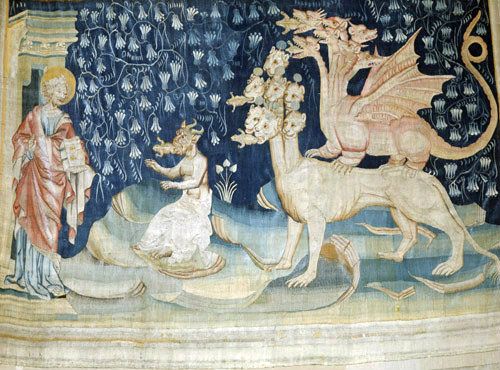
The sixth angel emptied his bowl, Angers Apocalypse tapestry, 1377-82, commissioned by
Louis I duke of Anjou, designed by Jean Bondol (Chateau d’Angers, France).

The sixth [angel] poured out his bowl on the great river, the Euphrates, and its water was dried up, to prepare a way for the kings…. Then I saw coming from the mouth of the dragon, from the mouth of the beast, and from the mouth of the false prophet three foul spirits like frogs…. “Behold, I come like a thief!” Blessed is he that stays awake and keeps his garments by him, so that he does not walk naked and his shame is seen. And they mustered them at the place which is called in Hebrew, “Armageddon.” (Apoc. 16:12-13, 15-16)

Almost everyone recognizes the place-name, Armageddon. It is imagined to be the location of the last battle–or maybe the nuclear war–that destroys the world. But very few people know anything more than that.

“Armageddon” means “the mountain of Megiddo.” This is a mountain pass in the north of Israel that makes possible passage from the coast to the plain of Jezreel. It is a geographic feature important for military-strategic reasons. Many battles were fought at Armageddon; it was especially associated with disaster after the death of King Josiah there (2 Kings 23:29-30).

Armageddon is also important in the Old Testament book of Judith, which is an extended parable about God’s deliverance of his Chosen People. (We think of parables as only a few sentences–or at most, a paragraph or two–because Jesus’ parables were all short. But there is no composition rule that insists that a parable has to be short.)

It is also interesting that the Old Testament readings generally called “prophecies” by Western Christians on Easter Eve or other significant occasions are called “parables” in Church Slavonic.

Judith lives in an imaginary town near the Armageddon pass. By placing the town there, the people hearing the parable would immediately know that the story of Judith was about the End of Days, the great Last Battle when they hoped that God would deliver his people from all their enemies. The people hearing the story of Judith knew that it was not history as we think of history. It was never meant to be understood as an historical record. It was a parable: a story told to make a point, to illustrate something true that was otherwise difficult to grasp or understand. The story of Judith at Armageddon is like the story of Moses at the Red Sea–God acts in a miraculous way to save his people through the intervention of his chosen servant. Judith is a female figure that represents the faithful of Israel, identified by the prophets as the Bride of God.

Because the enemies of Israel almost always have to come through the northern mountain pass at Armageddon to attack Israel, the direction North became associated with evil and the powers that oppose God or his people. That is why the medieval Western Christians would read the Gospel at High Mass facing north–both to proclaim the Gospel to the pagans living far in the north but also to proclaim God’s triumph over all the powers that oppose him. Reading the Gospel facing north was a kind of exorcism of the neighborhood, telling the devil to “Go away! You have no business here, devil! You have already been defeated by Christ–stop trying to avoid your inevitable imprisonment in Hell!”

When St. John described the battle at Armageddon, he might or might not have thought people would identify the earthly mountain pass as the place of the Last Battle. But they would certainly understand that wherever the Last Battle was to be fought would be “Armageddon” in a much more real and substantial way than the mountain in northern Israel.

See a talk I gave about Judith here. The passcode to view the recording is 2w$Pq&6e

Sea of Glass

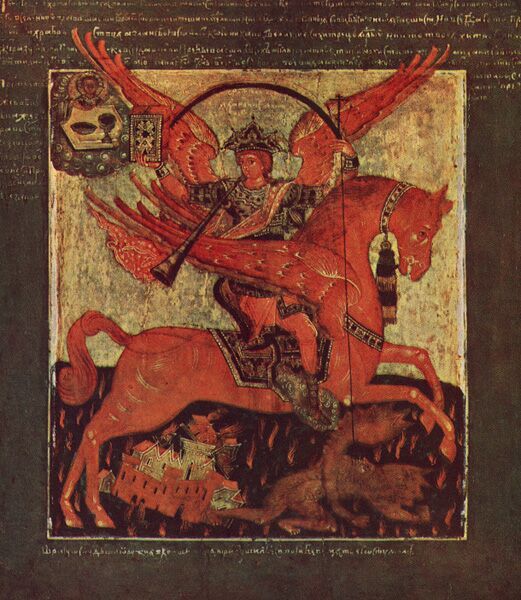
Russian icon depicting the victory of the Archangel Michael over the dragon, the beast, and Babylon the Great; Christ in the upper corner invites the faithful to the banquet of the heavenly Eucharist.

Then I saw another portent in heaven, great and astonishing: seven angels with seven plagues…. and I saw, as it were, a sea of glass mingled with fire and, standing beside the sea of glass and holding harps of God, were those who had been victorious against the beast and its image and the number of its name. (Apocalypse 15:1-2)

St. John sees another seven angels ready to unleash another seven plagues on the earth and then he sees the victorious martyrs standing beside a sea of glass and fire, holding harps and singing “the song of Moses, the servant of God, and the song of the Lamb.” (Apoc. 15:3)

We have encountered the sea of glass in Apoc. 4 — here it is described as a molten mix of glass and fire. This sea is an allusion to the Red Sea which was deliverance for the Israelites and doom for the Egyptians. Here, the victorious sing “the song of Moses” which is no vindictive triumph over enemies but solely a song of praise to the Lord and King.

St. Andrew of Caesarea thinks

The sea of glass is both the multitude of those being saved and the future condition–the brilliance of the saints-, who will shine by means of their sparkling virtue…. the fire will both burn the sinners and illuminate the righteous. Fire is both divine knowledge and the life-giving Spirit–for in fire God was seen by Moses and the Spirit descended upon the apostles as tongues of fire–and the harps indicate the mortification of members (Col. 3:5), the harmonious life of a symphony of virtues plucked by the musical pick (plectrum) of the divine Spirit. (Chapter 45, “Commentary on the Apocalypse”)

The sea is both salvation and condemnation, just as the incense in the bowls held by the angels:

We are the sweet fragrance of Christ among those who are being saved and among those who are perishing: indeed, to some the fragrance of life and to others the stench of death. (2 Cor. 2:15-16)

Tyconius, in his classic commentary on the Apocalypse, points out that the prayers of the saints–the incense offered by the angels, an allusion to the liturgical intercessions of the Church on earth–lead to both the salvation of the world and the condemnation of the fallen order.

As with so much in the Apocalypse–as in life–the same events or experiences can lead to either salvation or damnation. How do we choose to react to these events?

The choice is ours.