Leo the Lion


The Lion, long considered the "king of beasts," rules the sky from July 23 to August 23.

The Lion, long considered the “king of beasts,” rules the sky from July 23 to August 23.

Leo was one of the earliest recognized constellations, with archaeological evidence that the Mesopotamians had a similar constellation as early as 4000 BCE. The Persians called Leo Ser or Shir; the Turks, Artan; the Syrians, Aryo; the Jewish, Arye; the Indians, Simha, all meaning “lion”. In Babylonian astronomy, the constellation was called UR.GU.LA, the “Great Lion”; the bright star Regulus was known as “the star that stands at the Lion’s breast.” Regulus also had distinctly regal associations, as it was known as the King Star.

In Greek mythology, Leo was identified as the Nemean Lion which was killed by Hercules during one of his twelve labours, and next put into the sky.

The Roman poet Ovid called it Herculeus Leo and Violentus Leo. Bacchi Sidus (star of Bacchus) was another of its titles, the god Bacchus always being identified with this animal. However, Manilius called it Jovis et Junonis Sidus (Star of Jupiter and Juno).

In standard western astrology, the Sun is considered to be in the sign Leo from July 23 to August 23. People born under this sign are considered confident, ambitious, generous, loyal, and encouraging though they can also manifest less-desirable characteristics and be considered pretentious, domineering, melodramtic, stubborn, and vain.

Pope Innocent VIII and the witches

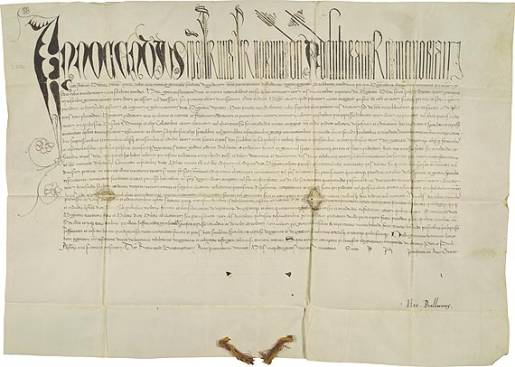
The papal bull of Pope Innocent VIII known as  Summis desiderantes (5 December 1484).

The papal bull of Pope Innocent VIII known as Summis desiderantes (5 December 1484).

During what is known as the Little Ice Age, the grip of freezing weather, failing of crops, rising crime, and mass starvation resulted in an increasing fear of witches. On the request of German inquisitor Heinrich Kramer, Innocent VIII issued the papal bull known as  Summis desiderantes(5 December 1484), which supported Kramer’s investigations against magicians and witches:

“It has recently come to our ears, not without great pain to us, that in some parts of upper Germany, […] Mainz, Koin, Trier, Salzburg, and Bremen, many persons of both sexes, heedless of their own salvation and forsaking the catholic faith, give themselves over to devils male and female, and by their incantations, charms, and conjurings, and by other abominable superstitions and sortileges, offences, crimes, and misdeeds, ruin and cause to perish the offspring of women, the foal of animals, the products of the earth, the grapes of vines, and the fruits of trees, as well as men and women, cattle and flocks and herds and animals of every kind, vineyards also and orchards, meadows, pastures, harvests, grains and other fruits of the earth; that they afflict and torture with dire pains and anguish, both internal and external, these men, women, cattle, flocks, herds, and animals, and hinder men from begetting […]”

Kramer would later write the polemic Malleus Maleficarum in 1486, which stated that witchcraft was to blame for bad weather. These remarks are included in Part 2, Chapter XV, which is entitled: “How they Raise and Stir up Hailstorms and Tempests, and Cause Lightning to Blast both Men and Beasts”:

“Therefore it is reasonable to conclude that, just as easily as they raise hailstorms, so can they cause lightning and storms at sea; and so no doubt at all remains on these points.”

Both the papal letter appended to the work and the supposed endorsement of Cologne University for it are problematic. The letter of Innocent VIII is not an approval of the book to which it was appended, but rather a charge to inquisitors to investigate diabolical sorcery and a warning to those who might impede them in their duty, that is, a papal letter in the by then conventional tradition established by John XXII and other popes through Eugenius IV and Nicholas V (1447-55).

In 1487, Innocent also confirmed Tomas de Torquemada as Grand Inquisitor of Spain, a role in which he has become infamous.

Innocent VIII died on 25 July 1492 leaving behind him two illegitimate children born before he entered the clergy “towards whom his nepotism had been as lavish as it was shameless”  In 1487 he married his elder son Franceschetto Cybo (d. 1519) to Maddalena de’ Medici (1473–1528), the daughter of Lorenzo de’ Medici, who in return obtained the cardinal’s hat for his thirteen-year-old son Giovanni, later Pope Leo X.


Ruby, the birthstone of July

Rubies are the birthstone of July and are said to guarantee health, wisdom, wealth and success in love.

Rubies are the birthstone of July and are said to guarantee health, wisdom, wealth and success in love.

Rubies are associated with the sun and were thought to preserve mental and physical health. In the middle ages, rubies were viewed as a stone of prophecy. It was thought the stone darkened when danger was near. Ivan the Terrible of Russia stated that rubies were good for the heart, brain and memory. A 13th century prescription to cure liver problems called for powdered ruby. In the 15th-16th centuries, rubies were thought to counteract poison. When rubbed on the skin, they were also thought to restore youth and vitality.

If a ruby were cast into water it would cause it to boil, and if carved and pressed into wax, would melt the wax.

Although the most well-known magical rubies in modern society are the ruby slippers Dorothy wore in the Wizard of Oz movie, the slippers were silver inthe book. The silver shoes, however, did not show well against the yellow brick road inthe film and so the silver shoes were replaced with ruby slippers, which coukld be more clearly seen.

Take a look at my previous post about the ruby slippers in the Wizard of Oz, “I’ll get you, my pretty… and your little dog too!”