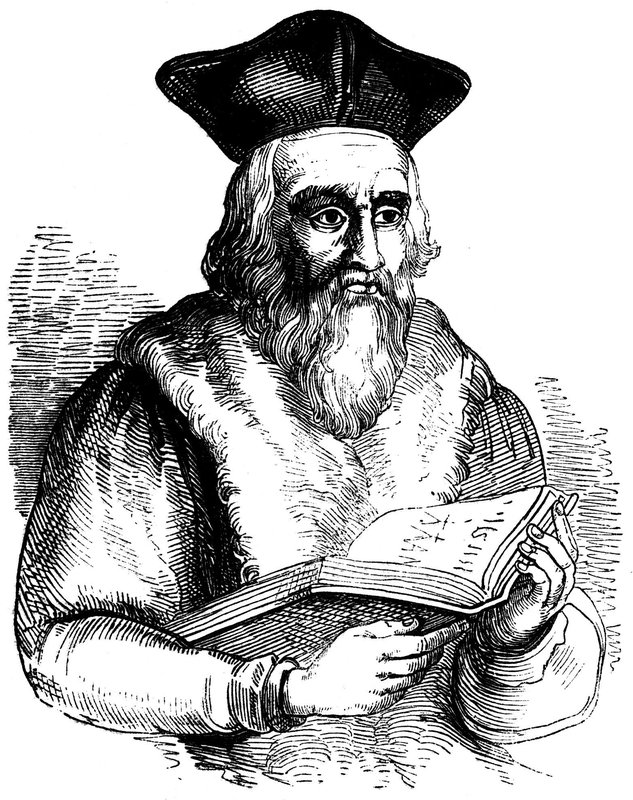
Edward Kelley, English alchemist, died inPrague after attempting to escape by jumping out a window and breaking his leg (and other bones).
Sir Edward Kelley, also known as Edward Talbot (August 1, 1555 – November 1, 1597), was an ambiguous figure in English Renaissance occultism and self-declared spirit medium who worked with John Dee in his magical investigations. (See the previous post on John Dee here.) Besides the professed ability to summon spirits or angels on a crystal ball, which John Dee so valued, Kelley also claimed to possess the secret of transmuting base metals into gold.
Legends began to surround Kelley shortly after his death. His flamboyant biography, and his relative notoriety among English-speaking historians (chiefly because of his association with Dee) may have made him the source for the folklorical image of the alchemist-charlatan.
Kelley approached John Dee in 1582. Dee had already been trying to contact angels with the help of a scryer, or crystal-gazer, but he had not been successful. Kelley professed the ability to do so, and impressed Dee with his first trial. Kelley became Dee’s regular scryer. Dee and Kelley devoted huge amounts of time and energy to these “spiritual conferences”. From 1582 to 1589, Kelley’s life was closely tied to Dee’s. In those seven years, they conducted these conferences, including “prayers for enlightenment… in the spirit of Dee’s ecumenical hopes that alchemy and angelic knowledge would heal the rift of Christendom”.
Kelley married a widow, Jane Cooper of Chipping Norton (1563–1606). He later helped educate her children and she described him as a ‘kind stepfather’ and noted how he took her in after the deaths of her two grandmothers. Kelley had also hired a Latin tutor for her, named John Hammond.
About a year after entering into Dee’s service, Kelley appeared with an alchemical book (The Book of Dunstan) and a quantity of a red powder which, Kelley claimed, he and a certain John Blokley had been led to by a “spiritual creature” at Northwick Hill. (Accounts of Kelley’s finding the book and the powder in the ruins of Glastonbury Abbey were first published by Elias Ashmole, but are contradicted by Dee’s diaries.) With the powder (whose secret was presumably hidden in the book) Kelley believed he could prepare a red “tincture” which would allow him to transmute base metals into gold. He reportedly demonstrated its power a few times over the years, including in Bohemia (present Czech Republic) where he and Dee resided for many years.
By 1590, Kelley was living an opulent lifestyle. He received several estates and large sums of money from Rožmberk. Kelley was able to access gold and silver mines, and he took advantage of this, working on his alchemy until various noblemen thought that he was able to produce gold. Rudolph II knighted him as Sir Edward Kelley of Imany and New Lüben on February 23, 1590 (but it is possible that this happened in 1589). Rudolf had Kelley arrested in May 1591 and imprisoned him in the Křivoklát Castle outside Prague, supposedly for killing an official named Jiri Hunkler in a duel, but it is also likely that he did not want Kelley to escape with his rumored alchemical secrets. Rudolf apparently never doubted Kelley’s ability to produce gold on a large scale, and hoped that imprisonment would induce him to cooperate. Rudolf may also have feared that Kelley would return to England. Elizabeth I was trying to convince him to return to England at the time. In 1595, Kelley agreed to cooperate and produce gold; he was released and restored to his former status. Again he failed to produce, and was again imprisoned, this time in Hněvín Castle in Most. His wife and stepdaughter attempted to help him by means of an imperial counselor, but Kelley died as a prisoner here in late 1597 or early 1598 of injuries received while attempting to escape (jumping out a window and climbing down the wall, he fell and broke several bones, including his leg).