Vlad the Impaler


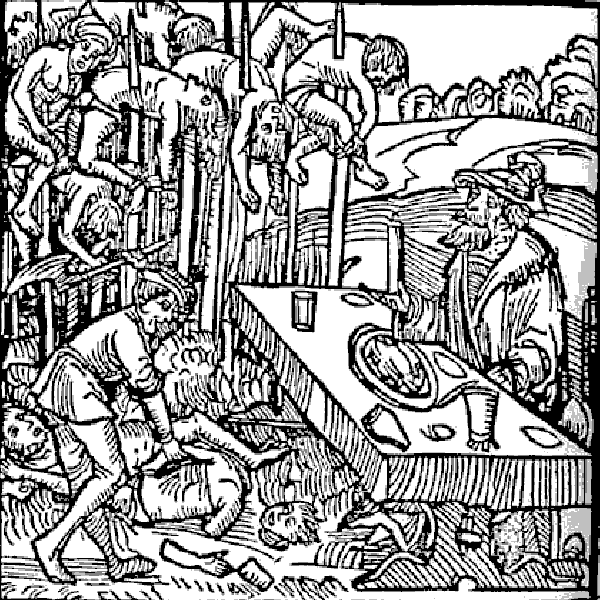
1499 German woodcut showing Vlad, the Son of the Dragon dining among the impaled corpses of his victims.

1499 German woodcut showing Vlad, the Son of the Dragon dining among the impaled corpses of his victims.

History has condemned Vlad the Impaler (known as Vlad Dracul, the Son of the Dragon, as his father was a knight of the Order of the Dragon) for killing many (about 500) of the nobility who did not like or agree with him. He was also reputedly trying to eliminate the povertry-stricken from society. He invited all the blind, handicapped, elderly, poor, etc. to a party (similar to a charity dinner) in a special house. All those invited entered the house, ate and drank. Afterward, Vlad asked them if they wanted to cease being a burden to their loved ones and end their poverty. All the people present agreed. When he heard that, he ordered the house locked, set on fire and all the people within burnt alive.

His first major act of revenge was aimed at the boyars of Tirgoviste for for not being loyal to his father. On Easter Sunday he invited all the boyar families who had participated to the royal celebration. He asked them how many princes had ruled in their lifetimes. They said they had lived through many reigns. Shouting that this was their fault because of their plotting, Vlad had them all arrested on the spot. He impaled the older ones on stakes while forcing the others to march from the capital to the town of Poenari. This fifty-mile trek was quite grueling and no one was permitted to rest until they reached destination. Vlad then ordered boyars to build him a fortress on the ruins of an older outpost overlooking the Arges River. Many died in the process, and therefore Vlad  succeeded in creating a new nobility and obtaining a fortress for future emergencies. What is left today of the building is identified as Poenari Fortress (Cetatea Poenari).

A German story about Brasov describes a masacre of 30,000 on August 24, 1460, says that Vlad the Impaler was sitting at a table filled with food and drink. In front of him, on a hill, some of his soldiers began to impale a number of the Saxon traders simply because of his dislike for them, and because of their attempts to remove him from the throne of Walachia. Another story describes the impaled bodies looking like a forest.

(Click here for a detailed article on Vlad the Impaler’s life.)
Elizabeth Bathory

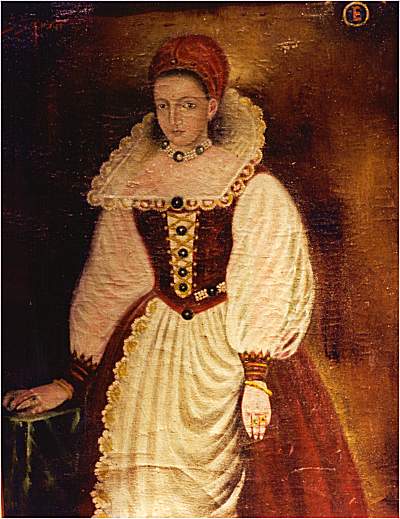
Copy of the lost 1585 original portrait of Erzsébet Báthory  (disappeared in the 1990s)

Copy of the lost 1585 original portrait of Erzsébet Báthory
(disappeared in the 1990s)

Countess Elizabeth Báthory de Ecsed (Báthory Erzsébet in Hungarian, Alžbeta Bátoriová in Slovak; 7 August 1560 – 14 or 21 August 1614) was a countess from the renowned Báthory family of nobility in the Kingdom of Hungar. She has been labelled the most prolific female serial killer in history and is remembered as the “Blood Countess,” though the precise number of victims is debated.

Later writings[ about the case have led to legendary accounts of the Countess bathing in the blood of virgins to retain her youth and subsequently also to comparisons with Vlad III the Impaler of Wallachia, on whom the fictional Count Dracula is partly based, and to modern nicknames of the Blood Countess and Countess Dracula.

After her husband Ferenc Nádasdy’s death, she and four collaborators were accused of torturing and killing hundreds of girls, with one witness attributing to them over 650 victims, though the number for which they were convicted was 80. Due to her rank, Elizabeth herself was neither tried nor convicted. But upon her arrest in December 1610, she was imprisoned in Čachtice Castle, now in Slovakia, where she remained immured in a set of rooms until her death four years later.

She was kept bricked in a set of rooms, with only small slits left open for ventilation and the passing of meals. She remained there for four years, until her death. On 24 August 1614, Elizabeth Báthory was found dead in her room by a guard looking in through one of the slots. Since there were several plates of food untouched, her actual date of death is unknown. She was buried in the church of Csejte, but due to the villagers’ uproar over having “The Tigress of Csejte” buried in their cemetery, her body was moved to her birth home at Ecsed, where it is interred at the Báthory family crypt.

The case of Elizabeth Báthory inspired numerous stories during the 18th and 19th centuries. The most common motif of these works was that of the countess bathing in her victims’ blood to retain beauty or youth. This legend appeared in print for the first time in 1729, in the Jesuit scholar László Turóczi’s Tragica Historia, the first written account of the Báthory case. At the beginning of the 19th century, this certainty was questioned, and sadistic pleasure was considered a far more plausible motive for Elizabeth Báthory’s crimes. In 1817, the witness accounts (which had surfaced in 1765) were published for the first time, which included no references to bloodbaths.

The legend nonetheless persisted in the popular imagination. This myth is speculated to persist in part because of Báthory’s connection to Transylvania and vampire lore. Some versions of the story were told with the purpose of denouncing female vanity, while other versions aimed to entertain or thrill their audience. The vampirism connection extends to the 21st century documentary Deadly Women, where she is profiled in the first episode of the series as maintaining her good looks by iron supplementation she obtained by drinking her victims’ blood.

Gladiolus


Gladiolus_illyricus

The long, lovely gladiolus is the birthday flower for August. A member of the iris family, “glads” are also called sword lilies because of their sharply pointed leaves and tall stalks of flowers with pointed tips. The Latin name for Gladiolus is gladius, a clear reference to the sword-swinging gladiators of ancient Rome.

There are 255 species of gladiolus and the plants range in size from two to five feet tall with elegant trumpet-shaped blossoms that grow in a double row along the stem. You can find hybrid varieties with ruffled, wavy or frilled petals and the flowers can be found in every color.

Gladiolus is native to tropical Africa and areas around the Mediterranean and Middle East. It is believed that gladiolus plants were first brought to Europe in the early 18th century. Around the 1820s, gardeners began to seriously cultivate gladiolus and create hybrid varieties that became very popular in gardens and as cut flowers.

In floral history, gladiolus flowers have several different meanings. Because of their association with gladiators, they traditionally symbolize strength, sincerity and moral integrity. Gladiolus flowers also represent remembrance. And even though their sword-shaped leaves hark back to ancient swords and battles, Victorian romantics determined that gladiolus flowers were capable of piercing someone’s heart with their beauty, adding infatuation to the list of traditional floral meanings.