
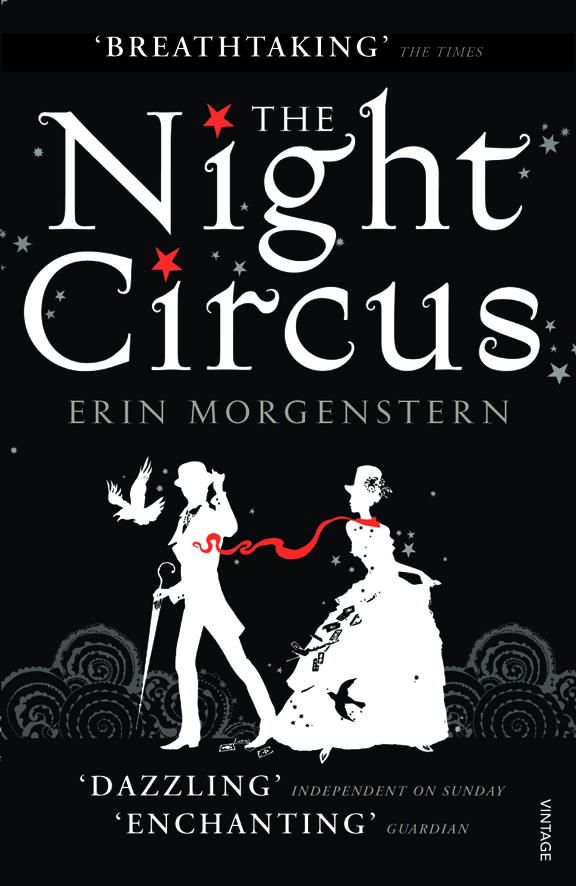
The Night Circus

night-circus-cover1

I was able to read The Night Circus by Erin Morgenstern recently while I was in Venice. It was a joy to come back each afternoon or evening to the apartment we were staying in and lose myself again for a while in the enchanting (and enchanted!) world of the circus. I was delighted to follow Celia and Marco, engaged in a duel of magical prowess to the death though neither of them realize the dire consequences of failure at the beginning of the game. Their respective teachers who train them in the use of their magical abilities have clearly been at this for quite some time, setting generation after generation of students on the perilous road to prove which instructor’s methods are better suited to unleash magic into the world (the story of Celia and Marco takes place over several years, stretching from the late 1800s to early 1900s).

The magical world of the circus comes to include a devoted group of followers whose lives become as entangled in the fate of the circus-world as the performers themselves. These followers become as critical to the life of the circus as the magicians who craft and sustain it and finally one of these devoted followers must make a choice that is as vital to the existence of the circus as the choices of Celia, Marco, and the other performers.

Magic suffuses everything in the Night Circus world, which is lovingly crafted and described by Ms. Morgenstern in this, her first novel. I heartily recommend it without reservation!
“Happy Beltane / May Day!”

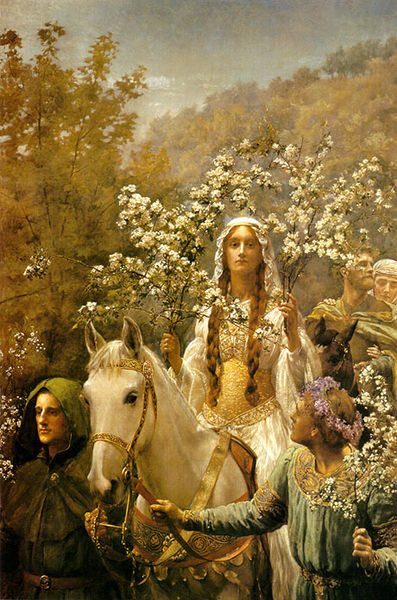
Queen Guinevere, as the May Queen, leads the May Day celebrations in Camelot.

Queen Guinevere, as the May Queen, leads the May Day celebrations in Camelot.

Considered the first day of the summer season in traditional European societies, the first day of May has been celebrated in many ways over many centuries. May Day is related to the Celtic festival of Beltane and the Germanic festival of Walpurgis Night. May Day falls half a year from November 1 (Samhain, Hallowe’en, and All Saints’ Day) and it has traditionally been an occasion for popular and often raucous celebrations.

The earliest May Day celebrations appeared in pre-Christian times, with the festival of Flora, the Roman goddess of flowers, and the Walpurgis Night celebrations of the Germanic countries. It is also associated with the Gaelic Beltane. Many pagan celebrations were abandoned or Christianized during the process of conversion in Europe. A more secular version of May Day continues to be observed in Europe and America. In this form, May Day may be best known for its tradition of dancing the maypole dance and crowning of the Queen of the May. Fading in popularity since the late 20th century is the giving of “May baskets”, small baskets of sweets and/or flowers, usually left anonymously on neighbors’ doorsteps. (I remember making May Baskets in school and field day Maypoles on the playground.)

The day was a traditional summer holiday in many pre-Christian European pagan cultures. While February 1 was the first day of Spring, May 1 was the first day of summer; hence, the summer solstice on June 25 (now June 21) was Midsummer.

In Oxford, it is traditional for May Morning revellers to gather below the Great Tower of Magdalen College at 6:00 a.m. to listen to the college choir sing traditional madrigals as a conclusion to the previous night’s celebrations.

On May Day, the Romanians celebrate the arminden (or armindeni), the beginning of summer, symbolically tied with the protection of crops and farm animals. The name comes from Slavonic Jeremiinŭ dĭnĭ, meaning the prophet Jeremiah’s feast day, but the celebration rites and habits of this day are apotropaic and pagan, possibly originating in the cult of the god Pan.

The day is also called ziua pelinului (mugwort day) or ziua bețivilor (drunkards’ day) and it is celebrated to insure good wine in autumn and, for people and farm animals alike, good health and protection from the elements of nature (storms, hail, illness, pests). People would have parties outdoors with fiddlers and it was customary to eat roast lamb, as well as new mutton cheese and drink mugwort-flavoured wine to refresh the blood and get protection from diseases. On the way back from the parties, the men wear lilac or mugwort flowers on their hats.

Other May Day practices in many places include people washing their faces with the morning dew (for good health) and adorning the gates for good luck and abundance with green branches or with birch saplings (for the houses with maiden girls). The entries to the animals’ shelters are also adorned with green branches. All branches are left in place until the wheat harvest when they are used in the fire which will bake the first bread from the new wheat.

Walpurgis Night (April 30)

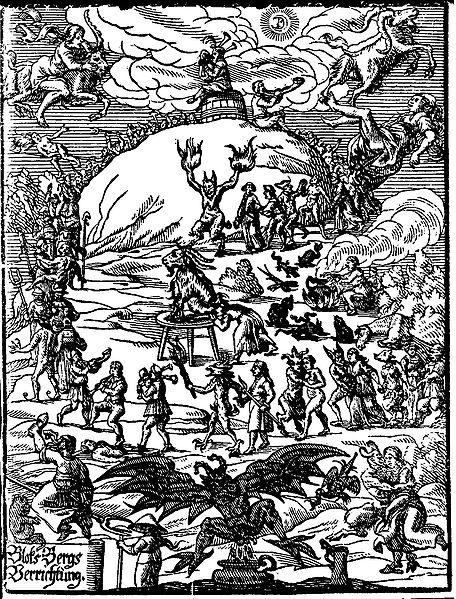
Title illustration of Johannes Praetorius (writer) (de)' Blocksbergs Verrichtung (1668) depicts the witches' festival and worship of the Devil commonly imagined to be celebrated on Walpurgis Night.

Title illustration of Johannes Praetorius (writer) (de)’ Blocksbergs Verrichtung (1668) depicts the witches’ festival and worship of the Devil commonly imagined to be celebrated on Walpurgis Night.

The current festival is, in most countries that celebrate it, named after the English missionary Saint Walpurga (ca. 710–777/9). As Walpurga was canonized on 1 May (ca. 870), she became associated with Beltane/May Day. The eve of May Day, traditionally celebrated with dancing, came to be known as Walpurgisnacht (“Walpurga’s night”). The name of the holiday is Walpurgisnacht in German and Dutch, Valborgsmässoafton in Swedish, Vappen in Finland Swedish, Vappu in Finnish, Volbriöö, (Walpurgi-öö) in Estonian, Valpurgijos naktis in Lithuanian, Valpurģu nakts or Valpurģi in Latvian, čarodějnice and Valpuržina noc in Czech.

The German term is recorded in 1668 by Johannes Praetorius (writer) as S. Walpurgis Nacht or S. Walpurgis Abend. An earlier mention of Walpurgis and S. Walpurgis Abend is in the 1603 edition of the Calendarium perpetuum of Johann Coler, who also refers to the following day, 1 May, as Jacobi Philippi, feast day of the apostles James the Less and Philip in the Catholic calendar.

The 17th century German tradition of a meeting of sorcerers and witches on May Day is influenced by the descriptions of Witches’ Sabbaths in 15th and 16th century literature.

In Bohemia (known today as the Czech Republic), Walpurgis Night is pálení čarodějnic (“burning of the witches”) or simply čarodějnice (“the witches”) and is the day when winter is ceremonially brought to the end by the burning of rag and straw witches or just broomsticks on bonfires around the country. The festival offers Czechs the chance to eat, drink and be merry around a roaring fire. (The Prague Post has an article about this, with a familiar-looking photo, here.)

In Estonia, Volbriöö is celebrated throughout the night of 30 April and into the early hours of 1 May, where May Day is a public holiday called “Spring Day” (Kevadpüha). Volbriöö is an important and widespread celebration of the arrival of spring in the country. Influenced by German culture, the night originally stood for the gathering and meeting of witches. Modern people still dress up as witches to wander the streets in a carnival-like mood.

From Bram Stoker’s short story, “Dracula’s Guest,” an Englishman (whose name is never mentioned) is on a visit to Munich before leaving for Transylvania. It is Walpurgis Night, and in spite of the hotelier’s warning not to be late coming back, the young man later leaves his carriage and wanders toward the direction of an abandoned “unholy” village. As the carriage departs with the frightened and superstitious driver, a tall and thin stranger scares the horses at the crest of a hill.

In some parts of northern coastal regions of Germany, the custom of lighting huge fires is still kept alive to celebrate the coming of May.